


Surya Ghar Yojana: A Solar Leap for Indian Households
The Union Ministry recently confirmed that the Surya Ghar Yojana has already delivered solar benefits to more than 32,02,697 households as of March 2026, according to a written reply in Parliament. This rapid uptake underscores the scheme’s role as a cornerstone of the Pradhan Mantri Sustainable Energy Initiative, which aims to install rooftop solar panels on one crore (10 million) households by 2027. Subsidies of up to 40 percent in general‑category states and 60 percent in special‑category states, coupled with low‑interest loan facilities, are driving both adoption and affordability. The program not only promises reduced electricity bills but also creates prosumer roles for citizens, enabling them to generate, store, and even sell excess power back to the grid.
Early data from the Ministry of New and Renewable Energy (MNRE) shows that the highest concentration of installations is emerging in Uttar Pradesh, Rajasthan, and Maharashtra, reflecting strong demand in densely populated and high‑insolation regions. Environmental modelling predicts that achieving the one‑crore target will avert roughly 12 million tonnes of CO₂ emissions annually, directly supporting India’s net‑zero ambition for 2070 under the Paris Agreement.
Historical Context and Policy Framework
India’s push for decentralized solar generation dates back to the Jawaharlal Nehru National Solar Mission launched in 2010, which set an ambitious 100 GW solar capacity goal. While utility‑scale projects dominated the early years, policymakers recognized the untapped potential of residential rooftops. Subsequent documents — including the Draft Solar Policy 2018 and the National Renewable Energy Action Plan 2023 — called for consumer‑centric incentives, paving the way for the Surya Ghar Yojana. The scheme was formally approved by the Cabinet in October 2023 with a budget of ₹9,800 crore for the 2024‑25 fiscal year, earmarking funds for capital subsidies, interest subvention, and extensive awareness campaigns. 
Industry stakeholders have largely welcomed the initiative. The Indian Solar Manufacturers Association (ISMA) highlights the subsidy structure as a catalyst for demand, while consumer advocacy groups stress the need for transparent grievance redressal. International collaborations with Germany and Japan are also feeding high‑efficiency bifacial module technology into the market, helping to lower the levelized cost of electricity for end‑users.
Eligibility Criteria, Application Process and Financial Incentives
Eligibility is deliberately straightforward: any residential consumer with a metered electricity connection and a roof of at least 10 square metres can apply, provided they are the owner or co‑owner of the property and have not previously received a central solar subsidy. The roof must be structurally sound and receive a minimum of six sunlight hours daily. Applicants must also be Indian citizens and clear title holders of the installation site.
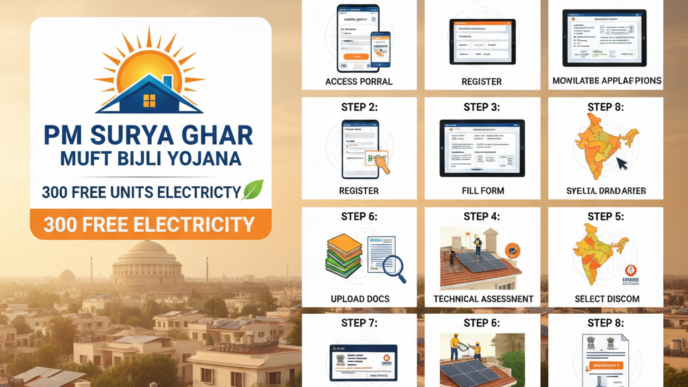
The online application unfolds in four steps on the National Portal for Rooftop Solar: registration, submission of a technical feasibility report generated by an empanelled vendor, selection of a certified installer, and verification by the state renewable energy agency. Upon successful verification, the applicant receives an approval letter and a unique application ID, after which the subsidy is released in tranches.
Financial incentives are tiered based on state classification. In general‑category states, the government subsidizes up to 40 percent of the total project cost, capped at ₹40,000 per kilowatt for systems up to 3 kW. Special‑category states enjoy a 60 percent subsidy, capped at ₹60,000 per kilowatt. In addition, the Solar Energy Finance Corporation offers interest subvention of up to 2 percent, making low‑interest loans accessible to low‑income households. A fully financed model is also available, where the installer bears the upfront cost and the household repays a zero‑interest loan over five years, a format that has gained popularity among renters and tenants.
Early Impact Assessment and Citizen Benefits
Preliminary impact studies reveal that the average household saves approximately ₹2,500 per year on electricity bills, translating to a payback period of four to five years for most installations. Installed capacity under the scheme has crossed 1.2 GW, with an average capacity factor of 18 percent, indicating robust solar generation across diverse climatic zones.
Socially, the scheme has generated around 12,000 direct jobs in installation, project management, and maintenance, while targeted skill‑development programmes have lifted women’s participation in the solar workforce by 15 percent. Environmental monitoring shows measurable reductions in urban particulate matter (PM2.5) concentrations where solar adoption is high, as rooftop systems displace diesel‑powered backup generators.
Strong demand has been recorded in Uttar Pradesh, Rajasthan, and Maharashtra, reflecting both high insolation levels and ambitious state‑level implementationRoadmap.
Future Roadmap and Policy Enhancements
Looking ahead, the Ministry plans to refine the subsidy architecture by introducing income‑based tiers, ensuring that the most vulnerable households receive proportionally higher support. A pilot in the North‑East will test innovative financing tools such as green bonds and community‑owned solar cooperatives, aiming to broaden access in remote regions.
Grid integration will be bolstered through linkage with the recently launched Smart Grid Initiative, enabling real‑time monitoring of distributed generation and facilitating ancillary services like frequency regulation. Enhanced data collection on the MNRE dashboard will improve subsidy disbursement accuracy and accelerate grievance redressal through a forthcoming toll‑free helpline.
Awareness drives are being amplified through partnerships with schools, panchayats, and digital platforms, with a target of onboarding an additional 2.5 million households by the end of the 2027 fiscal year. The upcoming budget allocates ₹12,000 crore to sustain momentum, underscoring the government’s commitment to a solar‑powered future.
Experts view the Surya Ghar Yojana as a replicable model for emerging economies seeking to democratise clean energy access. By coupling financial incentives with streamlined bureaucracy, the scheme not only accelerates adoption but also empowers citizens to become active participants in the energy ecosystem, driving both economic relief and environmental stewardship.
For more detailed information on eligibility and application procedures, visit the official portal or consult state renewable energy agencies that provide localized support and technical assistance.
Stay updated with the latest Yojana schemes and government initiatives for better awareness and eligibility. For personalized guidance on accessing these benefits, reach out to us.