


Supreme Court’s strong words for Prashant Kishor
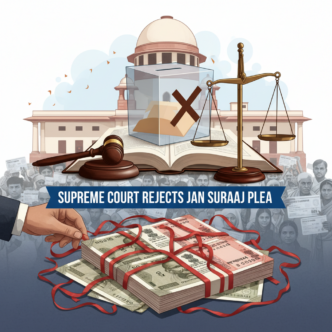
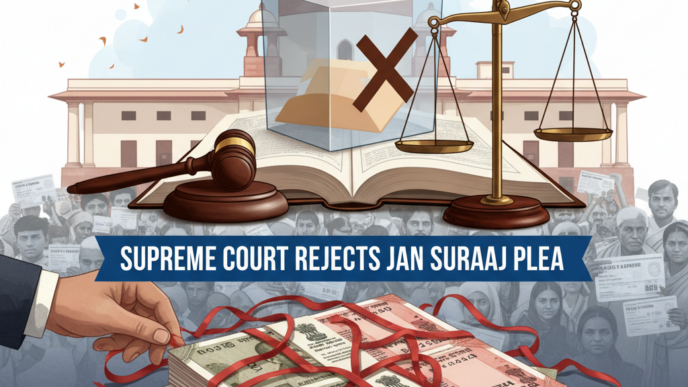
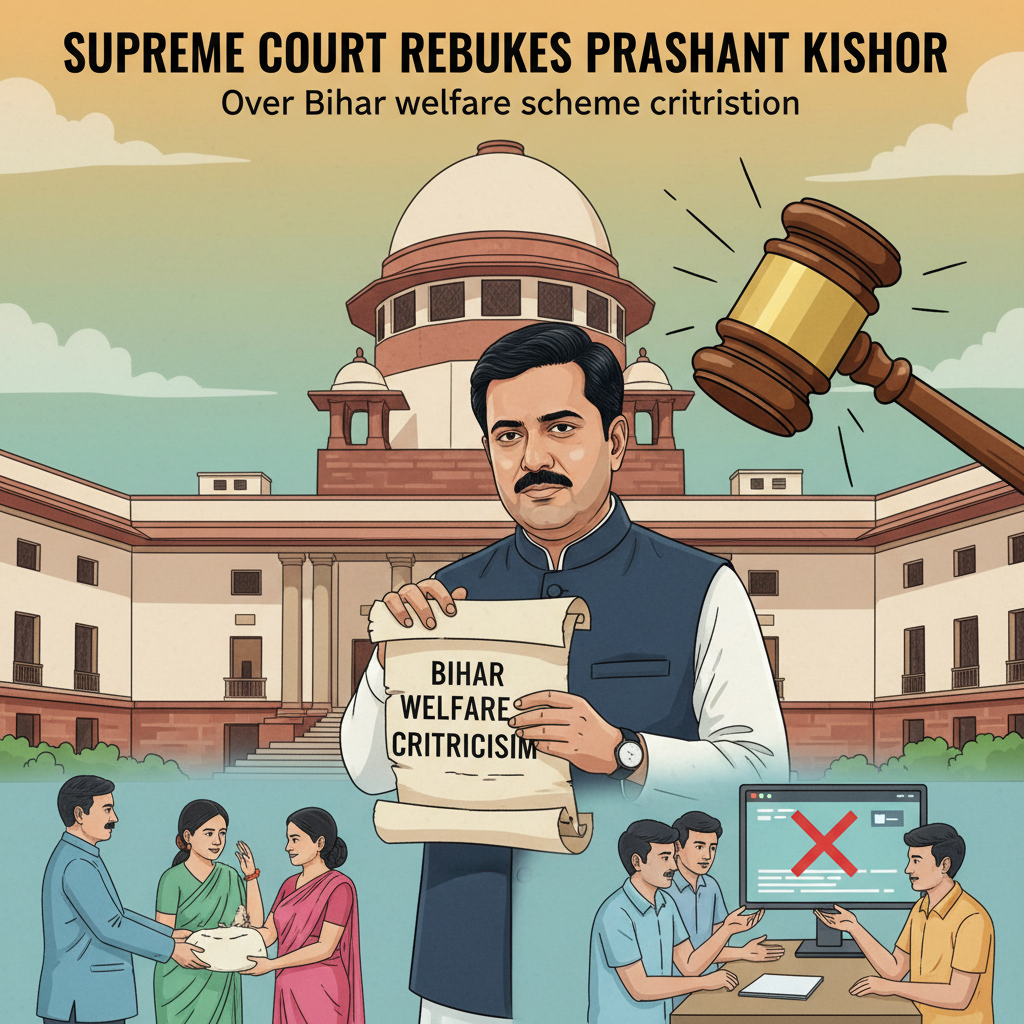
The apex court delivered a unequivocal rebuke to political strategist Prashant Kishor on Tuesday, cautioning that public criticism of government programmes must be tempered with respect for legislative decisions. In a pronouncement that resonated across media outlets, the judges emphasized that constructive feedback is indispensable, but it must be pursued responsibly and without resorting to sensationalism. The court warned that reckless accusations can erode public confidence in welfare initiatives, especially those aimed at uplifting rural communities in Bihar. Legal experts interpret the verdict as a reminder that discourse around public policy should prioritize factual accuracy and decorum over partisan theatrics.
Context of the controversy
The controversy stems from the Bihar Rural Livelihood and Employment Scheme (BRLES), a flagship programme launched in 2023 to provide direct cash transfers to eligible families in backward districts. Officially described as a “Bihar Livelihood Mission” initiative, the scheme promises a monthly stipend of INR 1,500 to households identified as below the poverty line in 11 high‑need blocks. Eligibility criteria include income thresholds, land‑holding limits, and proof of residence. Since its inception, the programme has disbursed over INR 2.5 billion to more than 120,000 families, according to the state’s Press Information Bureau release of September 2024. Critics, however, point to irregularities in beneficiary lists, delayed payments, and alleged politicisation of distribution centres.
Court’s emphasis on constructive feedback
During the hearing, Chief Justice D. Y. Chandrachud underscored the imperative of “responsible dissent” when addressing policy shortcomings. The bench observed that while the right to critique is fundamental, it must be exercised with a “fact‑based approach that respects the intent of legislative bodies.” The judges reiterated that civil society organisations, journalists, and political analysts have a duty to collaborate with government agencies by presenting actionable suggestions rather than launching blanket condemnations. This stance was reinforced by a reference to the rule of law principle, which obliges all stakeholders to uphold the integrity of public institutions while seeking improvement. 
Reactions from political circles
Supporters of the ruling coalition hailed the court’s directive as a vindication of governance norms, asserting that “disciplined discourse” safeguards developmental momentum. Senior minister Meganathan remarked that “policy dialogue must be guided by evidence, not by polemics that jeopardise public trust.” Conversely, opposition parties, including the Janata Dal (United) and the Rashtriya Janata Dal, demanded a transparent audit of the scheme’s finances and a comprehensive review of its implementation framework. Political analysts suggest that the court’s intervention could set a precedent for how future welfare programmes are debated, potentially encouraging more data‑driven advocacy in legislative forums.
Impact on citizens
For many beneficiary families, the scheme has been a lifeline. Take the case of 38‑year‑old Sunita Devi from Gaya district, who disclosed to local reporters that the monthly INR 1,500 has enabled her to purchase essential medicines and keep her children in school. Yet, field investigations reveal a stark contrast: numerous households in Purnea and Saharsa reported missed installments, with some attributing the delays to opaque verification procedures. Non‑governmental organisations have documented cases where eligible families were excluded due to outdated socio‑economic surveys, prompting calls for a digital grievance redressal portal to streamline grievance redressal. Local media coverage, including reports from The Times of India, highlight the mixed sentiment among citizens—gratitude for assistance tempered by frustration over bureaucratic inefficiencies.
Possible next steps
In response to the court’s admonition and emerging implementation gaps, the Bihar government announced a multi‑pronged review plan. Officials will commission an independent audit led by the Comptroller and Auditor General to verify fund allocation across districts. A dedicated digital portal is slated for launch by December 2024, designed to allow beneficiaries to track disbursement status and submit complaints in real time. Additionally, the state aims to strengthen coordination between district officials and grassroots NGOs through a joint monitoring task‑force. Key recommendations include:
- Conduct independent audits of fund allocation to ensure transparency.
- Introduce a grievance redressal portal for beneficiaries to report issues promptly.
- Strengthen coordination between district officials and NGOs for real‑time monitoring.
These measures are intended to restore confidence among citizens and stakeholders while aligning the programme with best practices in welfare delivery.
Broader implications for welfare policy
The episode underscores a pivotal lesson for policymakers: accountability thrives on constructive engagement rather than confrontational criticism. By championing a balanced dialogue, the Supreme Court reaffirmed the principle that civil society should act as a partner, not an adversary, in shaping public policy. This paradigm may influence other Indian states grappling with similar implementation challenges, encouraging them to adopt robust verification mechanisms and inclusive feedback loops. Moreover, the case highlights the need for transparent reporting standards, which can enhance data integrity and facilitate evidence‑based policy adjustments across the nation.
Historical perspective on welfare challenges in Bihar
Welfare delivery in Bihar has long been hampered by logistical bottlenecks and data gaps. Early initiatives such as the Mahatma Gandhi National Rural Employment Guarantee Act (MGNREGA) faced criticism for delayed payments and exclusion errors. In the past decade, the state experimented with digital payment systems and real‑time monitoring to mitigate these issues. Recent reforms, including the rollout of biometric authentication for scheme enrolment, have shown progress but have not been immune to setbacks. The current controversy illustrates how even well‑intentioned programmes can encounter friction when implementation lacks rigor and when feedback mechanisms are insufficient.
Expert opinions
Economists argue that targeted cash transfers, when coupled with robust verification, can significantly reduce poverty indicators. Dr. Anjali Singh of the Indian Institute of Public Administration notes that “evidence‑based assessment is essential; policies must be evaluated on the basis of quantifiable outcomes rather than anecdotal narratives.” Social scientists caution against allowing political narratives to dominate discourse, stressing that “public perception can be shaped by selective reporting, which undermines the objective evaluation of welfare impact.” Policy analysts from the Centre for Development Studies recommend that transparent reporting, third‑party audits, and independent evaluation are indispensable for restoring public confidence and ensuring that welfare schemes achieve their intended socio‑economic objectives.
Conclusion
The Supreme Court’s admonition serves as a clarion call for a more measured and fact‑centric approach to critiquing public programmes. While robust debate is a cornerstone of democracy, it must coexist with respect for institutional authority and accountability. Citizens are encouraged to move beyond mere criticism and actively contribute solutions that can enhance the efficacy of welfare initiatives. By fostering a culture of constructive engagement, policymakers, civil society, and the judiciary can together strengthen the delivery of schemes that aim to uplift the most vulnerable segments of society.
Stay updated with the latest Yojana schemes and government initiatives for better awareness and eligibility. For personalized guidance on accessing these benefits, reach out to us.