


Chief Minister’s Initiative and Context
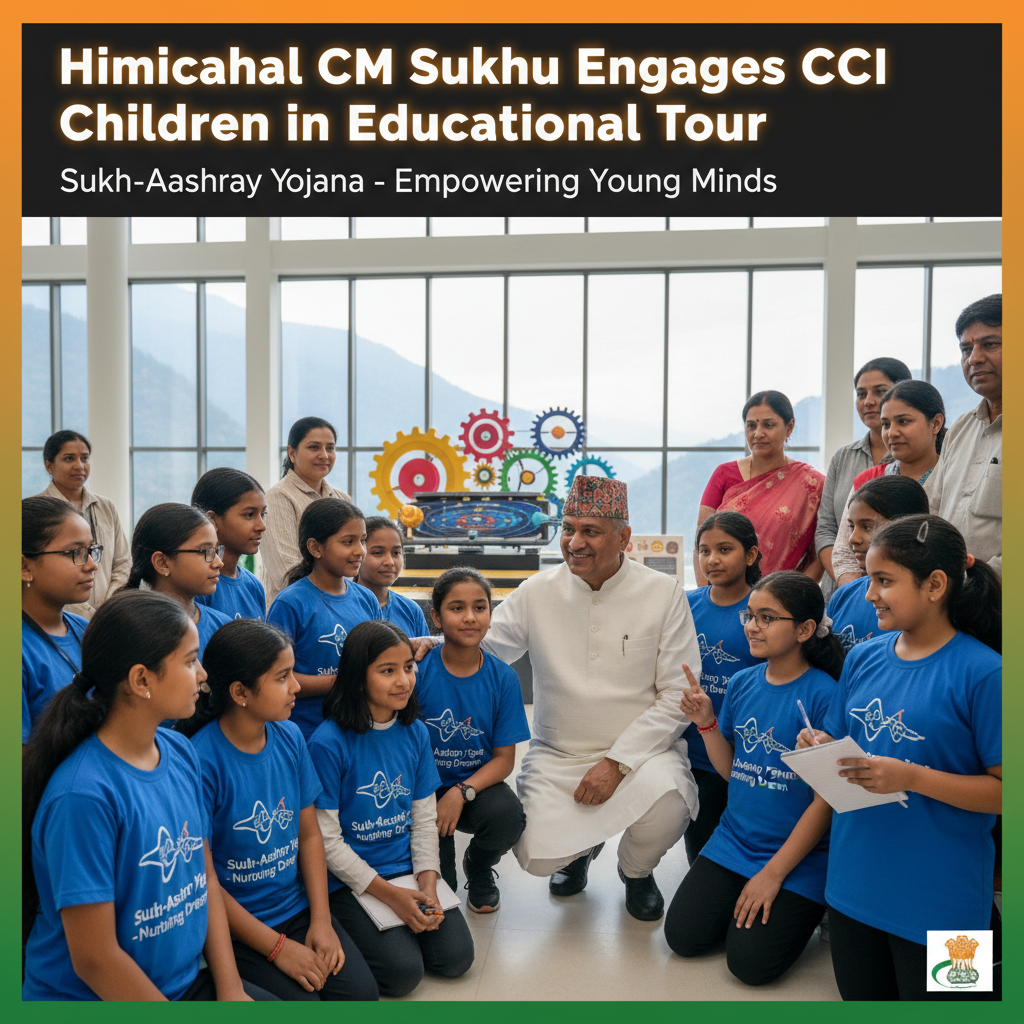
Himachal Pradesh Chief Minister Sukhvinder Singh Sukhu personally led an educational tour for children residing in Child Care Institutions (CCIs) under the state’s Sukh‑Aashray Yojana. The three‑day program, which concluded on 28 October 2024, was designed to showcase the government’s commitment to the holistic development of vulnerable youth. By engaging directly with the participants, Sukhu reinforced his administration’s promise to improve living conditions, expand educational opportunities, and foster social integration for children in institutional care.
Sukh‑Aashray Yojana: Objectives and Eligibility
The Sukh‑Aashray Yojana, launched in early 2023, forms a cornerstone of Himachal’s welfare agenda aimed at children placed in CCIs across the state. The scheme targets children aged 6 – 18 who are under state protection due to abandonment, orphanhood, or placement for welfare reasons. Its primary goals include:
- Ensuring access to quality formal education and vocational training
- Providing psychosocial support and life‑skill workshops
- Facilitating scholarships for higher education and skill‑development courses
- Creating mentorship networks that link professionals with youth
Eligibility criteria require children to be registered under the state’s Department of Social Justice and to meet academic or skill‑development benchmarks set by local education authorities. By integrating departments such as Social Justice, Education, and Health, the scheme offers a cohesive support ecosystem that addresses both academic and emotional needs. 
Details of the Educational Tour
The flagship tour, organized under the Sukh‑Aashray Yojana, spanned three days and took 45 children from nine district‑level CCIs to prominent cultural and scientific sites across Himachal. Highlights included visits to the historic Jakhoo Temple in Shimla, the Himalayan Museum of Natural History in Dharamshala, and the eco‑park at the Ridge in Kinnaur. Each location was selected to complement classroom curricula with experiential learning:
- Guided tours of heritage monuments reinforced history lessons.
- Hands‑on science experiments at the museum sparked curiosity in STEM subjects.
- Nature‑based activities in the eco‑park promoted environmental awareness.
Interactive workshops on art & craft, career counseling, and basic coding were conducted in collaboration with local NGOs, the Himachal Pradesh University, and corporate partners whose CSR contributions helped cover travel and accommodation expenses.
Chief Minister’s Engagement and Announcements
On the final day, Chief Minister Sukhu addressed the children in the auditorium of the Himachal State Museum. He listened attentively to their reflections, praised their enthusiasm, and announced several policy measures to amplify the scheme’s impact:
- An increase of 20 % in the yearly budget allocated to Sukh‑Aashray, sourced from state devolution and central grants.
- The launch of a merit‑based scholarship program for eligible students pursuing college education in science, engineering, or arts.
- The establishment of a statewide mentorship network linking industry professionals, university students, and CCI residents.
- A commitment to expand the scheme’s reach to remote districts such as Lahaul‑Spiti and Kinnaur by 2026.
Sukhu emphasized that “the future of Himachal rests on the empowerment of our youngest citizens,” underscoring his hands‑on approach to policy implementation.
Impact and Stakeholder Perspectives
Early impact assessments released by the Department of Social Justice indicate measurable improvements among tour participants. School attendance rates among the cohort rose by 12 % within two months post‑tour, and surveys revealed a 15 % boost in self‑reported confidence levels. Social activists and educators alike have praised the initiative for its role in reducing stigma associated with institutional care:
“When children experience the world beyond the walls of a CCI, they develop a sense of belonging and possibility,” said Dr. Anita Verma, a child psychologist associated with the Himachal Child Welfare Board.
Parent‑community liaison groups also reported heightened involvement, with families volunteering for follow‑up tutoring sessions and fundraising activities.
Collaborative Efforts, Funding, and Sustainability
Financing the educational tour relied on a multi‑sectoral funding model. While the state’s Social Justice Department allocated INR 2.5 crore for logistics, contributions from corporate CSR programs—including a INR 1 crore grant from Himurja Limited—offset travel and accommodation costs. A dedicated budgetary line in the 2024‑25 fiscal plan earmarks an additional 15 % increase in funds for Sukh‑Aashray, ensuring fiscal sustainability and scalability.
Public‑private partnerships extend beyond the tour. The scheme’s broader agenda incorporates digital learning modules, upgraded infrastructure in CCIs, and the procurement of educational kits, all supported by transparent financial oversight mechanisms and regular audits conducted by independent agencies.
Future Directions and Monitoring Framework
Looking ahead, the Himachal government plans to institutionalize annual educational tours and expand the Sukh‑Aashray Yojana’s reach to an additional 3,000 children across underserved districts by 2027. A robust monitoring and evaluation (M&E) framework will guide this expansion:
- Quarterly data collection on school attendance, academic performance, and psychosocial well‑being.
- Independent audits to verify fund utilization and program outcomes.
- Beneficiary feedback loops through mobile surveys and community meetings.
- Key performance indicators (KPIs) such as graduation rates, employment readiness scores, and scholarship uptake.
These metrics will be published on a dedicated government portal, enabling real‑time tracking by stakeholders and fostering accountability.
Community Involvement and Volunteer Mobilization
Community participation remains pivotal to the scheme’s sustainability. During the recent tour, 25 volunteer mentors from local universities, NGOs, and industry firms facilitated workshops on career counseling, creative writing, and basic robotics. Their involvement not only enriched the learning experience but also established mentorship bonds that persist beyond the tour.
The state has launched a Volunteer Mobilization Drive, encouraging citizens to register via an online portal and earn a “Child Welfare Champion” certification for sustained engagement. Recognition programs, including annual awards and public acknowledgment, motivate volunteers to contribute their time, expertise, and empathy toward child development initiatives.
Stay updated with the latest Yojana schemes and government initiatives for better awareness and eligibility. For personalized guidance on accessing these benefits, reach out to us.