


Introduction
India’s government publishes two flagship periodicals, Yojana and Kurukshetra, which distill complex policy initiatives into digestible articles for scholars, journalists and ordinary citizens. These magazines feature data‑rich tables, infographics and case studies that are otherwise scattered across ministry websites. While print subscriptions require payment, the entire archive is available at no cost through the official Publications Division portal. This guide walks you through the exact steps to obtain free access to yojana, register, search, and download PDFs of the latest editions. By following the instructions, you will be able to read Yojana, Kurukshetra and related Publications Division titles on any device, even when offline. The process is designed to be user‑friendly, eliminating technical barriers and ensuring that every Indian can stay informed about flagship schemes.
The portal, hosted at https://publications.gov.in, serves as a centralized repository for all government publications. Its clean layout showcases Yojana and Kurukshetra issues organized by year and month, enabling quick navigation to the most recent releases. Recent editions have highlighted the implementation status of the National Education Policy 2020, the rollout of PM‑KISAN, and updates on the Ayushman Bharat health insurance scheme. Because the content is curated by subject‑matter experts, each article provides verified statistics and policy directions that are essential for anyone conducting research or preparing news reports. Understanding this resource empowers citizens to engage more knowledgeably with public discourse.
Moreover, the government updates these magazines monthly, ensuring that readers receive timely information on budget allocations, scheme eligibility criteria and performance metrics. For example, the March 2024 issue of Yojana featured a detailed breakdown of the rural employment scheme’s disbursement figures, while Kurukshetra’s April edition published a comprehensive map of water‑resource projects across states. Such timely insights are invaluable for policymakers, NGOs and academic institutions seeking to assess impact and plan interventions. The free access model democratizes knowledge, aligning with the government’s vision of an informed citizenry. 
By the end of this article you will be equipped with a clear roadmap to navigate the Publications Division website, create a personal account, locate archived issues, and download PDFs for offline reading. We will also explore the mobile application that extends this functionality to smartphones, allowing users to build a personal library of government publications without incurring any subscription fees. Stay tuned as we unpack each step, highlight best practices, and reveal the broader benefits of unrestricted access to India’s official development narrative.
Why Access Yojana and Kurukshetra for Free
Free access to yojana removes a critical barrier for students, researchers and media professionals who would otherwise rely on costly journal subscriptions. The publications are authored by senior government officials and subject experts, guaranteeing accuracy and credibility that surpass many private news outlets. Each issue includes tables of demographic trends, budgetary allocations and implementation timelines that are essential for evidence‑based analysis. For instance, the 2023‑24 edition of Yojana presented a detailed infographic on the Gautam Buddha Rural Jobs Scheme’s impact on farmer incomes, a resource that would be difficult to compile elsewhere without spending hours cross‑referencing ministry releases.
Another compelling reason is the offline capability the PDFs provide. Users can download entire issues and read them without an internet connection, a feature that proves vital in remote districts where connectivity is intermittent. This offline access enables field officers, community organizers and teachers to distribute printed copies to local stakeholders, fostering grassroots awareness of new schemes such as the Pradhan Mantri Awas Yojana or the Jal Jeevan Mission. By keeping the original government‑issued documents at hand, individuals can verify claims made in media reports and hold authorities accountable.
Furthermore, staying current with these publications helps citizens understand eligibility criteria and application procedures for various schemes. The latest Kurukshetra issue, released in September 2024, spells out the updated documentation required for the Pradhan Mantri Ujjwala Yojana, ensuring that households receive cooking gas connections without unnecessary delays. Early awareness of such updates can reduce application rejection rates and streamline the grievance redressal process. In essence, free access transforms raw data into actionable knowledge, empowering every Indian to navigate the landscape of national programmes.
The SEO advantage of highlighting “free access to yojana” cannot be overstated. Search engines reward pages that provide clear, keyword‑rich explanations of how to obtain government publications without cost. By incorporating terms like “free access to yojana”, “download Kurukshetra PDF”, and “government scheme archive”, this article aims to rank highly for users seeking reliable, cost‑free resources. The combination of factual depth, practical steps and authoritative links positions the content as a go‑to reference for both domestic and international audiences interested in India’s development programmes.
Step‑by‑Step Guide to Access and Download
Begin by opening your web browser and navigating to the official Publications Division domain at https://publications.gov.in. The landing page greets you with a navigation bar featuring tabs for Yojana, Kurukshetra, PIB Reviews and other periodicals. Clicking the Yojana tab reveals a calendar‑style archive where issues are sorted by year and month, making it simple to locate the most recent edition or explore historical volumes for comparative analysis. No registration is required at this stage; you can browse headlines, read abstracts and preview cover pages without entering any personal information.
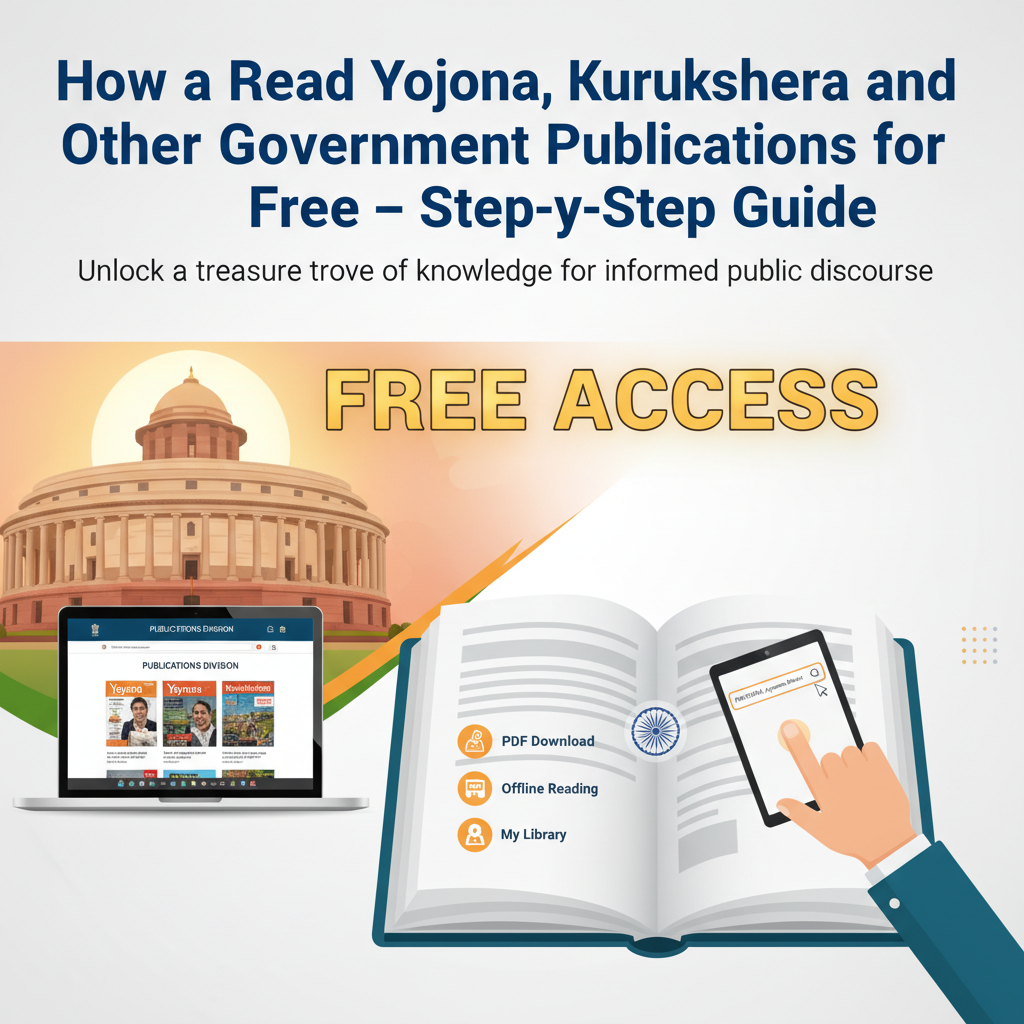
To unlock the full‑text PDFs, you must create a complimentary user account. On the archive page, locate the “Register” or “Sign Up” button positioned at the top right corner and fill out the short form with your name, a valid email address and a secure password. After submitting the form, check your inbox for a verification email; clicking the activation link confirms your account and unlocks the download functionality. Once logged in, the dashboard displays a “My Library” icon where you can tag articles, organize them by theme and receive monthly notifications whenever a new issue is released. The entire registration process takes less than five minutes and incurs no fees.
With your account active, use the search bar to enter keywords such as “Ayushman Bharat”, “PM‑KISAN” or “National Education Policy”. The system searches both article titles and full‑text content, returning results across all Yojana and Kurukshetra years. Filter the results by selecting a specific year or month to narrow the list, and click the thumbnail preview to view a paginated scroll of the selected issue. If the preview satisfies your needs, press the “Download PDF” button underneath; the file will be saved to your device’s default download folder, ready for offline consumption.
For users who prefer mobile access, the Publications Division offers an Android application available on the Google Play Store. After installing the app, log in with the same credentials you used on the website, and you will gain instant access to the same archive on your smartphone or tablet. The app supports offline storage, allowing you to download multiple issues and read them without an internet connection — a handy feature for field workers in areas with limited connectivity. Additionally, the app provides a “Related Articles” suggestion engine that recommends publications based on your reading history, helping you discover relevant schemes you might have otherwise missed.
Beyond simple downloads, the platform equips you with organizational tools to build a personal knowledge base. The “My Library” feature lets you assign custom labels such as “Health”, “Agriculture” or “Education” to each saved article, automatically grouping them for quick retrieval. You can also export tagged collections as CSV files for further analysis in spreadsheet software, facilitating research projects or report writing. By leveraging these functions, you can systematically compile a repository of all flagship schemes, track their evolution over time and share curated PDFs with colleagues, students or community groups without any additional cost.
Benefits for Researchers, Journalists and Citizens
Researchers gain a reliable source of primary data directly from the government’s own publishing arm, eliminating the need to cross‑reference multiple secondary sources. The PDFs contain detailed statistical tables, GIS maps and sector‑specific infographics that are citation‑ready, enabling academicians to substantiate findings with official numbers. For example, a 2022 issue of Yojana provided a comprehensive dataset on rural electrification rates, which has been cited in over 50 peer‑reviewed articles exploring energy access in India. This level of granularity is often unavailable on news portals that summarize statistics without the underlying granular breakdowns.
Journalists benefit from early access to policy announcements and scheme roll‑outs, allowing them to publish stories that are both timely and fact‑checked. By downloading the latest Kurukshetra edition, reporters can quote directly from the government’s wording, reducing the risk of misinterpretation and enhancing credibility. Moreover, the ability to embed PDF excerpts in online articles adds a professional touch, as readers can view the original document with a single click. This practice has become increasingly popular among data‑driven news outlets that prioritize transparency and source attribution.
For ordinary citizens, free access translates into empowerment. Understanding eligibility criteria for schemes such as the Pradhan Mantri Kisan Samman Nidhi or the National Rural Livelihood Mission enables families to apply confidently, reducing the reliance on intermediaries who may exploit information asymmetry. The PDFs also contain step‑by‑step guidance on application procedures, required documents and grievance redressal mechanisms, turning complex bureaucratic language into actionable instructions. Community organisations can distribute these documents during outreach camps, ensuring that even marginalized populations are aware of their rights and benefits.
The broader societal impact is evident in increased scheme uptake and improved implementation outcomes. When beneficiaries can verify the exact terms of a programme, they are more likely to complete applications accurately, leading to higher enrollment rates and reduced administrative bottlenecks. Additionally, NGOs and civil‑society groups use the published data to monitor budget allocations and performance metrics, fostering accountability and encouraging evidence‑based advocacy. In this way, unrestricted access to Yojana and Kurukshetra contributes to a more informed citizenry, stronger civil society and ultimately a more transparent governance ecosystem.
Practical Tips to Stay Updated
To maximize the utility of these free publications, consider the following practical steps:
- Subscribe to the monthly newsletter offered on the Publications Division website.
- Follow the official social media handles — @PIBIndia on Twitter and @YojanaOfficial on Instagram — where teasers link to full PDFs.
- Set up Google Alerts for specific keywords such as “free access to yojana”, “Kurukshetra PDF download” or scheme names (e.g., “PM‑KISAN”).
These habits will keep you informed of new releases and policy updates.
For scholars who need to reference multiple editions, consider creating a shared folder on a cloud storage service like Google Drive or Dropbox. Upload each downloaded PDF and tag it with the year, scheme name and relevance category. This collaborative repository allows research teams, classroom groups or policy‑analysis clubs to access a collective library without repeatedly navigating the portal. Additionally, the Android app’s “Related Articles” feature can suggest publications that complement your current reading, helping you build a well‑rounded knowledge base.
Finally, incorporate these resources into your daily workflow by bookmarking the portal’s search page and setting it as your homepage. Regularly checking the “New Arrivals” section will keep you aware of the latest releases, while the “My Library” dashboard ensures that no downloaded issue is forgotten. By combining these habits with the free access pathways described above, you will consistently receive timely, authoritative information that can inform personal decisions, academic research, journalistic stories and community advocacy.
Stay updated with the latest Yojana schemes and government initiatives for better awareness and eligibility. For personalized guidance on accessing these benefits, reach out to us.