


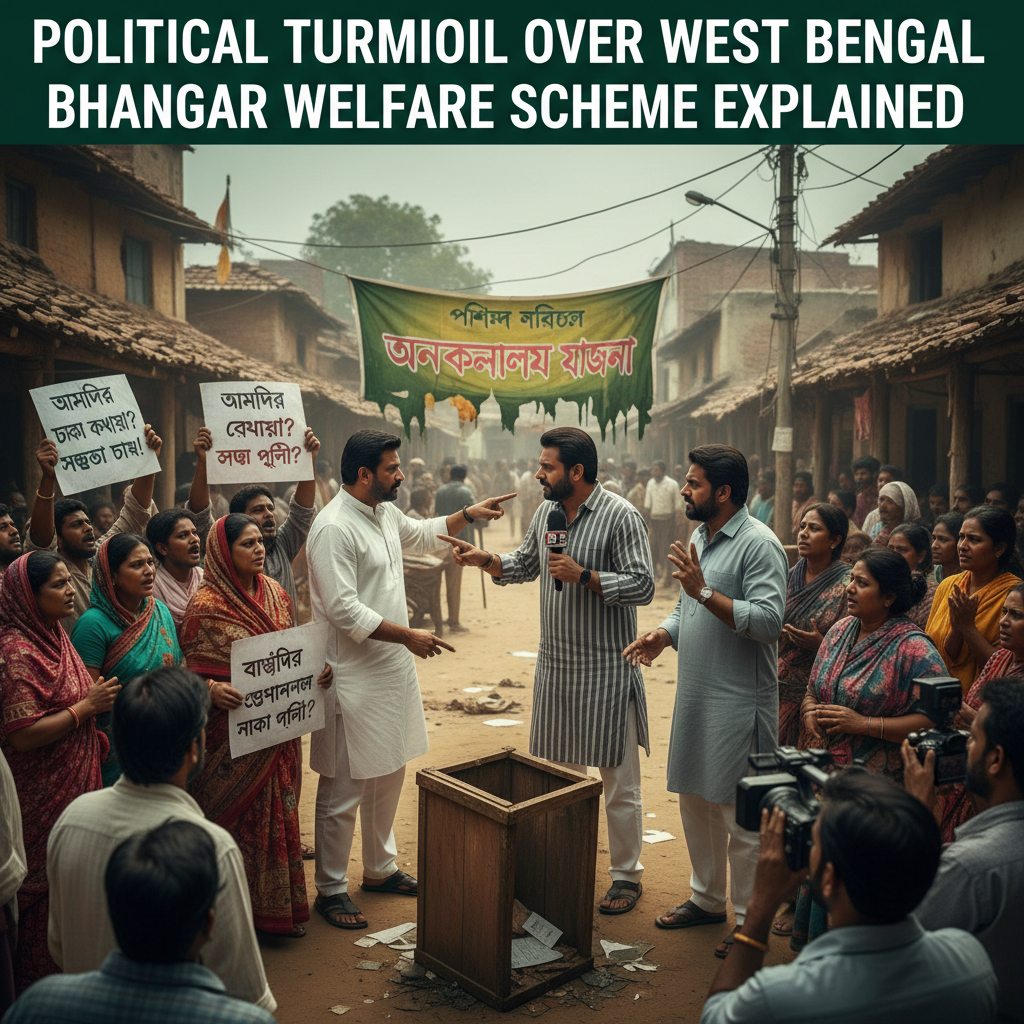
Background and Context
The welfare programme that has become the flashpoint in Bhangar was first announced during a massive rally in Kolkata where Chief Minister Mamata Banerjee outlined an ambitious vision to uplift economically disadvantaged households in the district. The official rollout, branded as the Bhangar Livelihood Enhancement Scheme, aims to combine direct cash transfers, housing material subsidies and skill‑development modules into a single package designed to reduce poverty and foster sustainable livelihoods. According to the programme document, the core objective is to lift 200,000 households out of poverty within two years while improving housing conditions and providing market‑ready vocational training.
Bhangar, a densely populated sub‑district in the South 24 Parganas district, has long suffered from inadequate infrastructure, fluctuating agricultural income and limited access to formal credit. Official statistics released by the West Bengal Department of Social Welfare indicate that over 35 % of households in the area live below the poverty line, a figure that is significantly higher than the state average. The scheme therefore aligns with the broader agenda of the state government to achieve the Sustainable Development Goals (SDGs) related to “No Poverty” and “Decent Work and Economic Growth.”
For more background on welfare initiatives in India, see the Welfare scheme article on Wikipedia and the West Bengal page which detail similar programmes across the state. 
Implementation Timeline and Rollout Details
According to the original rollout schedule, the first phase was slated to cover 200,000 eligible households within a six‑month window starting July 2023. Disbursements were to be made through bank‑linked digital wallets to ensure traceability and reduce leakage. The cash component, set at ₹5,000 per month per beneficiary, was intended to be transferred directly to beneficiaries’ accounts after verification of eligibility.
However, bureaucratic delays and logistical bottlenecks pushed the first payments beyond the projected date. By mid‑September 2023, only 38 % of the targeted households had received the initial tranche. Local administration units reported shortages of verification documents such as Aadhaar cards and land records, while certain community groups raised concerns about the transparency of the selection criteria. Critics argued that the criteria favored politically connected families, thereby undermining the scheme’s inclusive intent.
To address these issues, the state government introduced a revised timeline in October 2023, promising to complete the first phase by December 2023 with an expanded verification drive involving gram panchayat officials and independent auditors. The revised plan also includes a grievance redressal portal to handle complaints in real time.
Key Political Figures and Reactions
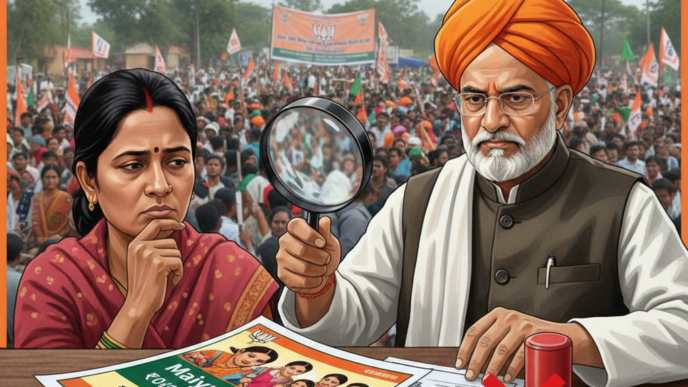
The controversy has drawn the attention of several senior politicians, each framing the debate in their own political narrative. State Finance Minister Amit Mitra defended the allocation of funds, emphasizing that the scheme is part of a larger fiscal strategy to boost rural consumption and create a safety net for the most vulnerable. “The money is not a handout; it is an investment in human capital,” Mitra stated at a press briefing in November 2023.
Opposition Leader Suvendu Adhikari, meanwhile, called for an independent audit of the programme, accusing the ruling party of using the scheme as a political bargaining chip ahead of the upcoming legislative elections. “The people of Bhangar deserve transparency, not propaganda,” Adhikari declared during a rally in the district.
Senior member of the ruling party, Sovan Kundu, suggested that the controversy could be leveraged to showcase the government’s responsiveness to citizen grievances, thereby strengthening its electoral prospects. Statements from these leaders have been extensively quoted in regional news outlets such as Ei Samay and Anandabazar Patrika, shaping public perception and fueling debate.
Community Reception and Grassroots Response
Opinions among residents are varied and often reflect the lived experiences of beneficiaries. For many, the cash infusion has been a lifeline; households reported using the funds to repair dilapidated roofs, purchase essential groceries and pay school fees. “When the money arrived, I could finally replace the leaking roof that had been causing my children to fall sick,” said Rina Das, a mother of three from Bhangar.
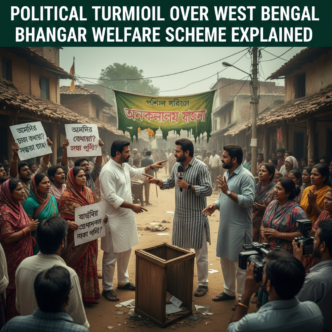
Conversely, a segment of the community feels alienated by the opaque selection process and fears that corruption may siphon off resources intended for the poor. Grassroots organisations such as the Bhangar Citizens’ Forum organised town‑hall meetings in early 2024 to collect testimonies and draft a set of recommendations for policy refinement. Their memorandum, submitted to the district magistrate, called for transparent verification, third‑party monitoring and a public dashboard to track fund flow.
These community‑driven initiatives have also partnered with local NGOs to provide informal training on financial literacy and digital payments, helping beneficiaries navigate the new cash‑transfer platform. The collaborative effort underscores a growing demand for participatory governance in the region.
Economic Impact and Expert Analysis
Economists from the Indian Institute of Economic Development modelled the potential multiplier effect of the scheme. Their projections indicate that each rupee injected into the local economy can generate up to three rupees of additional economic activity through spending on construction materials, agricultural inputs and small‑scale enterprises. The analysis highlighted that the cash transfers are likely to boost consumption patterns, especially in markets selling locally produced goods.
Nevertheless, the study warned that if the fiscal outlay is not balanced by revenue‑generating measures, the programme could strain state finances in the medium term. The researchers recommended linking the scheme to a modest levy on high‑value property transactions in the district, earmarking the proceeds for the programme’s sustainability fund. Such a fiscal linkage could also enhance public perception of fiscal responsibility.
For a deeper dive into economic multiplier effects, refer to the Fiscal multiplier page on Wikipedia, which explains the dynamics of government spending on economic growth.
Legal and Regulatory Dimensions
Legal experts have pointed out that the scheme must comply with existing welfare legislation, including the National Social Assistance Programme and the West Bengal Rural Development Act. Concerns have been raised about potential violations of transparency norms, particularly regarding the criteria used for beneficiary selection and the verification of land ownership for housing subsidies.
The state legal department has been tasked with reviewing the programme’s compliance framework and proposing amendments where gaps are identified. In a recent circular, the department outlined steps to incorporate independent third‑party auditors, mandatory public disclosures of fund allocation and a clause to prevent duplication of benefits with other state schemes. These measures aim to align the programme with the principles of public accountability.
Comparative Perspective and Best Practices
State‑level welfare experiments are not new in India. Kerala’s “Kudumbashree” programme, for instance, integrates community participation with micro‑enterprise support, while Tamil Nadu’s “Kalaignar Nagar” housing scheme emphasizes transparent beneficiary lists and real‑time monitoring. Comparative studies suggest that programmes which embed community feedback mechanisms and employ technology‑driven tracking tend to achieve higher beneficiary satisfaction.
The Bhangar case offers a fresh dataset that can inform best‑practice models for other regions. Policy analysts note that the integration of a grievance‑redressal portal, as recently introduced, mirrors successful elements of the Jharkhand housing scheme, which recorded a 22 % increase in beneficiary trust after implementing similar measures.
Media Narrative and Public Debate
Newspaper editorials have framed the controversy as a pivotal moment for governance accountability. Leading dailies such as The Telegraph and Financial Express argue that the gap between the government’s ambitious rhetoric and on‑ground realities must be addressed to maintain credibility. Op‑eds highlight the contrast between the scheme’s lofty goals and the reported delays in disbursement, urging policymakers to prioritise implementation efficiency.
Social media platforms have amplified dissenting voices, with hashtags like #BhangarScheme and #WelfareTransparency trending in Kolkata, Delhi and Bengaluru. Citizen journalists have posted video testimonies documenting delays, further pressuring the administration to respond. The viral spread of these narratives underscores the role of digital media in shaping policy discourse.
Stakeholder Recommendations and Policy Revisions
In response to the criticism, the administration outlined a revised roadmap that includes several concrete steps:
- Strengthen grievance redressal cells to address complaints promptly, ensuring a 48‑hour response time.
- Introduce transparent verification processes that involve independent third‑party observers, including civil‑society representatives.
- Deploy technology‑driven tracking systems to monitor fund flow and utilisation, leveraging blockchain‑based ledgers for auditability.
- Conduct regular impact assessments to measure socioeconomic outcomes, such as income growth and housing improvement metrics.
- Foster dialogue between policymakers and community representatives to co‑design future schemes, ensuring that local insights shape policy design.
These recommendations aim to transform the scheme from a politically contentious initiative into a model of inclusive, accountable governance.
Political Ramifications and Electoral Outlook
The unfolding drama could influence electoral strategies in the upcoming legislative sessions. Parties may use the issue to mobilise voter sentiment either in support of the ruling coalition or as a rallying cry for opposition unity. Analysts predict that the manner in which the government addresses the concerns will shape its credibility among swing voters, particularly in rural constituencies where the scheme has direct impact.
Political commentators suggest that a transparent, timely resolution could bolster the ruling party’s image as a responsive caretaker, potentially translating into electoral gains. Conversely, mishandling the controversy may provide ammunition to opposition parties, eroding trust and galvanising anti‑incumbency sentiment.
Future Directions and Implementation Roadmap
The state government has announced an expanded outreach campaign to inform eligible households about the scheme’s benefits, employing door‑to‑door campaigns, radio jingles and community radio stations. Capacity‑building workshops for local officials are scheduled to commence in early 2025, focusing on digital verification tools and ethical governance practices.
The revised plan also proposes incremental scaling of the programme based on performance indicators such as beneficiary retention rates, household income growth and housing condition improvements. Early pilot data from three gram panchayats indicate a 12 % increase in household savings and a 7 % reduction in incidences of roof collapse within six months of implementation.
By coupling fiscal prudence with participatory monitoring, the administration hopes to turn the Bhangar welfare scheme into a replicable model for other districts facing similar socio‑economic challenges.
Stay updated with the latest Yojana schemes and government initiatives for better awareness and eligibility. For personalized guidance on accessing these benefits, reach out to us.