


Overview of PM Dhan‑Dhaanya Krishi Yojana
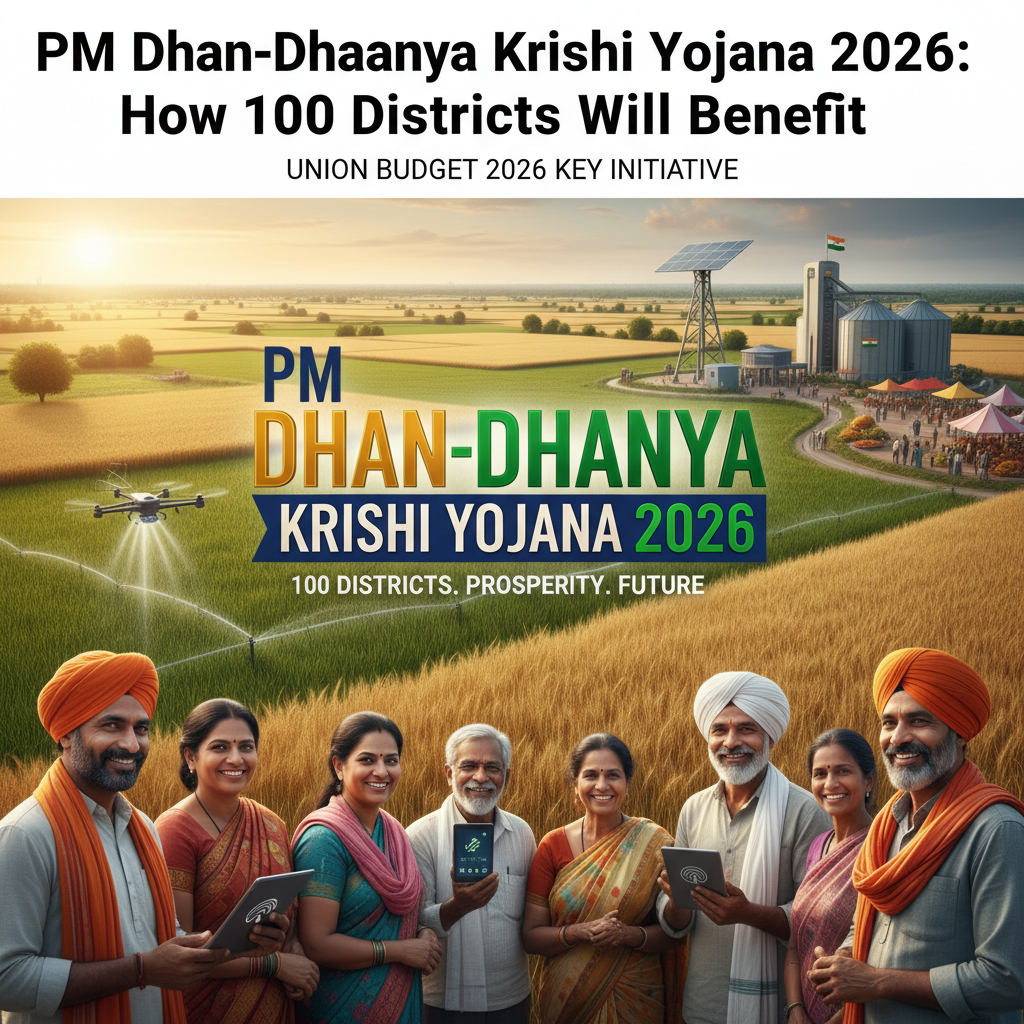
The Union Budget 2026 announced the launch of the PM Dhan‑Dhaanya Krishi Yojana, a targeted agricultural initiative aimed at revitalising 100 districts across India. The scheme seeks to boost farm incomes, improve irrigation, and provide better market linkages for small and marginal farmers. By concentrating resources on regions with low productivity and high poverty, the government hopes to create a multiplier effect that lifts rural livelihoods and strengthens food‑grain security. The programme is positioned as a catalyst for inclusive growth, aligning with the broader vision of doubling farmer incomes by 2027.
Key Objectives
- Short‑term crop loans up to ₹2 lakh at reduced interest rates.
- Micro‑irrigation and watershed development in identified districts.
- Strengthening farmer producer organisations (FPOs) to enhance collective marketing.
- Digital platforms for real‑time crop advisories and price alerts.
Why 100 Districts?
The selected districts were chosen based on a composite index that considered low agricultural productivity, high poverty incidence, and vulnerable farmer populations. Officials argue that focusing investments on these “high‑impact” zones will generate a spill‑over effect, encouraging private sector participation in agribusiness, improving rural infrastructure, and reducing migration to urban centers. The geographic spread includes high‑burden states such as Bihar, Odisha, Madhya Pradesh, and Jharkhand, where agrarian distress is most acute.
Implementation Framework
The scheme will be administered by the Ministry of Agriculture and Farmers’ Welfare in collaboration with state governments. Funds will flow through the National Bank for Agriculture and Rural Development (NABARD) to ensure transparent disbursement and monitoring. State agriculture departments will act as the primary implementing agencies, while NABARD will coordinate technical assistance, credit evaluation, and grievance redressal. The multi‑level structure is designed to blend central oversight with local implementation expertise, thereby ensuring contextual relevance. 
Financial Allocation
Budget 2026 earmarks ₹3,500 crore for the first phase, with additional funding planned for subsequent years. The allocation is split as follows: ₹1,800 crore for loan subsidies, ₹1,200 crore for infrastructure development (including micro‑irrigation and watershed projects), and ₹500 crore for capacity‑building programmes such as training and digital tools. The financial model adopts a revolving‑fund approach, where loan repayments are reinvested to sustain future cycles of financing.
Expected Impact on Farmers
Experts predict that the scheme could increase average farm incomes by 15‑20 percent in the targeted districts. By replacing informal lenders, farmers will gain access to formal credit at affordable rates, enabling investment in quality seeds, fertilisers, and equipment. Early pilot studies in Madhya Pradesh and Bihar indicate that loan‑linked irrigation can raise yields of staple crops such as wheat and rice by up to 12 percent, while also reducing loan default rates. The emphasis on market linkage through digital platforms is expected to cut post‑harvest losses and improve price realisation.
Support for Women Farmers
A dedicated component of the scheme allocates 30 percent of loan benefits to women‑led farm enterprises. Special training modules, delivered through Krishi Vigyan Kendras (KVKs), will focus on agribusiness skills, financial literacy, and market access for women. The initiative aims to empower female farmers, who traditionally face greater barriers to credit and extension services, thereby fostering gender‑inclusive growth in the agricultural sector.
Technology Integration
The scheme leverages the Kisan e‑Market portal to connect farmers directly with buyers, cutting middlemen margins. Satellite‑based weather forecasts are disseminated via mobile apps such as India Meteorological Department’s MeT, helping farmers plan sowing and irrigation cycles more efficiently. Additionally, integration with the Soil Health Card portal allows for geotagged recommendations on crop‑specific interventions, enhancing precision agriculture.
Monitoring and Evaluation
A robust Management Information System (MIS) will track key performance indicators such as loan disbursement, crop yields, and market prices. Real‑time dashboards display metrics like credit utilisation and irrigation coverage, enabling policymakers to adjust strategies promptly. Independent audits will be conducted annually to ensure fiscal discipline and transparency. The data‑driven approach is intended to create a feedback loop that informs iterative improvements in scheme design and implementation.
Challenges and Mitigation Strategies
Potential challenges include timely loan processing and preventing leakages. To mitigate these, the government will deploy Aadhaar‑linked biometric authentication for beneficiaries, reducing duplication and ensuring that subsidies reach the intended recipients. Additionally, grievance redressal cells will be established at the district level, providing a direct channel for farmers to report issues. Capacity‑building for local officials on digital tools is also part of the mitigation plan.
Comparison with Earlier Schemes
PM Dhan‑Dhaanya Krishi Yojana builds on the earlier PM‑KISAN and Pradhan Mantri Fasal Bima Yojana (PMFBY), but focuses specifically on district‑level clustering and integrated infrastructure development. Unlike the universal cash‑transfer model of PM‑KISAN, this scheme adopts a targeted approach that pairs credit with infrastructure and market linkages, addressing gaps left by sector‑wide programmes. This nuanced design aims to deliver more sustainable impacts on farmer livelihoods.
State‑Level Partnerships
Each of the 100 districts will partner with the respective state agriculture departments to design district‑specific action plans. States will identify local NGOs and cooperative societies to act as implementation partners, ensuring that cultural and agro‑ecological nuances are respected. This decentralized approach is expected to increase adoption rates among farmers and facilitate better alignment with state‑specific agricultural priorities.
Data‑Driven Decision Making
The scheme incorporates geotagged land records to map farm sizes and soil health. By integrating with the Soil Health Card portal, the government can recommend crop‑specific interventions based on real‑time soil data. Regional dashboards will visualise key metrics such as credit utilisation, irrigation coverage, and market price trends, enabling policymakers to respond swiftly to emerging challenges. This data‑centric framework enhances transparency and accountability.
Broader Rural Development Implications
Beyond individual farm incomes, the scheme is expected to stimulate ancillary businesses such as agro‑processing, rural retail, and transportation. Increased agricultural surplus will feed into the national food‑grain pool, potentially stabilising market prices and reducing import dependence. The ripple effects could spur job creation in rural areas, enhance rural connectivity, and contribute to overall regional development.
Financial Sustainability
To ensure long‑term viability, the scheme proposes a revolving‑fund model where loan repayments are reinvested into the next cycle of financing. Interest subsidies are structured to be fiscally neutral over a five‑year horizon, aligning with the fiscal consolidation roadmap. Periodic financial reviews will assess the fund’s health and adjust contribution levels as needed, ensuring that the programme remains budget‑friendly while delivering impact.
Community Mobilisation
Awareness campaigns using radio, television, and digital media will be rolled out in regional languages to inform farmers about eligibility criteria and application procedures. Gram Panchayats will play a pivotal role in facilitating applications and disseminating information at the grassroots level. Partnerships with local farmer groups and civil society organisations will further amplify outreach, ensuring that even remote and marginalised communities are aware of and can access the benefits.
Stay updated with the latest Yojana schemes and government initiatives for better awareness and eligibility. For personalized guidance on accessing these benefits, reach out to us.