



Suspension of Junior Engineer Highlights Governance Concerns
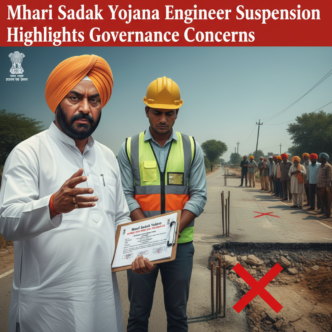
In a swift move that has sent ripples through the implementation of the Mhari Sadak Yojana, the Public Works Department of Shahabad Municipality recently issued a suspension notice to a junior engineer found responsible for bypassing critical quality‑control checks on a tramo of the rural road network. The disciplinary action follows a surprise audit conducted by the State Rural Development Board, which uncovered a series of irregularities including omission of prescribed concrete mix designs, failure to perform mandatory compaction tests, and neglect of safety protocols mandated by the Punjab Engineering Standards. Public Works Departments across India often rely on such audits to ensure that flagship schemes like the Mhari Sadak Yojana deliver infrastructure that meets durability and safety benchmarks.
The audit report, released on 12 September 2025, documented that the engineer in question approved a 3‑kilometre stretch of paved road without verifying that the sub‑grade met the minimum bearing capacity of 150 kPa, a parameter non‑negotiable under the scheme’s technical specifications. Moreover, field photographs showed inadequate curing time for the concrete slabs, raising concerns about premature cracking and reduced service life. In response, the department placed the engineer on administrative leave pending a comprehensive investigation and ordered the preparation of a corrective action plan within 15 days.
While the suspension underscores a zero‑tolerance stance toward procedural lapses, it also raises questions about the robustness of the monitoring framework that oversees the Mhari Sadak Yojana. Stakeholders, including farmer cooperatives and local business associations, have expressed both relief at the decisive action and apprehension regarding potential delays in project timelines. The incident serves as a stark reminder that even well‑intended flagship programmes can falter if oversight mechanisms are weak or under‑resourced. 
Overview of Mhari Sadak Yojana
Launched in 2022 by the Punjab Government, the Mhari Sadak Yojana is a state‑specific infrastructure initiative aimed at revitalising the rural road network across 14 districts identified as having low connectivity and high poverty incidence. The programme’s primary objectives are to construct and upgrade approximately 1,200 kilometres of all‑weather paved roads, install proper drainage systems, and institute a routine maintenance schedule that ensures longevity. Funding is a blend of state allocation, central assistance under the Pradhan Mantri Gram Sadak Yojana (PMGSY), and strategic participation of private contractors through a public‑private partnership model. As of the fiscal year 2024‑25, the scheme has already delivered over 250 kilometres of upgraded roads, reducing average travel time between villages and market centres by up to 30 minutes.
Eligibility for benefits under the Mhari Sadak Yojana extends to households located within a 5‑kilometre radius of the targeted road segments, with special provisions for Scheduled Castes, Scheduled Tribes, and small‑scale entrepreneurs. The scheme also mandates the inclusion of community input during the planning phase, ensuring that road alignments reflect local transportation demand and facilitate access to agricultural markets, health centres, and educational institutions. In addition, the programme incorporates a digital geo‑tagging component that records each kilometre of construction, enabling real‑time monitoring by the Rural Development Department.
Beyond physical connectivity, the Mhari Sadak Yojana is projected to generate socio‑economic multipliers: farm produce can reach mandis more quickly, reducing post‑harvest losses; artisans can transport goods to nearby towns, expanding informal market opportunities; and students in remote villages can commute to schools with greater ease. According to a recent impact assessment conducted by the Punjab Institute of Public Policy, the scheme is expected to lift approximately 120,000 rural families out of chronic poverty over the next five years, provided that implementation remains transparent and well‑managed.
Government Response and Accountability Measures
The incident involving the junior engineer prompted an immediate reaction from the state’s Rural Development Minister, who reiterated the administration’s commitment to “zero tolerance for lax implementation” of flagship schemes. Within 48 hours of the audit findings, a high‑level monitoring committee comprising senior engineers from the Public Works Department, independent auditors, and representatives from the State Planning Board was constituted to review all ongoing works under the Mhari Sadak Yojana. The committee’s mandate includes verifying compliance with technical specifications, evaluating the effectiveness of field‑level supervision, and recommending corrective actions to prevent recurrence.
In tandem with the committee, the Rural Development Department issued a directive mandating weekly progress reports from all municipal execution units. These reports, to be uploaded on the state’s official dashboard, must detail kilometre‑wise construction milestones, quality‑control test results, and any deviations from the approved design. To encourage whistle‑blowing, an anonymous helpline (toll‑free 1800‑123‑4567) has been established, allowing engineers, contractors, and citizens to report irregularities without fear of retaliation. The helpline data is logged in a secure database that triggers automatic alerts to the monitoring committee when a threshold number of complaints is received for a particular project.
Furthermore, the department has announced plans to integrate a Geographic Information System (GIS)‑based tracking tool that will overlay real‑time field data with the scheme’s digital repository. This technology, already piloted in the neighbouring district of Ludhiana, uses GPS‑enabled devices for on‑site verification of compaction tests and concrete curing, transmitting results instantly to a central server. By enhancing data transparency, the state hopes to rebuild public confidence and ensure that funds allocated to the Mhari Sadak Yojana translate into tangible, high‑quality infrastructure.
Impact on Citizens and Scheme Progress
The suspension of the junior engineer has introduced a temporary slowdown in the execution of a 4‑kilometre segment of the road network in the Shahabad region. Contractors, pending the outcome of the investigation, have been instructed to pause non‑essential works while senior engineers conduct supplemental quality inspections. However, officials assure that the overall timeline of the Mhari Sadak Yojana remains intact, thanks to a contingency pool of qualified personnel and pre‑identified backup contractors who can step in to maintain momentum.
Local residents have expressed a mixed response to the development. While many applaud the prompt action against negligence, citing a renewed faith that public funds will not be squandered, others worry about potential delays in reaching essential services such as hospitals and schools. Community leaders from the village of Bhikhi, located adjacent to the affected stretch, have called for transparent communication channels, urging the department to release periodic updates on repair schedules and expected completion dates. In a recent public meeting, they emphasized the importance of maintaining road accessibility during the transition period to avoid disruption of agricultural marketing.
Despite the hiccup, the broader impact of the Mhari Sadak Yojana on the targeted districts remains positive. Early statistics released by the Rural Development Department indicate a 12 % reduction in average travel time for farmers transporting produce to mandis in the districts where road upgrades have been completed. Small‑business owners report increased footfall as improved connectivity enables them to attract customers from neighboring towns. Moreover, the scheme’s emphasis on proper drainage has mitigated seasonal flooding, reducing crop loss incidents by an estimated 8 % in the 2023‑24 agricultural cycle.
Broader Implications for State‑Specific Schemes
The episode serves as a cautionary tale for other state‑level infrastructure programmes that rely heavily on decentralized implementation. In India, over 30 % of welfare projects are executed at the municipal or district level, making them vulnerable to gaps in capacity building, data integrity, and accountability. The Mhari Sadak Yojana experience underscores the need for a multi‑pronged approach that combines stricter audit protocols, capacity‑building workshops for frontline engineers, and the adoption of digital monitoring solutions.
Experts from the Indian Institute of Technology Delhi recommend a “Data‑Driven Governance Framework” that integrates satellite imagery, drone‑based site surveys, and blockchain‑secured transaction records to create an immutable audit trail. Such a system would enable real‑time verification of construction milestones and deter fraudulent reporting. Additionally, periodic third‑party evaluations, funded through a dedicated audit reserve, can provide objective assessments of project performance and highlight areas requiring corrective action.
Lessons learned from the suspension incident also inform policy discussions on the need for statutory penalties for officials who willfully bypass quality standards. Some policy analysts argue that the introduction of a “Performance‑Linked Incentive” model for executing agencies could align financial incentives with adherence to technical norms. By rewarding districts that achieve zero‑defect construction rates, the central and state governments can foster a culture of excellence and reduce the incidence of negligence.
Finally, the episode has spurred calls for greater civil‑society involvement in scheme monitoring. Non‑governmental organisations and local consumer forums have proposed the creation of community watch groups that would periodically inspect construction sites and publish independent reports. Such participatory mechanisms, when coupled with government‑led transparency initiatives, can create a robust ecosystem of accountability that ensures the Mhari Sadak Yojana fulfills its promise of equitable rural development.
Stay updated with the latest Yojana schemes and government initiatives for better awareness and eligibility. For personalized guidance on accessing these benefits, reach out to us.