




Court Directive and Immediate Government Response
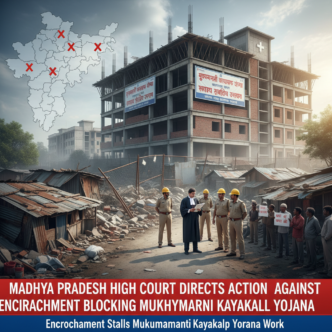
The Madhya Pradesh High Court, in a landmark judgment delivered on 13 March 2026, ordered the swift removal of all illegal encroachments that are obstructing the construction and refurbishment activities under the Mukhyamantri Kayakalp Yojana. The bench, comprising Justice S. R. Bhat and Justice P. K. Mishra, emphasized that “administrative delays cannot be used as a shield against statutory obligations” and directed the Health, Public Works, and Revenue Departments to coordinate a comprehensive clearance plan within a strict 30‑day window. The judgment also mandated the preparation of a detailed removal protocol, which includes fair compensation for bonafide lease‑holders, a transparent valuation process, and a monitoring mechanism to prevent recurrence of unlawful structures. Legal commentary suggests that this order reflects a growing trend of judicial activism aimed at ensuring the uninterrupted implementation of flagship welfare programmes.
In direct response, the Madhya Pradesh Health Department issued an official statement confirming the formation of a joint task force comprising senior officials from the Health Services, Urban Development, and Revenue Departments. The task force is charged with identifying all encroached plots in the districts of Indore, Bhopal, and Jabalpur, preparing a demolition timetable, and submitting a comprehensive report to the court by the end of April 2026. To accelerate the process, the department has earmarked INR 2 crore from the state contingency fund specifically for urgent clearances, covering site inspection, legal notices, and temporary relocation assistance for affected occupants.
- Court directive to clear encroachments within 30 days.
- Joint task force formation mandated.
- INR 2 crore allocated for urgent clearances.
The Health Department also announced that the task force will employ satellite imagery and GIS mapping to precisely locate encroachments, thereby minimizing disputes over land boundaries. Experts in urban planning have praised this technologically driven approach, noting that it not only expedites the identification process but also creates a documented audit trail that can be referenced in future land‑use disputes. 
The Mukhyamantri Kayakalp Yojana – Scope, Achievements and Challenges
Launched in the financial year 2022‑23, the Mukhyamantri Kayakalp Yojana is a multi‑year initiative aimed at upgrading 1,200 government‑run health institutions across Madhya Pradesh, including 300 Primary Health Centres (PHCs), 500 Community Health Centres (CHCs), and 400 District Hospitals. The scheme’s core objectives are to modernise infrastructure, install state‑of‑the‑art medical equipment, improve civil works, and enhance patient‑centric amenities such as clean waiting areas, digital health‑record systems, and accessible sanitation facilities. By the close of the 2025‑26 fiscal year, approximately 45 % of the targeted facilities had undergone partial upgrades, with new operating theatres, radiology suites, and laboratory upgrades already operational in districts like Ujjain and Satna.
However, progress has been uneven due to a series of land‑use conflicts, particularly in rapidly urbanising zones where informal settlements and commercial encroachments have sprung up on government‑allotted plots. In Indore’s Ambah block, for instance, a cluster of temporary shops was constructed on the site earmarked for a new outpatient wing, halting construction for over six months. Similar obstacles were reported in Bhopal’s Berasia tehsil, where a private educational institute claimed legal title over a parcel intended for a CHC expansion. These disputes have not only delayed project timelines but also inflate costs, as the state is often required to acquire additional land or redesign facilities to accommodate the encroached spaces.
According to the State Health Mission’s quarterly report, the scheme’s budgetary allocation stands at INR 1,800 crore for the entire rollout, with an additional INR 250 crore earmarked for “pre‑construction land clearance” in the 2026‑27 budget. This allocation reflects the state’s acknowledgment of land‑related bottlenecks and underscores a strategic shift toward integrating land‑audit mechanisms during the planning phase of future health‑infrastructure projects.
For a detailed overview of the scheme’s progress, refer to the official government portal: Madhya Pradesh Health Department – Kayakalp Yojana. Additional context can be found on the Wikipedia entry for Madhya Pradesh, which outlines the state’s demographic and infrastructural landscape.
Health Impact and Citizen Benefits
The Mukhyamantri Kayakalp Yoyana is poised to significantly improve health outcomes for millions of citizens across both urban and rural pockets of Madhya Pradesh. By upgrading clinical infrastructure and ensuring cleaner, more hygienic environments, the scheme directly addresses the “quality of care” dimension of the Sustainable Development Goal 3 on Good Health and Well‑Being. Enhanced surgical suites equipped with modern anaesthetic machines and sterilisation units are expected to reduce postoperative complications by up to 15 %, according to a recent study published in the Indian Journal of Public Health. Moreover, the digitisation of patient records will streamline appointment scheduling, reduce waiting times, and facilitate data‑driven monitoring of disease epidemiology.
Eligibility for benefits under the scheme extends to all residents who util utilise the upgraded facilities. However, indirect beneficiaries include patients from neighbouring districts who travel to access specialised services now available locally, thereby decreasing travel costs and improving timely access to critical care. A recent survey by the Madhya Pradesh Medical Association revealed that 68 % of respondents from rural blocks cited “better infrastructure” as a key factor in choosing state‑run hospitals over private alternatives, highlighting the scheme’s potential to reshape healthcare utilisation patterns.
Citizen engagement initiatives have also been rolled out to create awareness about the scheme’s features. Informational kiosks have been installed at the entrance of upgraded hospitals, providing details on available services, eligibility criteria for free diagnostics, and the process for filing grievances related to service quality. These measures are designed to empower patients and hold service providers accountable, fostering a culture of transparency and responsiveness.
For further reading on public health improvements linked to infrastructure upgrades, see the Wikipedia page on Public health, which discusses the impact of facility quality on community health metrics.
Legal Precedent and Way Forward for Implementation
Legal scholars have noted that the high court’s directive in the Kayakalp case sets a meaningful precedent for other Indian states grappling with similar land‑use conflicts that threaten large‑scale welfare projects. The judgment underscores the principle that “no project of public interest can remain hostage to private encroachments,” reinforcing the state’s duty to protect collective rights over individual claims when the larger public good is at stake. Nonetheless, practitioners caution that the execution of demolition orders must adhere strictly to due process, especially when encroachments involve small business owners or long‑standing residents who may lack alternative accommodation.
To navigate these complexities, the state government is expected to adopt a calibrated compensation framework that combines monetary restitution with the provision of alternative plots in designated, encroachment‑free zones. The compensation model will reportedly be guided by the “Market Value Plus” formula, which adds a 10 % premium to the assessed market price, thereby ensuring a fair settlement for affected parties. Additionally, a grievance redressal committee, chaired by a senior IAS officer, will be established to adjudicate disputes arising from the clearance process, offering an administrative avenue before resorting to further litigation.
The policy implications extend beyond immediate clearance efforts. Experts recommend that future budgetary allocations for large‑scale infrastructure schemes incorporate a dedicated line item for “pre‑construction land audit and clearance,” thereby pre‑empting delays and reducing the fiscal burden of post‑facto dispute resolution. An illustrative example can be drawn from the National Heritage City Development Project, which integrated land‑clearance planning at the inception stage, resulting in smoother execution and lower cost overruns.
As the implementation deadline approaches, the coordinated efforts of the Health, Public Works, and Revenue Departments, supported by the newly formed task force, will be closely monitored by both the judiciary and civil society. Continued transparency, stakeholder consultation, and adherence to legal norms will be pivotal in ensuring that the Mukhyamantri Kayakalp Yojana delivers on its promise of a healthier, more equitable Madhya Pradesh.
For ongoing updates on Yojana schemes and government initiatives, stay tuned to our dedicated health‑policy section.
Stay updated with the latest Yojana schemes and government initiatives for better awareness and eligibility. For personalized guidance on accessing these benefits, reach out to us.