


Overview of Mukhyamantri Nidan Yojana
The Himachal Pradesh government launched the Mukhyamantri Nidan Yojana in the fiscal year 2023‑24 as a targeted financial assistance programme aimed exclusively at laboratory staff employed across state‑run hospitals, research institutes and public health laboratories. The scheme’s primary purpose is to guarantee that every eligible technician, scientist and support personnel receives a fixed monthly stipend directly credited to their bank accounts on a predetermined date, thereby ensuring uninterrupted service delivery in diagnostic and research functions. Under the programme, beneficiaries are required to be permanent or contractual employees whose posts fall under the categories of pathology, microbiology, radiology or other scientific support roles, and who have completed a minimum tenure of six months in the service. The state allocated an initial budget of ₹ 150 crore for the first year, with additional provisions earmarked for arrears clearance and monitoring mechanisms.
Eligibility criteria also include submission of verified service records, adherence to attendance standards and the absence of pending disciplinary actions. The scheme is designed to complement existing pay‑scale revisions and to act as a safety net for personnel whose remuneration is otherwise governed by complex contractual terms. According to the Department of Health & Family Welfare, the Nidan Yojana not only seeks to improve morale among technical staff but also aims to reduce attrition rates in critical public‑health laboratories, thereby enhancing diagnostic capacity for diseases such as tuberculosis, hepatitis and emerging infections. For citizens, timely salary disbursement translates into more reliable laboratory services, faster test results and better overall health outcomes.
For more detailed guidelines and the official notification, one can refer to the Himachal Pradesh Health Department portal or the Wikipedia entry on Himachal Pradesh, which provides context on the state’s broader welfare initiatives. 
Trigger for the Una Protest
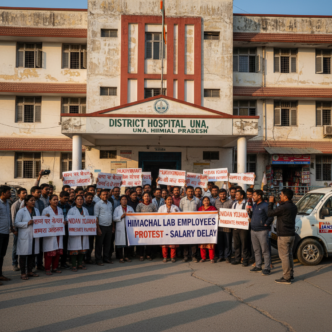
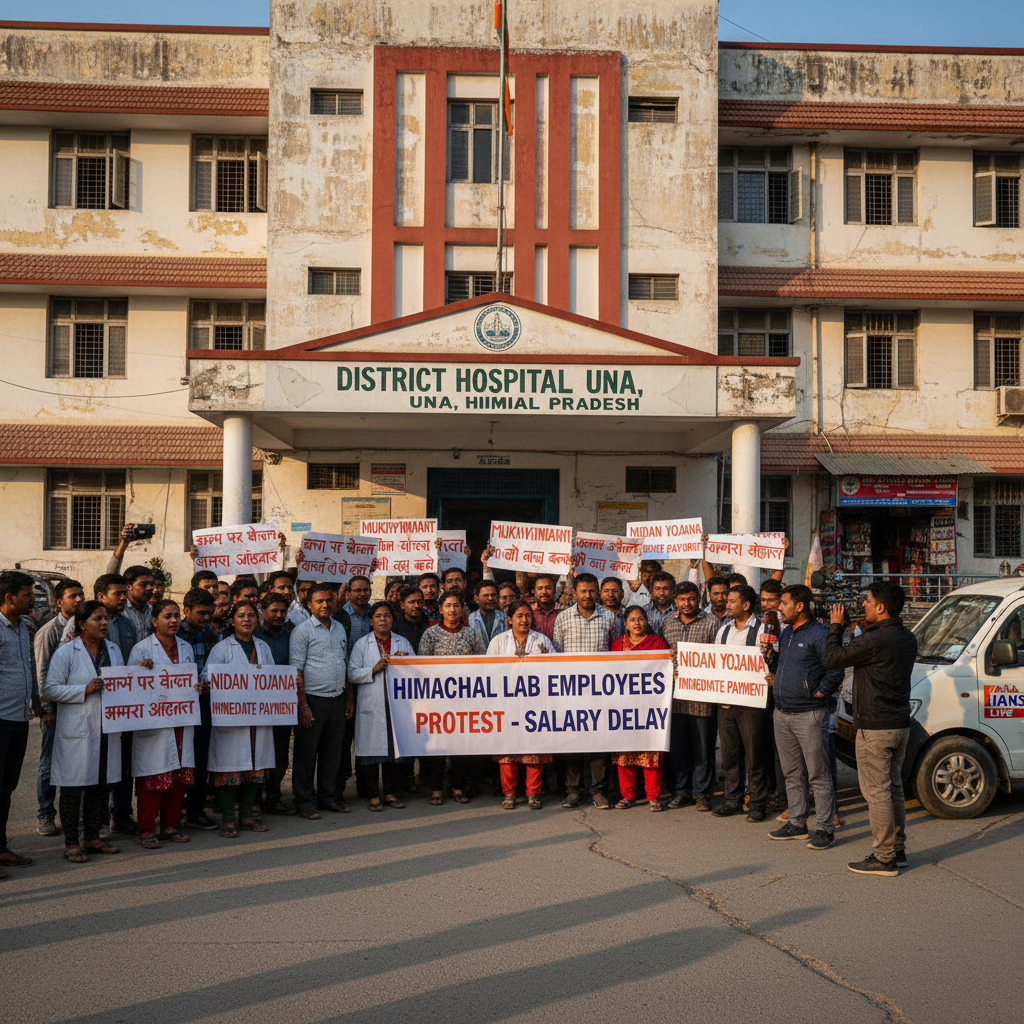
On 10 February 2026, a coordinated demonstration took place outside the District Hospital laboratory in Una, Himachal Pradesh, marking a significant escalation in the grievances of laboratory employees. Approximately sixty staff members gathered, brandishing placards that read “Timely Salary Is Our Right” and “Implement Mukhyamantri Nidan Yojana Now”. The protest was live‑streamed by IANS LIVE, drawing statewide attention to the issue. Employees alleged that their monthly salaries had been withheld for three consecutive months despite having filed formal applications and receiving verbal assurances from senior health officials that the funds would be released under the provisions of the Nidan Yojana. They contended that the delays were not mere administrative oversights but symptoms of deeper systemic failures in the state’s financial disbursement chain, jeopardising the livelihood of families dependent on these earnings for basic necessities such as food, education and medical expenses.
The demonstrators highlighted that the laboratory workforce in Una comprises over 120 personnel, including pathology technicians, microbiology researchers and data entry operators, all of whom are integral to the district’s diagnostic capabilities. The protest was organized by the Himachal Laboratory Employees Association, which claimed that similar salary delays were emerging in other districts, suggesting a pattern rather than isolated incidents.
Demands and Chants of the Protesters
During the rally, the employees presented a comprehensive set of demands that extended beyond the immediate request for salary clearance:
- Immediate credit of all pending salary amounts, including retroactive payments to be processed without further delay.
- Establishment of an independent grievance redressal cell dedicated to monitoring salary‑related complaints under the Mukhyamantri Nidan Yojana, providing a swift and transparent avenue for dispute resolution.
- Conduct of a comprehensive audit of the entire disbursement workflow, encompassing data entry, approval hierarchies and fund allocation processes, to identify bottlenecks and rectify procedural errors.
- Public commitment from the state government guaranteeing that future salary payments would adhere strictly to the stipulated release schedule, thereby preventing any recurrence of similar delays.
The chants of “Nidan Yojana” and “Immediate Payment” resonated throughout the gathering, reflecting the urgency and determination of the participants. Speakers also called for greater transparency in the release of funds, urging the finance department to publish monthly disbursement reports accessible to all employees.
Government’s Official Response
In the immediate aftermath of the Una protest, the Himachal Pradesh Department of Health and Family Welfare issued an official statement addressing the grievances of laboratory staff. The statement affirmed that the Mukhyamantri Nidan Yojana remains a top priority for the state government and assured that the outstanding salary amounts would be credited to the employees’ accounts within the next seven business days. To demonstrate its commitment to transparency, the department announced that it would conduct a thorough review of the disbursement workflow involving the Finance Department, the Human Resources Division and the State Treasury to pinpoint any procedural deficiencies that may have contributed to the delay. Additionally, the government pledged to deploy periodic monitoring committees comprising senior officials and elected representatives to oversee the timely execution of salary payments across all state‑run laboratories. These measures were framed as part of a broader strategy to reinforce accountability, enhance inter‑departmental coordination and restore confidence among public‑sector employees in the reliability of the Nidan Yojana’s financial provisions.
The response was also accompanied by a promise to issue a revised schedule for salary releases, effective from the next fiscal quarter, and to incorporate real‑time data analytics into the payment process. Stakeholders welcomed the proactive stance, while employee unions emphasized the need for legislative backing to enforce strict timelines.
Expert Analysis of the Yojana’s Implementation
Policy analysts have weighed in on both the strengths and vulnerabilities of the Mukhyamantri Nidan Yojana’s implementation, highlighting that while the scheme represents a progressive step toward targeted welfare support, its efficacy is contingent upon robust administrative oversight and adequate budgetary allocation. Dr. Anjali Sharma, a senior researcher at the Institute of Public Policy, emphasized that the Nidan Yojana provides a necessary safety net for laboratory personnel but its impact will be limited unless there is transparent tracking of fund releases and enforceable accountability mechanisms for delays.
Financial economists have warned that without systematic audits and real‑time monitoring, the scheme may be susceptible to bureaucratic inertia, leading to repeated salary arrears. Legal scholars have pointed out that the absence of a statutory enforcement clause could leave employees vulnerable to prolonged periods of non‑payment, underscoring the need for legislative reinforcement to guarantee timely disbursement.
From an implementation perspective, experts recommend integrating a digital dashboard that displays payment status, deadlines and pending arrears, accessible to both employees and oversight bodies. Such a system would enable early detection of bottlenecks and facilitate corrective actions before delays snowball into larger crises. Ultimately, the consensus among commentators is that the Nidan Yojana’s success hinges on its ability to combine clear performance metrics, transparent reporting and a culture of responsiveness within the state’s administrative apparatus.
Broader Implications for State Employees
The Una protest has ignited a broader conversation about labour rights for government employees throughout Himachal Pradesh, extending beyond the specific domain of laboratory staff. While the Mukhyamantri Nidan Yojana was originally designed to address the unique challenges faced by scientific personnel, the grievances raised by the demonstrators have resonated with teachers, nurses and clerical workers who also contend with irregular salary payments and inadequate benefits. Advocacy groups such as the Himachal Staff Welfare Forum have called upon the state government to consider expanding the protective umbrella of timely salary disbursement to encompass all public‑sector employees, arguing that equitable remuneration is a fundamental prerequisite for maintaining morale, ensuring service quality and upholding democratic principles of fair labour treatment.
Political analysts suggest that the current dispute may serve as a catalyst for comprehensive reforms in workforce management, prompting policymakers to revisit existing welfare frameworks, introduce standardized payment schedules and establish independent oversight bodies tasked with safeguarding the financial well‑being of all state employees. Some commentators also see an opportunity for the government to adopt best practices from other states that have successfully implemented automated salary disbursement systems, thereby reducing manual interventions and curbing delays.
Conclusion
In conclusion, the protest by laboratory employees in Una underscores the critical importance of reliable salary payment mechanisms for ensuring the smooth operation of state‑run health laboratories and preserving the integrity of public‑health services. As the Himachal Pradesh government moves to address the immediate salary arrears under the Mukhyamantri Nidan Yojana, the episode serves as a salient reminder of the broader need for transparent financial management, responsive grievance redressal and proactive administrative oversight within welfare schemes. Stakeholders — including employees, policy analysts and civil‑society organisations — share a common hope that the promised corrective actions will not only restore timely salary disbursements but also reinforce public confidence in the government’s commitment to its workforce and citizens alike. By strengthening the operational foundations of the Nidan Yojana, Himachal Pradesh has an opportunity to set a benchmark for efficient welfare implementation that can be emulated by other states seeking to enhance the well‑being of their public‑sector employees.
Stay updated with the latest Yojana schemes and government initiatives for better awareness and eligibility. For personalized guidance on accessing these benefits, reach out to us.