


Protest Overview
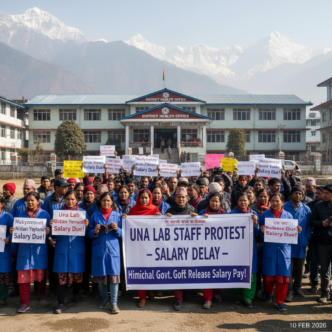
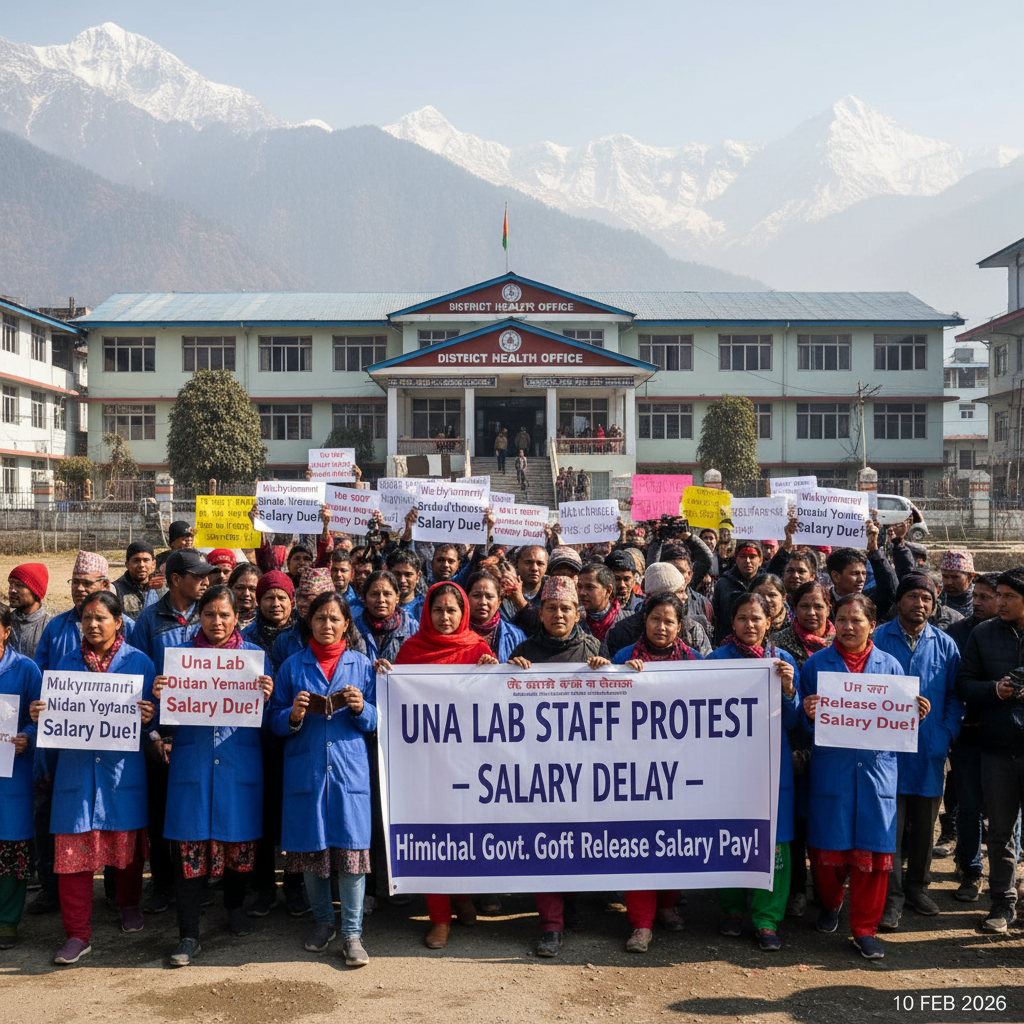
On Tuesday, 10 February 2026, more than three hundred laboratory technicians, data entry clerks and field assistants gathered outside the Una District Health Office to register a forceful protest against the delayed payment of salaries under the Mukhyamantri Nidan Yojana. The demonstrators, carrying placards that read “Release Our Dues Now” and “We Demand Timely Compensation,” demanded that the Himachal Pradesh government disburse the pending October, November and December 2025 instalments without further postponement. The rally, which commenced at 07:30 a.m., was peaceful yet assertive, with union leaders delivering speeches that highlighted the financial distress faced by families who rely on a monthly paycheck to meet basic household expenses. Police officials monitored the gathering closely, ensuring that the protest remained within the designated perimeter, while local media captured the scene for broadcast across regional news channels.
The protest was convened by the Himachal Pradesh Contractual Health Workers’ Union, a body that has been vocal about the precarious nature of contractual employment in the state’s health sector. In a press statement released on the eve of the demonstration, the union alleged that the salary delays were not an isolated administrative lapse but part of a systematic pattern of fiscal neglect that began after the scheme’s rollout in early 2023. Workers pointed to a series of unfulfilled assurances from the health department, including promises of monthly salary increments tied to performance metrics and seniority, which they claim have not been honoured since the beginning of the fiscal year. The demonstrators emphasized that the stakes extend beyond personal remuneration; they argue that delayed payments jeopardize staff morale, potentially leading to absenteeism that could disrupt diagnostic services across the district’s primary health centres (PHCs) and community health centres (CHCs).
Social media platforms saw a surge of activity as protestors live‑streamed the event, using hashtags such as #NidanSalaryDelay and #UnaHealthWorkers to mobilise support beyond the immediate locality. Within hours, messages of solidarity poured in from employees in neighboring districts, expressing concern that the issue could become a statewide crisis if left unresolved. Moreover, citizen groups and local NGOs issued statements urging the state government to adopt a transparent approach, insisting that the welfare of health‑care frontline staff is integral to the success of the broader public‑health agenda. The widespread attention underscores the growing intersection between labour rights and health‑service delivery in Himachal Pradesh’s pursuit of universal health coverage. 
Employees and the Mukhyamantri Nidan Yojana
The workforce at the centre of the dispute comprises contractually engaged laboratory technicians, data entry operators and field assistants who were recruited to reinforce diagnostic capabilities across rural health institutions in Himachal Pradesh. According to official recruitment notices released in 2023, these positions were offered on a temporary basis with the explicit promise of salary increments linked to performance appraisals, seniority and the successful completion of specified training modules. The contract terms stipulated a baseline monthly remuneration of INR 15,000, with incremental raises of up to 10 % every six months contingent upon meeting diagnostic throughput targets and maintaining zero error rates. While the contractual nature of the employment was acknowledged by the employees, many argued that the scheme’s design intended to treat these workers on par with regular staff in terms of job security and benefits, particularly given the critical role they play in ensuring timely laboratory results for patients suspected of infectious diseases such as dengue, malaria and COVID‑19.
Under the Mukhyamantri Nidan Yojana, the state government allocated dedicated budgetary resources to upgrade laboratory equipment, provide continuous skill‑development programmes and subsidise the salaries of contractual personnel to bridge the gap between temporary appointments and permanent civil service cadres. The scheme’s eligibility criteria required that participating districts demonstrate a minimum diagnostic workload, thereby justifying the deployment of additional technical staff. As a result, the employees view their contracts not merely as short‑term engagements but as integral components of a larger public‑health infrastructure aimed at reducing turnaround time for test results, enhancing disease surveillance and ultimately improving patient outcomes. In this context, the salary delay is perceived not only as a financial grievance but also as a breach of the contractual trust that underpins the scheme’s operational legitimacy.
Moreover, the workers highlighted that their remuneration is tied to performance‑based indicators that were explicitly outlined in the scheme’s policy document, which promised a “transparent salary progression framework” to motivate staff and retain expertise in remote locations where private sector opportunities are limited. Many technicians, especially those with advanced diplomas in clinical pathology or microbiology, have accrued several years of service and argue that the promised increments are essential for meeting the cost‑of‑living standards in Himachal’s hill towns, where housing, transportation and educational expenses for children add considerable financial pressure. The protest therefore reflects a broader discontent among contractual health workers who feel that their contributions are undervalued despite the scheme’s ambition to create a robust diagnostic network across the state’s diverse geography.
Public records obtained through a Right to Information (RTI) request revealed that the total outlay earmarked for contractual staff salaries under the Nidan Yojana amounted to approximately INR 120 crore annually, a figure that represents roughly 8 % of the scheme’s total budget. Despite this allocation, recent fiscal disclosures indicate that a significant portion of these funds remained unutilised due to delays in the release of state‑level grants, prompting the health department to reconsider the disbursement schedule. Employees contend that the lack of prior notification regarding such financial re‑allocations violates the principles of contractual good faith, as they were not given an opportunity to adjust their personal finances in anticipation of the delay. Consequently, the union has called for a formal audit of the budgetary flow to ensure that earmarked funds are transparently accounted for and that any re‑allocation is communicated well in advance to avoid sudden payment disruptions. The issue also touches on broader concerns in contractual employment, where workers seek greater protection against fiscal volatility.
Government Response and Way Forward
In response to the mounting pressure, Himachal Pradesh Health Minister Jagat Singh Negi addressed the media on 12 February 2026, acknowledging the legitimacy of the workers’ grievances and confirming that the issue is currently under active review. The minister indicated that the finance department is exploring several avenues to release the pending dues, including the reprioritisation of unused budgetary allocations from the rural development sector and the utilisation of contingency funds from the state disaster‑relief reserve. While acknowledging the fiscal constraints, Negi assured that the government remains committed to safeguarding the welfare of contractual health workers and emphasized that any decision will be guided by the principle of ensuring uninterrupted diagnostic services for citizens across Una and the wider state.
Following the ministerial statement, an inter‑departmental fast‑track committee was constituted, comprising senior officials from the Health Services Directorate, the Finance Department, and representatives of the contractual workers’ union. The committee’s mandate is to devise a concrete roadmap for salary disbursement, which may involve a phased release of arrears, the introduction of a bi‑annual salary reconciliation process, and the establishment of a dedicated fund for contractual employee remuneration that would be insulated from ad‑hoc fiscal maneuvers. In addition, the panel has pledged to draft a revised policy framework that would formally incorporate contractual staff into the regular payroll matrix, thereby granting them eligibility for standard benefits such as medical insurance, pension contributions and periodic salary increments based on tenure.
Stakeholders have suggested that the state could adopt best practices from other Indian states that have successfully navigated similar contractual‑employment challenges within health schemes. For instance, Kerala’s “Aadharitha Karmikam” model, which guarantees a minimum wage for contract workers and includes a statutory grievance redressal mechanism, has been cited as a roadmap for ensuring financial predictability. By studying such examples, Himachal Pradesh may be able to formulate a sustainable compensation structure that aligns with the objectives of the Nidan Yojana while protecting the rights of its workforce. Moreover, experts recommend that periodic financial audits and transparent reporting of budget utilisation could pre‑empt future salary delays, thereby strengthening public confidence in government‑run health initiatives.
Beyond immediate remediation, the committee has committed to engaging with citizen groups and academic institutions to conduct a impact assessment of the Nidan Yojana’s diagnostic outcomes, correlating them with staffing levels and remuneration stability. Preliminary findings suggest that a 15 % decline in staff availability could result in a 30 % increase in turnaround time for critical tests, potentially compromising early detection of outbreaks in remote villages. Consequently, the government’s long‑term strategy may involve expanding the pool of trained technicians, investing in automated laboratory equipment that reduces manual workload, and instituting a performance‑linked incentive scheme that rewards timely salary payments as a key performance indicator. Such forward‑looking measures aim to transform the current crisis into an opportunity to institutionalise fair labour practices within the state’s health‑delivery ecosystem.
Implications and Path Ahead
The ongoing impasse over salary payments under the Mukhyamantri Nidan Yojana carries far‑reaching implications for Himachal Pradesh’s public‑health landscape, especially in districts like Una where laboratory services serve as the backbone of disease surveillance in remote, hilly terrains. Health experts warn that prolonged payment delays could erode employee morale, leading to an upsurge in absenteeism, turnover and, ultimately, a shortage of qualified technicians at a time when the state is striving to expand its diagnostic footprint. Given that the Nidan Yojana was launched to curb diagnostic turnaround times from an average of 48 hours to under 24 hours, any disruption in staffing could reverse these gains and jeopardise timely treatment for patients suffering from infectious diseases that demand swift laboratory confirmation. Moreover, the ripple effect could extend to private clinics and referral hospitals that depend on consistent test results from public health labs, thereby amplifying the crisis across the entire healthcare supply chain.
Citizen impact is equally significant: delays in diagnostic services can lead to prolonged patient wait times, unnecessary referrals to tertiary care centres, and increased healthcare costs for families already grappling with economic hardship. In rural communities where private laboratory facilities are scarce, the public health labs funded under the Nidan Yojana are often the sole point of contact for essential diagnostic testing. If the contractual workforce were to withdraw services in protest, patients might face heightened risks of undiagnosed conditions, delayed treatment, and potential complications. As such, the resolution of this labour dispute is not merely a matter of bureaucratic accountability but a critical determinant of health outcomes for thousands of residents across Himachal’s geographically dispersed population. The stakes are magnified when considering the broader goal of achieving universal health coverage across the state’s varied topography.
From a policy perspective, the situation underscores the necessity for robust legislative safeguards that protect contractual employees from fiscal volatility. Legal scholars suggest that incorporating explicit clauses in employment contracts that guarantee timely remuneration, even in the event of budgetary reallocations, would mitigate the risk of recurring disputes. Additionally, establishing an independent grievance redressal authority, empowered to enforce timely salary payments, could provide a safety net for workers while preserving the state’s fiscal responsibilities. Such reforms would align Himachal Pradesh with the broader national discourse on contractual employment rights, which has gained momentum following the implementation of the Code on Social Security (2020) in India, aimed at extending social protection to gig and contract workers.
Looking forward, the trajectory of the Una protest will likely influence similar movements in other districts where contractual health personnel have voiced concerns about payment irregularities. If the government succeeds in delivering the overdue salaries and institutionalising a transparent compensation framework, it may foster a more cooperative relationship between the administration and frontline staff, paving the way for smoother implementation of future health initiatives. Conversely, a failure to address the core demands could catalyse a broader statewide strike, potentially halting diagnostic services across multiple districts and drawing national media attention to the challenges faced by contractual workers in public health schemes. In either scenario, the outcome will serve as a bellwether for how Himachal Pradesh balances fiscal prudence with the welfare of its health workforce, offering valuable lessons for other states navigating similar intersections of labour rights and public‑health policy.
In conclusion, the salary‑delay protest by laboratory staff in Una encapsulates the complex dynamics of contractual employment, fiscal management and public‑health delivery within the framework of the Mukhyamantri Nidan Yojana. While the scheme has made notable strides in enhancing diagnostic capacity across Himachal Pradesh, its sustainability ultimately hinges on the timely remuneration of the workforce that drives its operations. The ongoing negotiations between the state government, the finance department and employee unions present an opportunity to reinforce a mutually beneficial partnership that safeguards both fiscal accountability and the rights of contractual workers. As the administration works toward a durable solution, the eyes of citizens, health professionals and policy analysts remain fixed on the path forward, hoping for a swift resolution that restores confidence in the Nidan Yojana and ensures that the promise of universal health coverage is upheld for every corner of the state.
Stay updated with the latest Yojana schemes and government initiatives for better awareness and eligibility. For personalized guidance on accessing these benefits, reach out to us.