


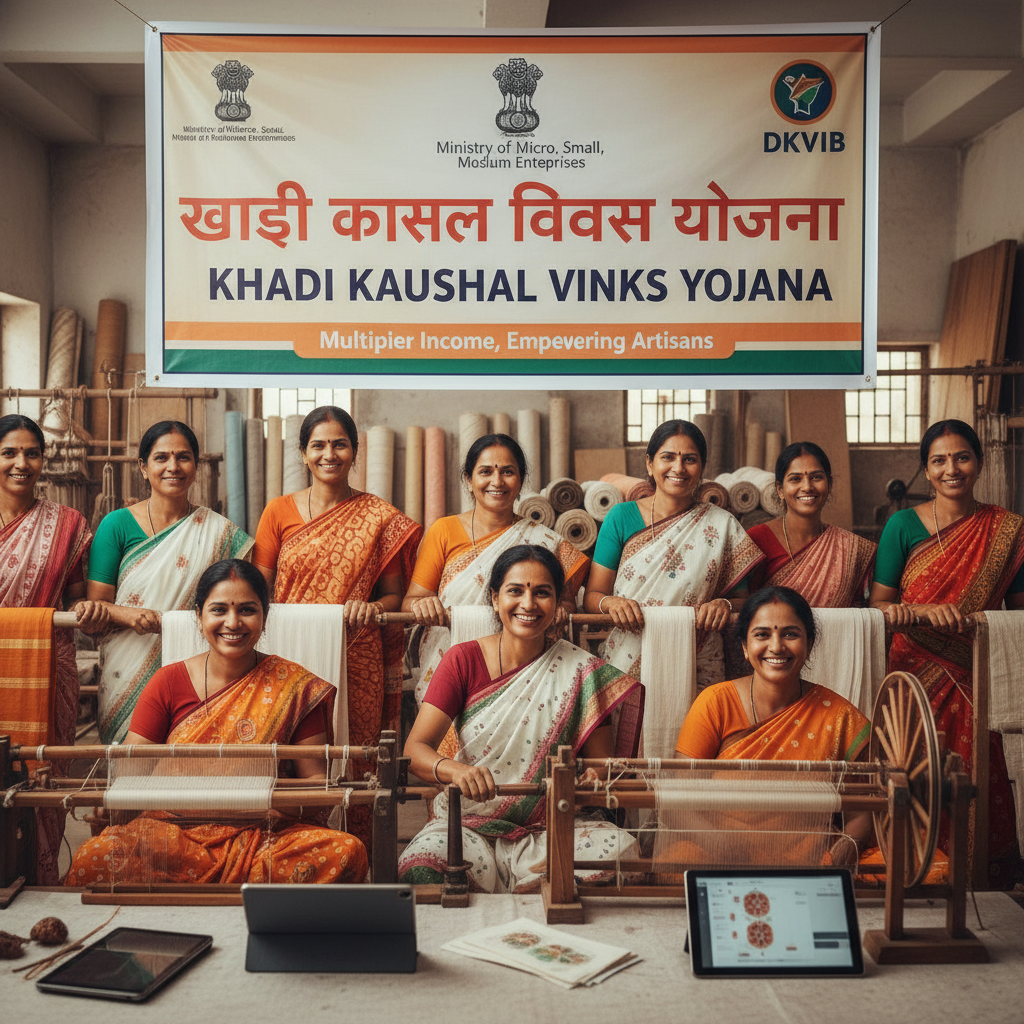
Introduction to Khadi Kaushal Vikas Yojana
The Ministry of Micro, Small and Medium Enterprises (MSME) through its implementing arm, the Khadi and Village Industries Commission (KVIC), has recently cleared the Khadi Kaushal Vikas Yojana. The programme is designed to upskill artisans engaged in khadi production across the country, improve product quality, expand market access and ensure a sustainable livelihood for traditional craftsmen. By integrating modern techniques with age‑old craftsmanship, the scheme aims to revitalise the khadi sector while preserving its cultural heritage. Recent data from the KVIC shows that over 1.2 million artisans are currently employed in khadi units, many of whom face challenges related to skill obsolescence and limited market exposure.
- Target beneficiaries include weavers, dyers, embroiderers and other khadi workers
- Training modules cover modern weaving techniques, design innovation and business management
- Eligibility is open to individuals aged eighteen to sixty five who hold a valid khadi registration
Objectives and Implementation Strategy
The primary objective of the Yojana is to multiply the income of khadi artisans by up to thirty percent through skill enhancement and diversification. The rollout plan spans fiscal years 2025 to 2028 and follows a three‑phase approach. Phase one (2025‑2026) focuses on capacity building in identified clusters of Uttar Pradesh, Gujarat and Himachal Pradesh, where khadi production is concentrated. Phase two (2026‑2027) introduces entrepreneurship workshops and market linkage events, while Phase three (2027‑2028) involves rigorous monitoring, evaluation and scaling up of successful pilot projects. Funding for the initiative is sourced from the central government’s allocation for KVIC and supplemented by corporate social responsibility (CSR) contributions. The total outlay for the first two years is estimated at INR 1,200 crore, underscoring the government’s commitment to revitalising rural artisanship.
For more details on the KVIC’s role, see the KVIC Wikipedia page. 
Training Curriculum and Skill Development
Curriculum development has been undertaken by a consortium of textile institutes, industry experts and academic partners. Core modules include advanced loom operation, sustainable raw material sourcing, digital marketing and financial literacy. Hands‑on workshops will be conducted at regional training centres equipped with state‑of‑the‑art machinery, ensuring that participants gain practical experience with modern equipment. An online learning portal will complement classroom instruction, allowing artisans to upgrade skills continuously. Special emphasis is placed on gender inclusivity; dedicated slots are reserved for women artisans to encourage their participation in decision‑making roles within cooperatives. The curriculum also incorporates modules on design innovation that blend traditional motifs with contemporary aesthetics, preparing trainees for evolving market demands.
Market Linkage and Product Innovation
Skill development alone is insufficient without robust market linkage. The Yojana integrates a comprehensive market outreach strategy that includes participation in national trade fairs, listings on e‑commerce platforms and collaborations with fashion designers for contemporary product lines. A digital catalog will be created to showcase innovative designs that marry traditional motifs with modern aesthetics, facilitating wider visibility. Partnerships with retail chains specializing in ethically sourced textiles will strengthen distribution channels, expanding the consumer base beyond domestic markets to include premium international buyers. By linking artisans with high‑value markets, the scheme aims to translate skill gains into tangible income growth for rural households.
Monitoring, Evaluation and Grievance Redressal
A dedicated monitoring unit will track key performance indicators such as the number of beneficiaries trained, post‑training income levels and market penetration metrics. Independent audits will be commissioned annually to assess financial utilization and impact assessment, ensuring transparency and accountability. Grievance redressal mechanisms are being established at the district level, featuring a toll‑free helpline and an online portal where artisans can report issues related to training quality, payment delays or procurement disputes. This feedback loop is intended to address bottlenecks promptly and improve the overall effectiveness of the programme.
Expected Socio‑Economic Impact
Policymakers anticipate that the Khadi Kaushal Vikas Yojana will generate direct employment for an estimated 150,000 artisans and create indirect jobs in allied sectors such as transportation, packaging and marketing. By preserving traditional craftsmanship while introducing modern practices, the scheme aims to safeguard cultural heritage while improving living standards in rural communities. Successful implementation could serve as a replicable model for other skill‑development programmes in the handloom and handicraft sectors across India. The initiative also aligns with broader national goals of rural entrepreneurship and sustainable industrialisation, contributing to the “Make in India” agenda.
Financial Incentives and Support
Under the Yojana each beneficiary will receive a stipend of INR 15,000 for the duration of the training program, along with a toolkit grant to purchase modern equipment. Additionally, a performance‑linked incentive of up to INR 50,000 will be provided upon successful completion of the final assessment and demonstration of market‑ready products. These financial supports are designed to offset living expenses and encourage full‑time participation in skill upgradation. By reducing economic barriers, the scheme ensures that artisans can focus on learning and innovation without the burden of financial uncertainty.
Stakeholder Engagement and Partnerships
The implementation of the scheme follows a multi‑stakeholder framework that includes the KVIC, state khadi boards, non‑governmental organisations (NGOs) and private sector partners. NGOs play a crucial role in mobilising community participation and delivering on‑ground training, while private corporations contribute through CSR funds and by offering internship opportunities for trainees in design and marketing departments. Academic institutions such as the National Institute of Fashion Technology (NIFT) have pledged research support for innovative product development and to conduct impact‑evaluation studies over the coming years. These collaborations ensure that the programme benefits from diverse expertise and resources.
Case Studies from Pilot Regions
Early results from pilot clusters validate the scalability of the Yojana. In the Ludhiana cluster of Punjab, a group of twenty‑five weavers who completed the first phase of training reported an average income increase of twenty‑eight percent within six months. Similarly, in the Chamoli district of Uttarakhand, women artisans introduced new embroidery techniques that have already entered the boutique segment of Delhi‑based retailers. These success stories illustrate the tangible benefits of skill enhancement and market linkage, providing valuable lessons for refining training modules and expanding outreach.
Future Outlook and Expansion Plans
The Ministry plans to extend the Yojana to additional states with high concentrations of khadi production, including Rajasthan and Madhya Pradesh, by the fiscal year 2027. Expansion will be accompanied by a revised curriculum that incorporates emerging trends such as sustainable dyeing methods and digital storytelling for brand building. Continuous feedback loops with beneficiaries will ensure that the programme remains responsive to evolving industry demands. As the initiative gains momentum, it is expected to create a ripple effect of economic empowerment across rural India, fostering a new generation of skilled artisans who can compete in both domestic and global markets.
Stay updated with the latest Yojana schemes and government initiatives for better awareness and eligibility. For personalized guidance on accessing these benefits, reach out to us.