



Congress Walkout Over Laadli Behna Yojana Sparks Political Clash in Madhya Pradesh Assembly
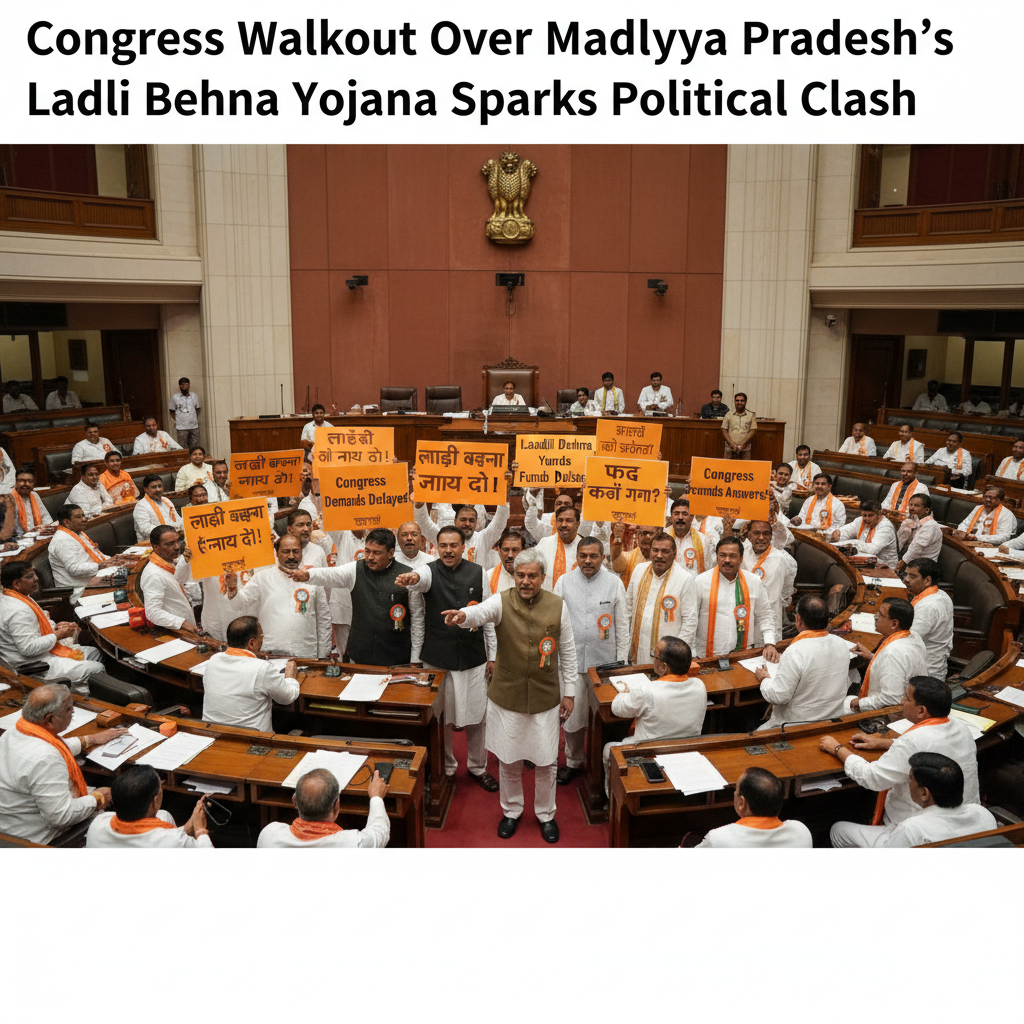
The Indian National Congress staged a dramatic walkout during the recent session of the Madhya Pradesh Legislative Assembly, protesting what party leaders describe as the undue delay in the disbursement of benefits under the Laadli Behna Yojana. The scheme, launched by the state government to empower women from economically disadvantaged families, promises a monthly cash transfer of Rs 1000 to eligible female beneficiaries. Congress legislators argued that the state’s failure to release the funds on schedule reflects a broader neglect of women’s welfare programs and called for immediate corrective action. The protest, widely reported as the Laadli Behna Yojana protest, disrupted the assembly’s agenda for nearly thirty minutes before the Speaker intervened and requested a return to the scheduled items.
Understanding the Laadli Behna Yojana
Introduced in the fiscal year 2023‑24, the Laadli Behna Yojana targets women aged 25 to 60 who belong to families living below the poverty line. Eligibility criteria include a family income ceiling of Rs 2 lakh per annum and the requirement that the applicant possess a valid Aadhaar card linked to a bank account. According to official data released by the Department of Women and Child Welfare, more than 1.5 million women have been enrolled in the programme, with the state projecting a total outlay of Rs 18,000 crore over the next five years. The scheme’s primary objective is to improve financial independence, nutrition and education prospects for women who otherwise lack stable sources of income. More details can be found on the Press Information Bureau website.
- Monthly cash transfer of Rs 1,000 to eligible beneficiaries
- Target group: women aged 25‑60 from families with income ≤ Rs 2 lakh
- Requirement of Aadhaar‑linked bank account
- Projected five‑year outlay: Rs 18,000 crore
- Over 1.5 million women already enrolled
Congress Protest and Demands
During the walkout, Congress members raised slogans demanding transparency in the allocation and monitoring of funds, and they accused the ruling Bharatiya Janata Party (BJP) of politicising the initiative for electoral gains. Party leader Kamal Nath addressed the assembly, stating that “the promise of modern India cannot be fulfilled while the most vulnerable women continue to wait for the assistance they deserve.” The protest highlighted several grievances: 
- Delayed release of the first instalment for many beneficiaries
- Lack of clear communication about eligibility verification
- Inadequate grievance redressal mechanisms
- Perceived politicisation of welfare schemes for electoral advantage
The walkout lasted for nearly thirty minutes before the Speaker intervened and requested a return to the scheduled agenda. Critics argue that the Laadli Behna Yojana protest is part of a larger pattern of opposition parties using parliamentary disruption to force accountability.
Government Response and Implementation Status
In response, the state’s chief minister, Shivraj Singh Chouhan, defended the programme’s rollout, emphasizing that the government has already transferred funds to over 800,000 beneficiaries in the current quarter. He highlighted that the delay originated from technical glitches in the banking interface and that corrective measures are underway to ensure seamless credit of the monthly instalments. The chief minister also asserted that the administration remains committed to expanding the scheme’s coverage to include additional marginalised groups in the coming months. Officials pointed to the Madhya Pradesh Women’s Resource Centre as the primary portal for beneficiary updates and grievance filing.
- Funds transferred to 800,000+ beneficiaries this quarter
- Technical issues identified in the bank‑government interface
- Plans to upgrade the digital payment gateway by Q3 2025
- Commitment to enlarge eligibility to include additional marginalised groups
Expert Opinions and Future Outlook
Analysts from the Center for Development Studies pointed out that while the Laadli Behna Yojana aligns with national objectives of gender equity and poverty alleviation, its implementation faces challenges related to data accuracy, beneficiary verification and grievance redressal mechanisms. They recommended that the state adopt a more robust digital tracking system to reduce leakages and improve accountability. Economists at the National Institute of Public Finance and Policy estimated that each rupee transferred under the scheme could generate up to three rupees of additional economic activity through multiplier effects, provided that the funds are channelled into productive expenditures. However, concerns remain about fiscal sustainability, especially as the state grapples with debt servicing costs and other competing development priorities. A recent report by the National Institute of Public Finance and Policy underscores the need for transparent monitoring.
- Data accuracy and beneficiary verification remain critical
- Need for stronger grievance redressal channels
- Potential fiscal strain on state budget
- Opportunity for economic multiplier effect
Looking ahead, policymakers are expected to convene a high‑level review committee to assess implementation bottlenecks and to propose legislative amendments that streamline fund disbursement. The committee’s terms of reference include evaluating the efficacy of the current bank‑centric model, exploring alternative direct cash transfer mechanisms, and recommending measures to enhance beneficiary outreach. Stakeholders from NGOs, financial institutions and academic institutions are likely to participate in the deliberations, aiming to forge a consensus on best practices for similar welfare programmes across the country.
Stay updated with the latest Yojana schemes and government initiatives for better awareness and eligibility. For personalized guidance on accessing these benefits, reach out to us.