



Centre halts fortified rice supply in welfare schemes
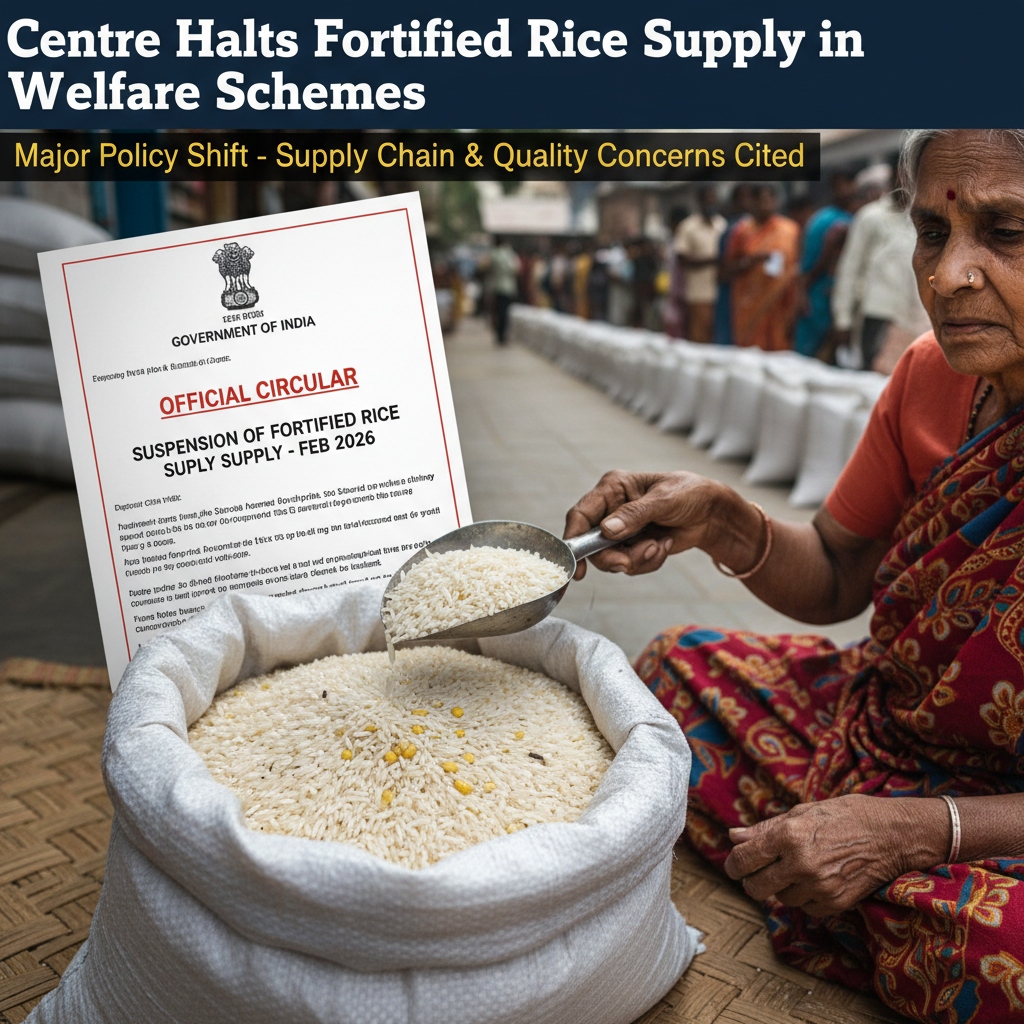
The central government announced a temporary suspension of fortified rice distribution across key welfare programmes, including the Public Distribution System (PDS), Pradhan Mantri Garib Kalyan Yojana (PMGKAY) and the Antyodaya Anna Yojana (AAY). The decision, disclosed in an official circular dated 26 February 2026, cites supply‑chain disruptions and concerns over the uniformity of fortified grain quality as the primary reasons for the halt. Authorities stress that the pause is intended to safeguard the nutritional integrity of the programme rather than to cancel it permanently.
Under the circular, all state‑level distribution agencies were instructed to halt the release of fortified rice stocks until a comprehensive audit is completed. The order applies to both freshly milled grains and existing buffer stocks that are yet to be dispatched to fair‑price shops. While the suspension affects millions of households, officials emphasise that the measure is precautionary and that the distribution will resume once the audit validates that all fortified rice meets the prescribed micronutrient standards.
Political observers note that the move comes at a time when the government is preparing for the upcoming budget session, and the issue is likely to be debated vigorously in parliament. Opposition parties have already begun to question the administration’s handling of food‑security initiatives, while supporters in the ruling coalition frame the suspension as a responsible step to protect the programme’s credibility. 
Beneficiaries across the country have been advised to stay tuned to official communications from their respective state food departments for updates on the resumption of supplies. In the meantime, many households are exploring alternative sources of nutrition through local markets or community‑run schemes.
Why fortified rice matters for public health
Fortified rice, enriched with iron, vitamin A, folic acid and other micronutrients, serves as a cornerstone of India’s strategy to combat anaemia and micronutrient deficiencies among low‑income households. According to the Ministry of Health and Family Welfare, more than 100 million beneficiaries have been receiving fortified rice under various schemes, a figure that underscores the programme’s extensive reach and its critical role in improving public health outcomes nationwide.
Iron‑deficiency anaemia remains a pressing concern, especially among women of reproductive age and young children. National Family Health Survey (NFHS‑5) data reveal that nearly 57 % of Indian women aged 15‑49 are anaemic, a condition linked to reduced cognitive development, poorer pregnancy outcomes and lower labour productivity. By delivering rice fortified with iron and folic acid, the government aims to close this nutritional gap without requiring major changes to dietary habits.
Beyond anaemia, fortification addresses other deficiencies such as vitamin A deficiency, which can lead to night blindness and increased susceptibility to infections. The World Health Organization (WHO) recognises fortified staple foods as one of the most cost‑effective interventions for improving micronutrient status at the population level. Consequently, the fortified rice initiative is viewed not merely as a welfare measure but as a public‑health imperative that aligns with India’s broader nutrition security goals.
Reasons behind the suspension and audit programme
Officials from the Ministry of Consumer Affairs explained that the suspension is not a permanent discontinuation but a pause to allow for a comprehensive audit of the fortification process. The audit will involve third‑party laboratory testing, a review of vendor certifications, and an assessment of storage conditions across depots to ensure that all fortified grains meet the stipulated nutritional standards before they are released for distribution.
Recent reports of contamination in certain batches of fortified rice have prompted the Food Safety and Standards Authority of India (FSSAI) to issue a showcause notice to several manufacturers. Preliminary investigations indicate that a small percentage of consignments may have failed to meet the mandated iron and folic acid levels, raising concerns about potential health risks if consumed at scale. These findings have heightened scrutiny of the entire supply chain, from raw paddy procurement to final milling and packaging.
The official circular also highlighted supply‑chain disruptions caused by logistics bottlenecks and fluctuating raw‑material availability. Transport delays, regional inventory mismatches and the impact of seasonal weather events have collectively contributed to an uneven distribution of fortified rice stocks. To mitigate these challenges, the government has announced a joint task force comprising representatives from the Ministry of Consumer Affairs, state food departments and independent experts.
For a deeper understanding of the regulatory framework, you can refer to the FSSAI’s guidelines on food fortification and the Ministry’s detailed circular on the suspension of fortified rice supply.
Alternative nutrition measures and state‑level responses
In the interim, state governments have begun exploring stop‑gap measures to ensure continuity of nutrition support. Some states have proposed distributing fortified pulses and fortified wheat blends as alternatives, while others are considering temporary supplementation of iron and folic acid tablets alongside regular rice rations. Pilot projects in Maharashtra, Bihar and Rajasthan are reportedly being evaluated for scalability, and early results suggest that these measures can mitigate the short‑term impact on beneficiary households.
For example, the Maharashtra Food and Civil Supplies Department has started a pilot where fortified soy‑based pulses are packaged and supplied to PDS outlets in five districts. In Bihar, the state health department is distributing weekly iron‑folic acid (IFA) tablets to all AAY beneficiaries as a complementary intervention. Rajasthan, on the other hand, is experimenting with a blended wheat‑fortified flour that can be mixed with regular wheat to increase micronutrient content without altering taste.
These alternative approaches are not meant to replace fortified rice but to bridge the nutrition gap while the audit and quality‑control processes are underway. State officials emphasise that the temporary measures are being closely monitored for efficacy, and lessons learned will inform a more robust, long‑term strategy once fortified rice supply resumes.
For further reading on nutrition‑security alternatives, see the WHO fact sheet on micronutrient deficiency and the NITI Aayog policy paper on fortified foods.
Industry reaction, audit timeline and what beneficiaries can expect
Industry stakeholders, including major grain millers and fortification technology providers, have pledged cooperation with the audit process. Representatives from the Rice Fortification Industry Association emphasised that the sector has robust quality‑control mechanisms in place and is eager to address any gaps identified. They also called for clear timelines to restore supply, citing the need to minimise disruption to millions of beneficiaries who rely on fortified rice for essential micronutrients.
In response to industry requests, the Ministry of Consumer Affairs has announced that a review committee will be formed to examine the audit findings and develop a roadmap for reinstating fortified rice distribution. This committee is expected to submit its report within 90 days, after which a revised schedule for resumption may be announced. Until then, beneficiaries are advised to monitor official communications for updates on scheme operations, and to explore alternative nutrition support options being made available by state agencies.
Political analysts predict that the issue will feature prominently in parliamentary debates, with queries directed at the Minister of Consumer Affairs regarding the timeline for reinstating fortified rice distribution. Meanwhile, civil‑society groups have called for greater transparency in the audit process, urging the government to publish detailed findings and corrective action plans to rebuild public trust.
For the latest official updates, you may visit the Ministry of Consumer Affairs portal at consumeraffairs.gov.in, and keep an eye on press releases from the Food Safety and Standards Authority of India (FSSAI).
Stay updated with the latest Yojana schemes and government initiatives for better awareness and eligibility. For personalized guidance on accessing these benefits, reach out to us.