



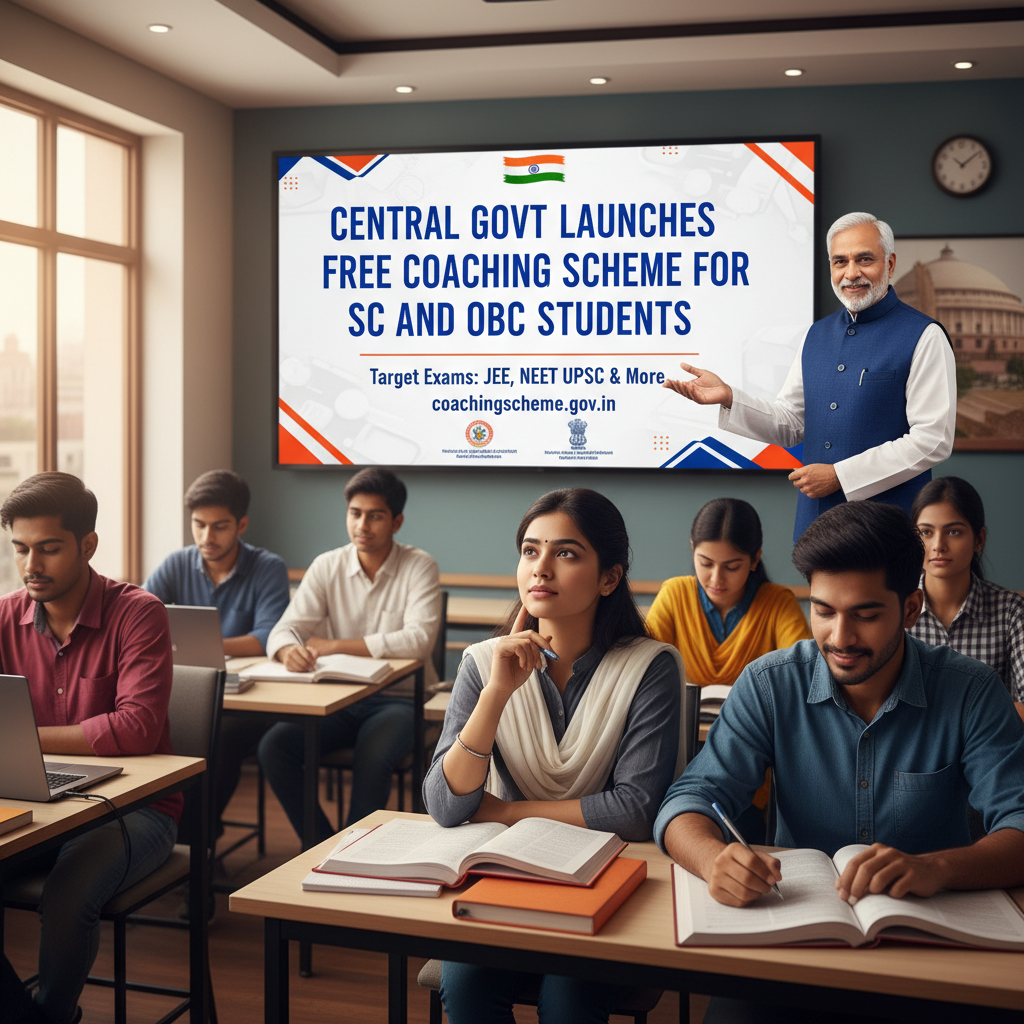
Central Govt Launches Free Coaching Scheme for SC and OBC Students
The Ministry of Education, together with the Ministry of Social Justice and Empowerment, has announced a flagship Free Coaching Scheme for SC and OBC Students that will provide completely tuition‑free preparation for a wide range of national entrance examinations. Beginning this fiscal year, the initiative targets high‑potential candidates from economically weaker sections whose annual family income does not exceed ₹8 lakh. By covering engineering, medical, civil services and emerging professional exams, the programme seeks to remove the financial barrier that has historically limited access to premium coaching for Scheduled Caste and Other Backward Class aspirants. Real‑time data from the previous year shows that only 12 % of eligible SC and OBC students could afford private coaching; the new scheme aims to raise that figure dramatically, fostering greater social equity and expanding the pipeline of talented professionals across the country.
Eligibility and Application Process
Students who have completed Class 12 or its equivalent and hold a valid caste certificate are eligible, provided their family’s gross annual income stays below the ₹8 lakh threshold. Applicants must submit their documents—academic transcripts, income certificates, caste certificates, and a recent passport‑size photograph—through the official portal coachingscheme.gov.in during the application window, typically from 15 February to 30 March each year. Following verification, candidates sit for an online aptitude test; those who clear it are placed on a merit list and allowed to choose from a roster of empanelled coaching centres. The seat allocation follows a transparent first‑come‑first‑served basis, with a predetermined distribution: 60 % of seats for engineering aspirants, 30 % for medical aspirants, and the remaining 10 % for other categories such as civil services and emerging professional exams. In high‑demand periods, a waiting list is maintained, and candidates are offered alternative centres or subject streams to ensure no seat goes unfilled.
Coaching Centers and Curriculum
The Ministry has empanelled over 150 premium coaching institutes across metropolitan hubs—including Delhi, Mumbai, Bengaluru, and Hyderabad—as well as tier‑2 cities like Lucknow, Jaipur, and Cochin. These centres have been vetted for academic excellence, state‑of‑the‑art infrastructure, and a proven track record in competitive exam preparation. The curriculum, aligned with the latest exam patterns for JEE, NEET, UPSC, banking and defence services, comprises regular classroom sessions, live online lectures, mock examinations, and intensive doubt‑clearing workshops. Periodic reviews by subject‑area experts ensure that study material stays current with evolving test formats. 
Each enrolled student receives a monthly stipend of ₹5,000, disbursed directly into their bank account after attendance and academic progress are verified. The funds are earmarked for purchasing reference books, study materials, and travel to the coaching centre. High‑performing candidates may also qualify for supplemental grants that cover participation in summer camps, research internships, or national‑level hackathons, thereby enriching their academic and professional development.
Support Structure and Monitoring
To ensure accountability and continuous improvement, every participating centre appoints a senior faculty mentor who monitors attendance, academic performance, and overall well‑being of each cohort. Quarterly review meetings, convened by regional officers of the Ministry, assess key performance indicators such as attendance rates, pass percentages, and stipend utilization. These meetings also serve as platforms for sharing best practices and addressing logistical challenges faced by the centres.
The Ministry has launched an interactive dashboard on its official website that visualizes real‑time data on enrolment numbers, gender distribution, and course completion rates. This transparency tool enables stakeholders—including parents, community leaders, and civil society organisations—to track the scheme’s impact and hold authorities accountable. In the event of discrepancies, corrective actions such as re‑allocating seats or providing additional funding to under‑utilised centres are swiftly implemented.
Impact on Social Equity
Historical data reveals a stark disparity in coaching accessibility for SC and OBC students prior to this initiative. In 2022, only approximately 12 % of eligible candidates could afford private coaching, resulting in significantly lower qualifying rates in national examinations. Pilot implementations in 2023 and 2024 demonstrated a 27 % increase in pass percentages among participants who benefitted from the free coaching model, underscoring the scheme’s capacity to level the playing field.
Beyond examination success, the programme is expected to catalyse broader socio‑economic upliftment. Increased representation of SC and OBC graduates in engineering, medical, and civil services will diversify professional landscapes and inspire younger aspirants from marginalized communities to pursue higher education. Moreover, higher earning potential for these graduates contributes to improved household incomes, better community infrastructure, and a more inclusive national economy.
Success Stories
One standout example is Priya Sharma, an OBC candidate from Bhopal, who secured an All‑India Rank of 85 in the NEET exam after completing the free coaching programme. Facing daily financial constraints, Priya leveraged the monthly stipend to purchase essential study materials and travelled to a centre in Indore for practical sessions. Her achievement not only fulfilled a personal ambition of becoming a doctor but also inspired several peers in her locality to consider the scheme.
Another compelling narrative comes from Arjun Patel, an SC student from Ahmedabad, who cleared the JEE Main exam with a score of 285. Arjun attributes his success to the structured curriculum, regular mock tests, and dedicated mentorship he received at his empanelled coaching centre. Both stories illustrate how targeted financial support and high‑quality instruction can transform the educational trajectories of talented but under‑privileged students.
Funding Mechanism
The financial outlay for the scheme is projected at ₹2,500 crore for the inaugural fiscal year, sourced from the Central Budget’s allocation for higher education and social welfare programmes. Funds are earmarked for coaching institute empanelment, stipend disbursement, technological infrastructure for online sessions, and administrative overheads. A rigorous audit framework, overseen by the Comptroller and Auditor General (CAG), ensures that expenditures adhere strictly to approved budgetary parameters. Annual audit reports will be published on the Ministry’s website, enhancing transparency and public trust.
Challenges and Mitigation Strategies
Implementation hurdles include guaranteeing equitable geographic distribution of coaching centres, addressing internet connectivity gaps in remote regions, and maintaining consistent teaching standards across all empanelled institutes. To mitigate these challenges, the Ministry plans to partner with telecom operators to provide subsidised broadband services, deploy mobile coaching vans that travel to underserved villages, and institute a continuous professional development programme for faculty members. Additionally, a grievance redressal mechanism has been established to promptly address any concerns raised by students or coaching centres.
Future Outlook
Looking ahead, the scheme is slated for expansion in the upcoming fiscal year, with intentions to broaden the spectrum of exam categories to include banking, defence services, data science, and artificial intelligence. The Ministry is also exploring public‑private partnership models to diversify funding sources and enhance infrastructure quality. Stakeholders anticipate that, if sustainably administered, the programme could significantly improve the socioeconomic status of millions of SC and OBC families over the next decade, fostering a more inclusive and equitable professional landscape.
How to Maximize Benefits
Prospective applicants are encouraged to prepare meticulously for the aptitude test by reviewing previous years’ question papers and attempting mock examinations. Consistent attendance, active participation in doubt‑clearing sessions, and judicious use of the monthly stipend for study materials can markedly enhance performance. Candidates should also network with alumni and mentors associated with the scheme to gain nuanced insights into exam strategies and long‑term career planning.
Contact Information
For any queries regarding eligibility, application procedures, or scheme benefits, candidates can visit the official portal or contact the dedicated helpline at 1800‑COACH‑HELP. Email support is also available at [email protected]. Local district education offices can assist with document verification and provide on‑ground guidance.
Stay updated with the latest Yojana schemes and government initiatives for better awareness and eligibility. For personalized guidance on accessing these benefits, reach out to us.