




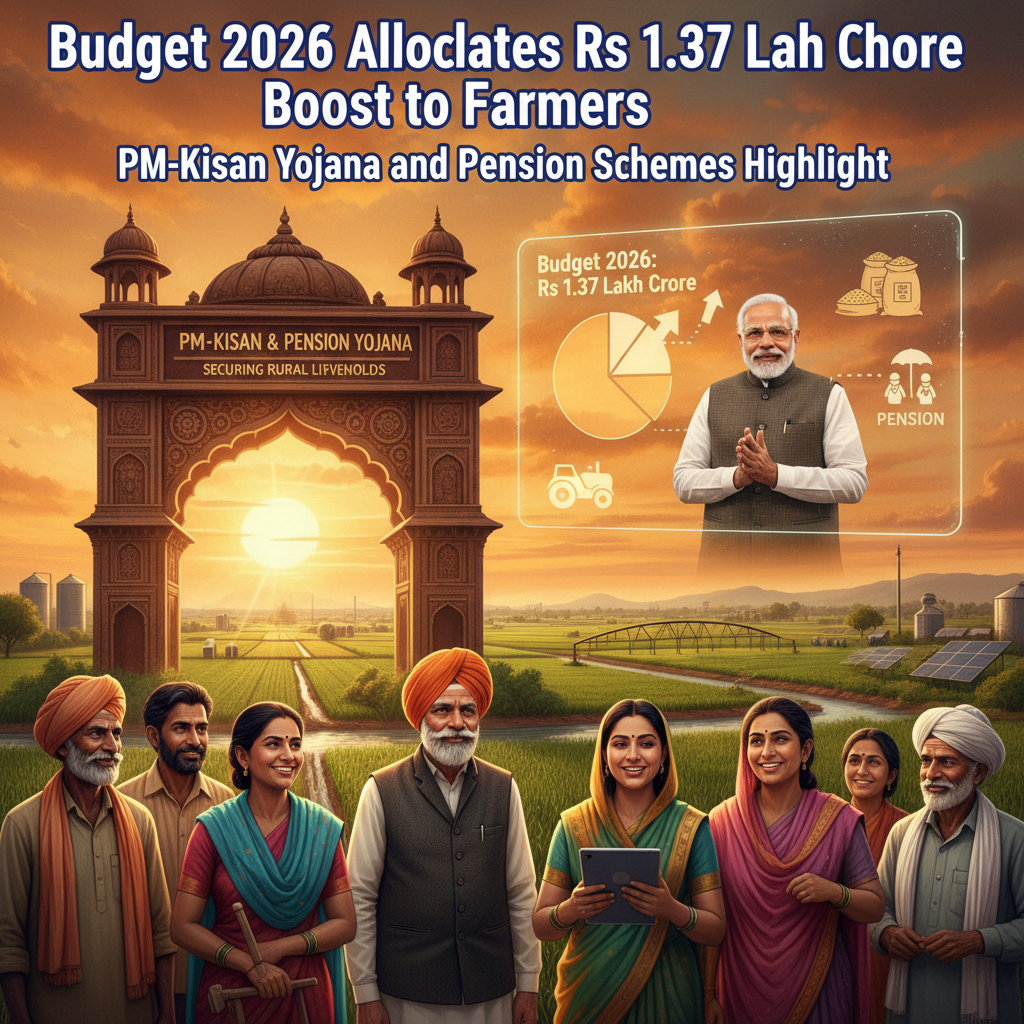
Budget 2026 Allocates Rs 1.37 Lakh Crore Boost to Farmers: PM‑Kisan Yojana and Pension Schemes Highlighted
Prime Minister Narendra Modi’s government unveiled a historic fiscal infusion for the agriculture sector in the Union Budget 2026, earmarking over Rs 1.37 lakh crore to strengthen farmer welfare, improve rural infrastructure and expand social security. The allocation reflects a decisive shift toward a more structured safety net, with the flagship PM‑Kisan Samman Nidhi Yojana slated for a major expansion and the rollout of a dedicated Agricultural Pension Scheme for senior cultivators. Officials say the move is designed to cushion agrarian distress, mitigate climate‑linked risks and secure rural livelihoods ahead of the 2027 general elections.
Key Highlights of the 2026 Agricultural Budget
The budget’s agricultural outlay is anchored on four pillars: direct income support, pension security, accessible credit and targeted infrastructure development. Together, these measures aim to address the longstanding gaps that have limited farm productivity and profitability.
- PM‑Kisan Yojana Expansion: The scheme will now cover an additional 10 million small and marginal farmers, taking total beneficiaries beyond 120 million. Eligible families will continue to receive Rs 6,000 per year, released in three instalments aligned with the kharif, rabi and summer cropping seasons.
- New Agricultural Pension Scheme: A dedicated pension fund will provide a monthly stipend of Rs 3,000 to farmers aged 60 and above who have completed a minimum of 30 years of service in agriculture. The scheme is projected to benefit around 5 million retirees initially.
- Credit Facilities and Interest Subvention: Short‑term credit limits for agro‑enterprises are being raised, coupled with a 4% interest subvention on loans up to Rs 2 lakh for marginal farmers.
- Infrastructure Investments: Rs 25,000 crore is allocated for expanding irrigation networks, modern warehousing and cold‑chain facilities in high‑potential states such as Punjab, Maharashtra and Karnataka.
- Research and Extension Funding: Funding for the Indian Council of Agricultural Research (ICAR) rises by 15%, aiming to accelerate the development of high‑yielding, drought‑resistant crop varieties.
These allocations are complemented by a strategic increase in the National Agriculture Market (e-NAM) budget, ensuring better market access for producers. The combined central‑state outlay is expected to unlock an additional Rs 2.5 lakh crore of private and public investment in the agricultural value chain over the next five years. 
Impact on Farmers and Rural Economies
Economic analysts anticipate that the Rs 1.37 lakh crore injection will generate a multiplier effect across rural India. Direct cash transfers under the expanded PM‑Kisan scheme are projected to lift household consumption spending by an average of 8 %, while also improving savings rates among smallholder families. The newly introduced pension scheme offers a crucial safety net for aging cultivators, reducing poverty incidence among the elderly agrarian cohort and encouraging retirement planning.
Speaking on the broader macro‑economic implications, Finance Ministry Secretary Rajnish Kumar highlighted that “timely credit at subsidised rates, coupled with enhanced post‑harvest infrastructure, addresses the core constraints that have historically limited agricultural productivity.” He added that the budget’s focus on cold‑chain development will help reduce post‑harvest losses, which currently stand at 15–20 % for perishable commodities.
State governments are expected to leverage these central allocations to complement their own schemes, particularly in the areas of crop insurance and market linkage. Preliminary estimates suggest that the synergy between central and state outlays could translate into an extra Rs 2.5 lakh crore of investment in rural infrastructure, irrigation and market access by 2030.
Stakeholder Reactions and Political Implications
Farmers’ organisations have largely welcomed the budget’s targeted measures. The Bharatiya Kisan Union (BKU) described the pension initiative as “a long‑awaited relief for the elderly agrarian community,” while urging the Centre to streamline disbursement mechanisms to ensure timely payments. Similarly, the Samyukt Kisan Morcha issued a statement praising the expansion of PM‑Kisan but called for faster rollout of the pension scheme in drought‑prone regions.
Political commentators view the budget as a calculated effort to consolidate rural support ahead of the 2027 elections. Rajiv Sharma, senior political analyst at Indian Politics Portal, noted that “the emphasis on PM‑Kisan and pension schemes is a clear signal that the ruling coalition is positioning farmer welfare as a cornerstone of its electoral narrative.”
Nevertheless, some economists caution that the real impact will hinge on implementation efficiency. Dr. Anjali Mehta, senior analyst at the National Institute of Agricultural Economics, remarked, “While the fiscal commitment is impressive, the ultimate benefit will depend on how swiftly and transparently the funds reach the intended beneficiaries.”
Challenges and Future Outlook
Implementation hurdles remain, especially in states with limited fiscal space and weak administrative capacities. Monitoring mechanisms will need to be strengthened to track fund utilisation, beneficiary coverage and disbursement timelines. Moreover, sustaining such large outlays over multiple years will require careful macro‑economic balancing to avoid crowding out other developmental priorities.
Looking ahead, the government plans to integrate the new Agricultural Pension Scheme with the existing Atal Pension Yojana, creating a unified social security framework for all informal sector workers, including farmers. This integration could potentially expand the scheme’s reach to an additional 10 million beneficiaries, according to a recent Press Information Bureau release.
In addition, the budget envisages a National Digital Agriculture Platform to streamline land records, credit assessment and crop advisory services. By leveraging satellite imagery and AI‑driven analytics, the platform aims to provide hyper‑localised weather forecasts and market price intelligence, thereby reducing information asymmetry for smallholders.
The successful execution of these initiatives will depend on robust partnerships between the Centre, state governments, private agri‑tech firms and civil society organisations. If implemented effectively, the 2026 Budget is poised to transform the agrarian landscape, fostering resilience, profitability and inclusive growth for India’s farming community.
Stay updated with the latest Yojana schemes and government initiatives for better awareness and eligibility. For personalized guidance on accessing these benefits, reach out to us.