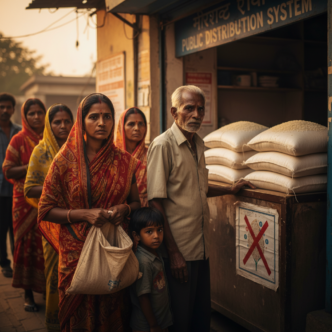



Overview of theVerdict
The Supreme Court’s recent judgment on welfare scheme denial has sent a clear message to the Union and state governments: procedural oversights that block eligible citizens from receiving benefits amount to a “travesty of justice.” The bench, comprising Justice R.F. Nariman and Justice Surya Kant, emphasized that the right to livelihood and dignity are integral to Article 21 of the Constitution, making timely access to welfare programmes a constitutional imperative. The court observed that when clerical errors, delayed processing, or mismatched beneficiary databases prevent deserving families from availing schemes such as the Pradhan Mantri Garib Kalyan Yojana, the Mahatma Gandhi National Rural Employment Guarantee Act (MGNREGA), or the National Food Security Act (NFSA), the executive is failing its constitutional duty. This ruling comes amid growing concerns about the implementation gaps in flagship programmes aimed at poverty alleviation, food security, and rural employment, and it compels the government to adopt stringent monitoring mechanisms to prevent arbitrary exclusion.
Administrative Lapses and Their Impact
Administrative lapses manifest in numerous ways, from incomplete documentation and delayed disbursement of funds to opaque grievance redressal processes. A single digit typo in an otherwise accurate application can render an otherwise qualified applicant ineligible, while duplicated entries in beneficiary databases may lead to duplicate allocations or, paradoxically, exclusion. The court highlighted that these failures are not isolated incidents but part of a broader pattern that erodes the credibility of welfare delivery. Families that rely on the Pradhan Mantri Garib Kalyan Yojana’s direct cash transfers find themselves without the promised assistance, resulting in heightened vulnerability, increased reliance on informal credit, and in some cases, forced migration or child labour. Moreover, when grievance redressal mechanisms are slow or non‑existent, beneficiaries experience a sense of alienation that diminishes public trust in governmental institutions.
Instances of welfare scheme denial have been documented across states, where outdated software, lack of real‑time data analytics, and insufficient training of frontline staff contribute to systemic exclusion. According to a recent report by the National Human Rights Commission, over 12 % of applications under the NFSA were rejected due to technical errors rather than genuine ineligibility. The financial impact is substantial: delayed payments exacerbate cash flow constraints for low‑income households, undermining the very purpose of poverty‑alleviation schemes. The human cost is equally significant, as affected families often miss out on essential nutrition, healthcare, and educational support, perpetuating inter‑generational poverty. 
- Data entry mistakes leading to eligibility mismatches.
- Delayed fund releases causing cash‑flow crises for beneficiaries.
- Opaque grievance mechanisms that discourage appeals.
- Inadequate digital infrastructure in remote regions.
Legal Reasoning Behind the Judgment
The bench’s legal reasoning hinged on the interplay between substantive rights and procedural safeguards. While recognizing the state’s prerogative to set procedural norms, the court held that such norms must not become “instrumentalities of exclusion.” It clarified that the right to livelihood, enshrined under Article 21, obliges the state to ensure that welfare benefits reach eligible citizens without undue delay or discrimination. The judgment invoked Article 14’s guarantee of equality before the law, noting that procedural technicalities cannot be allowed to nullify the substantive intent of welfare legislation. By treating administrative bottlenecks as constitutional violations when they result in welfare scheme denial, the court reinforced the principle that the executive must prioritize substantive justice over procedural formalism.
Furthermore, the judgment underscored the courts’ role as guardians of fundamental rights, stating that judicial intervention is warranted when the executive fails to fulfill its constitutional obligations, especially when vulnerable populations are affected. The ruling cited precedents where courts have ordered the implementation of interim relief to prevent irreversible harm caused by delayed benefits. This legal framework sets a persuasive precedent for future challenges against administrative inaction, signaling that courts will not shy away from scrutinizing procedural compliance when substantive rights are at stake.
Implications for Future Welfare Programs
In response to the Supreme Court’s directives, ministries and state governments are expected to undertake comprehensive audits of their welfare programmes to identify systemic weaknesses. The judgment mandates the integration of real‑time data analytics, the deployment of blockchain‑based beneficiary verification, and the establishment of independent oversight committees to monitor disbursements. Additionally, the court ordered the central government to formulate a standardized grievance redressal portal that ensures swift resolution of complaints within a stipulated timeframe, thereby reducing the incidence of welfare scheme denial.
These measures aim to improve transparency, enhance beneficiary trust, and ensure that subsidies and entitlements are delivered without unnecessary delay. By adopting advanced verification techniques, such as Aadhaar‑linked biometric authentication and AI‑driven anomaly detection, authorities can pre‑empt errors that traditionally led to exclusion. The judgment also anticipates a shift toward greater citizen participation, encouraging beneficiaries to engage with digital platforms and assert their rights through legally backed appeals. Ultimately, the ruling is poised to catalyze a paradigm shift in welfare delivery, compelling policymakers to align procedural efficiency with the constitutional promise of equitable access.
State Responses and Pilot Initiatives
Several states have already begun implementing reforms in line with the court’s directives. For instance, the Maharashtra government launched a pilot project that integrates satellite‑based geotagging with the Mahatma Gandhi National Rural Employment Guarantee Act (MGNREGA) wage payments, ensuring that funds reach only verified workers. Similarly, the Karnataka Rural Development Department introduced an AI‑enabled grievance redressal system that logs complaints in real time and escalates unresolved issues to senior officials within 48 hours. These initiatives are complemented by partnerships with civil society organisations that assist beneficiaries in navigating application portals and collecting evidentiary documentation to contest welfare scheme denial.
At the national level, the Ministry of Rural Development has announced plans to roll out a unified digital dashboard that aggregates data from multiple schemes, enabling real‑time monitoring of enrollment, disbursement, and grievance trends. The dashboard, accessible through a public URL (Digital Dashboard), aims to increase transparency and allow citizens to verify the status of their applications instantly. Moreover, the Ministry of Food Processing Industries has committed to adopting blockchain technology for the Public Distribution System (PDS) to curb leakages and ensure that food grains reach eligible households without diversion.
What Citizens Can Do
Beneficiaries encountering welfare scheme denial are encouraged to exercise their right to appeal through established channels. The first step involves filing a grievance on the official portal of the relevant ministry or department, where applicants can upload supporting documents such as application receipts, eligibility certificates, and correspondence with officials. If the initial response is unsatisfactory, individuals may approach the State Consumer Disputes Redressal Commission or seek assistance from legal aid clinics, many of which offer free counsel for marginalized communities.
Effective advocacy also requires meticulous documentation of all interactions with government officials, including dates, names, and reference numbers. Civil society organisations play a pivotal role in aggregating data on exclusion incidents, providing legal assistance, and launching public awareness campaigns that highlight available remedies. By collectively documenting patterns of welfare scheme denial, NGOs can pressure authorities to adopt systemic reforms and improve accountability.
- Verify eligibility criteria and retain all application documents.
- Submit grievances promptly through official portals.
- Escalate unresolved issues to consumer courts or legal aid services.
- Engage NGOs for advocacy and documentation of systemic failures.
Recent Context: The Supreme Court Case
The judgment emerged from a public interest litigation that highlighted widespread welfare scheme denial in the implementation of the National Food Security Act across several districts. Petitioners argued that procedural delays, inaccurate beneficiary databases, and lack of grievance mechanisms had prevented millions of vulnerable families from receiving their entitled food subsidies. The Supreme Court, in its deliberations, referenced data from the Ministry of Consumer Affairs indicating that over 3 million applications were pending adjudication as of the previous fiscal year, with an estimated 12 % ultimately rejected due to administrative errors rather than genuine non‑eligibility.
Legal scholars note that the case sets a crucial precedent for interpreting administrative law in the context of socio‑economic rights. By framing welfare scheme denial as a violation of constitutional guarantees, the judgment expands the scope of judicial review beyond traditional procedural defects to encompass substantive impacts on citizens’ livelihoods. This shift is expected to influence future litigations involving other flagship schemes, such as the Pradhan Mantri Awas Yojana (Housing) and the Janani Suraksha Yojana (Maternal Health), where similar patterns of exclusion have been reported.
How to Verify Eligibility and Navigate Application Processes
Understanding the eligibility criteria is essential to avoid inadvertent welfare scheme denial. Most schemes publish detailed guidelines on their official websites, outlining income thresholds, demographic specifications, and required documentation. For example, the eligibility conditions for the Pradhan Mantri Garib Kalyan Yojana can be reviewed on its dedicated page (Pradhan Mantri Garib Kalyan Yojana), which also provides a step‑by‑step application flowchart. Applicants should ensure that all documents are scanned in high resolution, saved in PDF format, and uploaded before the stipulated deadline to prevent technical rejections.
To streamline the process, many state portals now offer an online eligibility checker that assesses whether an applicant meets the basic criteria before submission. These tools typically require the entry of personal details such as Aadhaar number, income proof, and residential address, after which the system generates a pre‑assessment report. Applicants are advised to retain the generated acknowledgment receipt, as it serves as proof of submission and can be referenced in subsequent grievance filings. Additionally, beneficiaries can subscribe to SMS alerts that notify them of status updates and upcoming disbursement dates, thereby reducing the risk of missing critical communication windows.
Finally, citizens should be aware of the grievance redressal timelines stipulated by law. The central government’s grievance portal (Central Grievance Portal) mandates that all complaints be addressed within 30 days, with an escalation mechanism available for delayed responses. By leveraging these official channels, beneficiaries can hold officials accountable and ensure that welfare benefits are delivered in a timely and transparent manner.
Stay updated with the latest Yojana schemes and government initiatives for better awareness and eligibility. For personalized guidance on accessing these benefits, reach out to us.