


Introduction
Recent media reports and state health department bulletins have highlighted a noticeable trend: a number of private hospitals are being removed from the empanelment list of the Ayushman Bharat Pradhan Mantri Jan Arogya Yojana (AB PM‑JAY). While the scheme continues to expand its network, the de‑empanelling of private facilities raises questions about access to secondary and tertiary care for over 500 million beneficiaries. This article examines the mechanics of de‑empanelling, the latest enrollment figures, the drivers behind the removals, and what patients can do to safeguard their coverage.
Launched in September 2018, Ayushman Bharat is billed as the world’s largest publicly funded health insurance programme. It promises a cover of up to ₹5 lakh per family per year for inpatient care, with an annual cap of ₹1 lakh for outpatient procedures. The programme is jointly funded by the Centre and states, and it operates through a robust network of accredited hospitals – both public and private – that can bill the government directly for services rendered to eligible families.
What Does De‑Empanelling Mean?
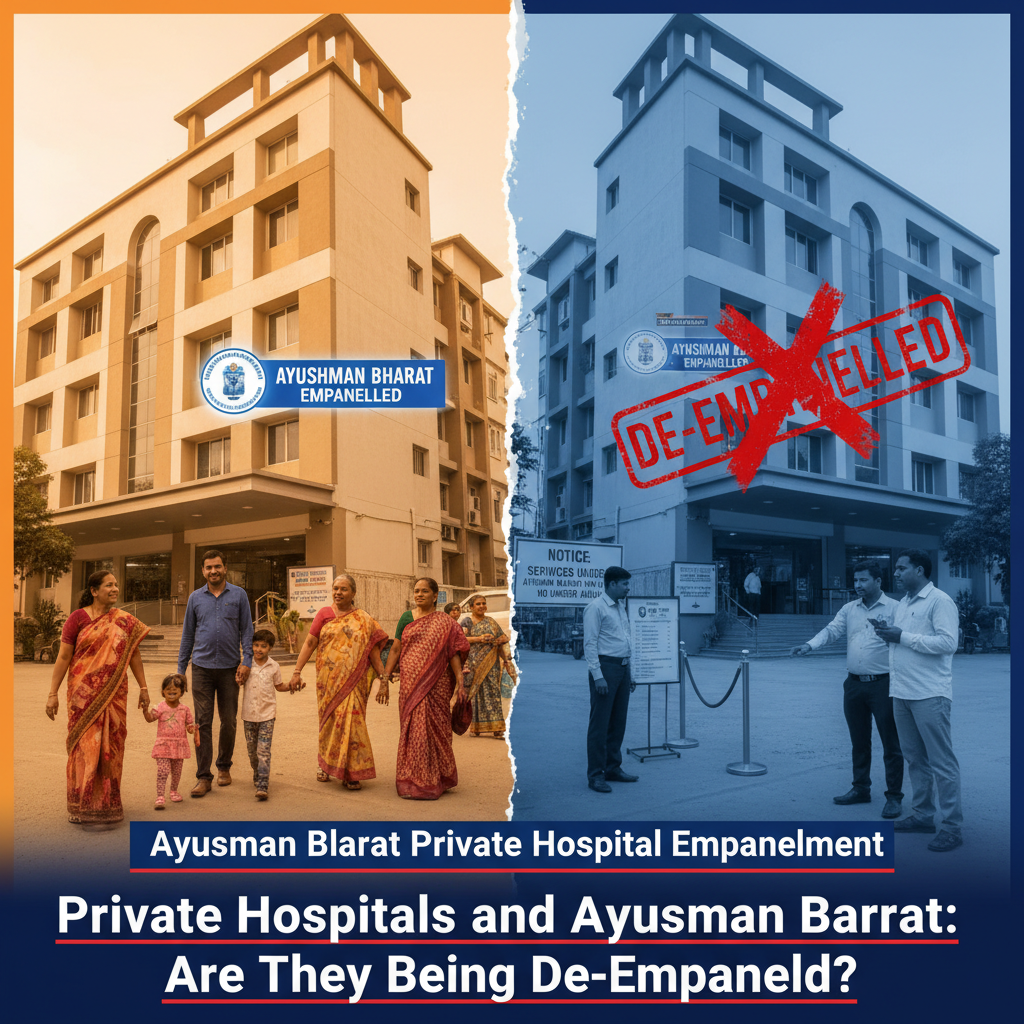
De‑empanelling refers to the formal removal of a hospital from the list of accredited providers under a health insurance scheme. When a private hospital is de‑empaneled from Ayushman Bharat, it loses the ability to submit claims for services covered under PM‑JAY, which means that patients treated there can no longer rely on the scheme’s reimbursement for eligible procedures. 
The process is typically initiated by the state health agency after an audit or complaint, and it may be temporary or permanent depending on the nature of the violation. According to the Ministry of Health and Family Welfare’s 2025‑2026 audit report, 112 private facilities were de‑empaneled during the fiscal year ending March 2026, a slight increase from the 89 removals recorded in 2023‑24.
Beneficiaries are advised to verify the empanelment status of their chosen hospital before scheduling any Procedure, as unexpected de‑empanelling can result in out‑of‑pocket expenses that would otherwise have been covered.
Current Status of Private Hospital Enrollment
As of the latest Union Health Ministry data released in early 2026, more than 2,500 private hospitals remain enrolled across 28 states and union territories, accounting for roughly 30 % of the total accredited network. This figure represents a modest rise from the 2,300 private facilities recorded in 2022, reflecting ongoing efforts to broaden private‑sector participation.
The growth has not been uniform. States such as Maharashtra, Tamil Nadu, and Karnataka boast the highest concentrations of private hospitals under the scheme, while smaller jurisdictions like Nagaland and Tripura have only a handful of enrolled private institutions. The ministry emphasizes that enrollment is dynamic; new hospitals can join after meeting accreditation standards, while others may exit voluntarily or due to non‑compliance.
Hospitals are required to maintain specific infrastructure, including operation theatres, intensive care units, and diagnostic facilities, and they must adhere to quality‑control protocols stipulated by the National Health Authority (NHA). Continuous compliance monitoring ensures that the scheme’s promise of high‑quality, affordable care is upheld.
Reasons Behind Recent De‑Empanelling Actions
Several interrelated factors have contributed to the recent wave of de‑empanelling decisions:
- Quality compliance failures: Hospitals that fall short on prescribed medical standards — such as inadequate infection‑control measures, insufficient staffing ratios, or outdated equipment — may be removed to protect patient safety.
- Billing irregularities and fraud: Audits have uncovered cases of over‑billing, duplicate claims, and submission of inflated procedure codes. The Ministry has instituted stricter penalties, leading to the expulsion of facilities found guilty of misconduct.
- Financial unsustainability: Some private hospitals have reported that the reimbursement rates under PM‑JAY do not cover their operating costs, especially for high‑cost procedures. Faced with narrow margins, certain institutions have chosen to withdraw from the network rather than continue operating at a loss.
These actions are executed in coordination with state health departments, which have the authority to audit, suspend, or permanently de‑empaneli hospitals. In many instances, the decision follows a warning period during which the hospital is given an opportunity to rectify deficiencies.
Transparency measures, such as publishing de‑empaneling notices on the official Ayushman Bharat portal, aim to keep beneficiaries informed and deter malpractice.
Impact on Beneficiaries and the Way Forward
The removal of private hospitals from the empanelment list can temporarily curtail choice for patients who prefer specialty or multi‑speciality centres for complex diagnoses. However, the Ministry stresses that the overall network is expanding, and public‑sector hospitals are being fortified to bridge any gaps.
Beneficiaries are encouraged to use the Ayushman Bharat beneficiary portal or the state health department’s website to verify whether a particular hospital is currently empaneled. Many state portals now feature a searchable database that lists accredited facilities by district, specialty, and service type.
If a preferred private hospital is de‑empaneled, patients can explore nearby alternatives, seek treatment at an empaneled government hospital, or opt for a private facility in an adjacent district that remains on the list. In some cases, the scheme allows for “out‑of‑network” utilizations under specific emergency conditions, but these are subject to strict documentation and reimbursement caps.
Looking ahead, the government plans to conduct periodic enrollment drives, introduce revised reimbursement structures to improve financial viability, and strengthen quality‑assurance mechanisms. Stakeholders — including hospital managements, patient advocacy groups, and insurance providers — are engaged in ongoing dialogues to refine the scheme’s architecture and ensure that private‑sector participation remains a cornerstone of universal health coverage.
Stay updated with the latest Yojana schemes and government initiatives for better awareness and eligibility. For personalized guidance on accessing these benefits, reach out to us.