


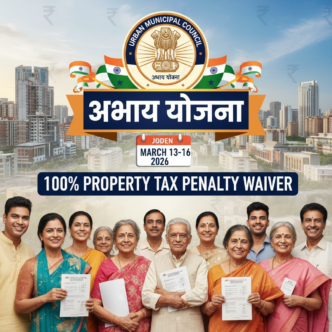

The Urban Municipal Council has announced a targeted relief measure called Abhay Yojana, offering a full waiver on property tax penalty amounts for a short, four‑day window from March 13 to March 16, 2026. This initiative is designed to help property owners who have fallen behind on their tax obligations settle their dues without the added burden of accumulated penalties. Eligible residents can clear their tax assessments, have any penalty component reduced to zero, and avoid further interest accrual once the scheme closes. The announcement has sparked widespread interest across the city, with many citizens seeking clarification on eligibility, the application steps, and the broader implications for municipal finances.
Key Details of the Waiver
During the specified period, the council will cancel all outstanding penalty amounts that have accumulated on residential and commercial properties within its jurisdiction. The waiver is not limited to future penalties; it applies exclusively to penalties that were incurred prior to the programme’s launch and have not been subject to any ongoing legal dispute. To qualify, owners must have paid the full assessed tax for the relevant financial year before the cut‑off date of March 16, 2026. Once the penalty is waived, only the regular tax liability for that year remains payable. This targeted approach distinguishes Abhay Yojana from previous blanket discounts, as it focuses solely on penalty relief while preserving the council’s revenue base.
Eligibility Criteria and How to Apply
Eligibility hinges on several clear conditions. First, the property must fall within the Urban Municipal Council’s geographic limits. Second, the owner must have filed the most recent property tax return and the assessment must be up to date. Third, any penalty amount must stem from a prior default that is not currently under litigation. Finally, applicants must submit a self‑declaration confirming that all tax dues have been cleared before the deadline. The scheme covers a wide range of property types, including residential plots, commercial establishments, industrial units, and vacant land parcels. 
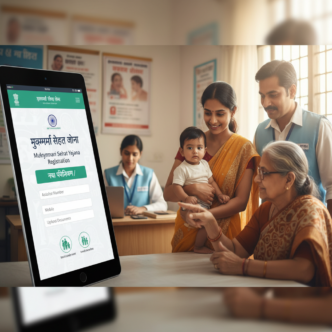
Applications can be submitted through two channels. The preferred method is online via the council’s official portal, where owners log in using their Property Identification Number (PIN) and select the Abhay Yojana option from the menu. The system automatically verifies eligibility and generates a confirmation receipt. For those who prefer face‑to‑face interaction, the same form is available at any of the designated zonal offices or at the reception desk of the main administrative building.
- Online submission through the council portal
- In‑person submission at zonal offices or the main administrative building
- Verification of eligibility by the system before receipt issuance
Required Documentation
To streamline verification, applicants should prepare a concise set of documents. A copy of the latest property tax assessment order is essential, as it proves that the tax liability has been calculated and is current. Proof of payment for the current year’s tax must be attached, typically a receipt from the bank or online transaction portal. If the owner has previously paid any penalty, a receipt of that payment should also be included. Valid identity proof — such as an Aadhaar card, passport, or driver’s licence — must be provided to confirm the applicant’s identity. In cases of joint ownership, a signed joint declaration from all co‑owners is required, affirming that they collectively meet the eligibility criteria.
Having these documents ready not only accelerates the clearance process but also reduces the likelihood of delays caused by incomplete submissions. The council has emphasised that incomplete paperwork may result in the application being placed on hold, potentially missing the narrow waiver window.
Benefits for Citizens and Municipal Finance
The Abhay Yojana delivers immediate financial relief to property owners who have been strained by accumulated penalties, especially those facing economic hardship or recent liquidity issues. By removing the penalty component, the scheme encourages timely tax compliance and reduces the psychological barrier that often discourages arrears settlement. Moreover, the clear deadline creates a sense of urgency, prompting owners to plan their payments efficiently and avoid procrastination.
From a municipal perspective, the temporary loss of penalty revenue is offset by the anticipated increase in voluntary compliance in subsequent periods. Historical data from similar amnesty programmes in other Indian cities — such as the 2022 water‑bill waiver in Pune — has shown a measurable rise in tax collections the following year, as residents develop a habit of clearing dues promptly. The council projects that the net fiscal impact of Abhay Yojana will be neutral to positive, strengthening the overall municipal budget in the long term.
Expert Opinions, FAQs and Conclusion
Urban policy analysts highlight that targeted amnesty periods like Abhay Yojana can break the cycle of chronic arrears and foster a culture of responsible fiscal citizenship. Financial advisors recommend that property owners with pending penalties should seize the opportunity now, as the scheme will not be extended beyond March 16, 2026. For further reading, you may refer to the Wikipedia entry on property tax in India and the broader concept of tax amnesty.
Frequently Asked Questions
- What types of properties are covered? All residential, commercial, industrial, and vacant land parcels within the council’s jurisdiction.
- Is the waiver applicable to future penalties? No, the relief applies only to penalties incurred before the programme’s commencement.
- Can the waiver period be extended? The council has not announced any extension; the current window remains fixed.
- Do I need to pay any interest after the waiver? Interest will continue to accrue on any undiscovered penalties after March 16, 2026.
In conclusion, the launch of Abhay Yojana marks a significant step toward alleviating the financial burden on property owners while reinforcing the Urban Municipal Council’s commitment to transparent and efficient revenue management. Eligible residents are urged to act promptly, settle their outstanding dues, and fully benefit from the waiver before the deadline passes. By doing so, they not only safeguard their own finances but also contribute to a healthier fiscal environment for the entire community.
Stay updated with the latest Yojana schemes and government initiatives for better awareness and eligibility. For personalized guidance on accessing these benefits, reach out to us.