


Overview of PM Surya Ghar Yojana
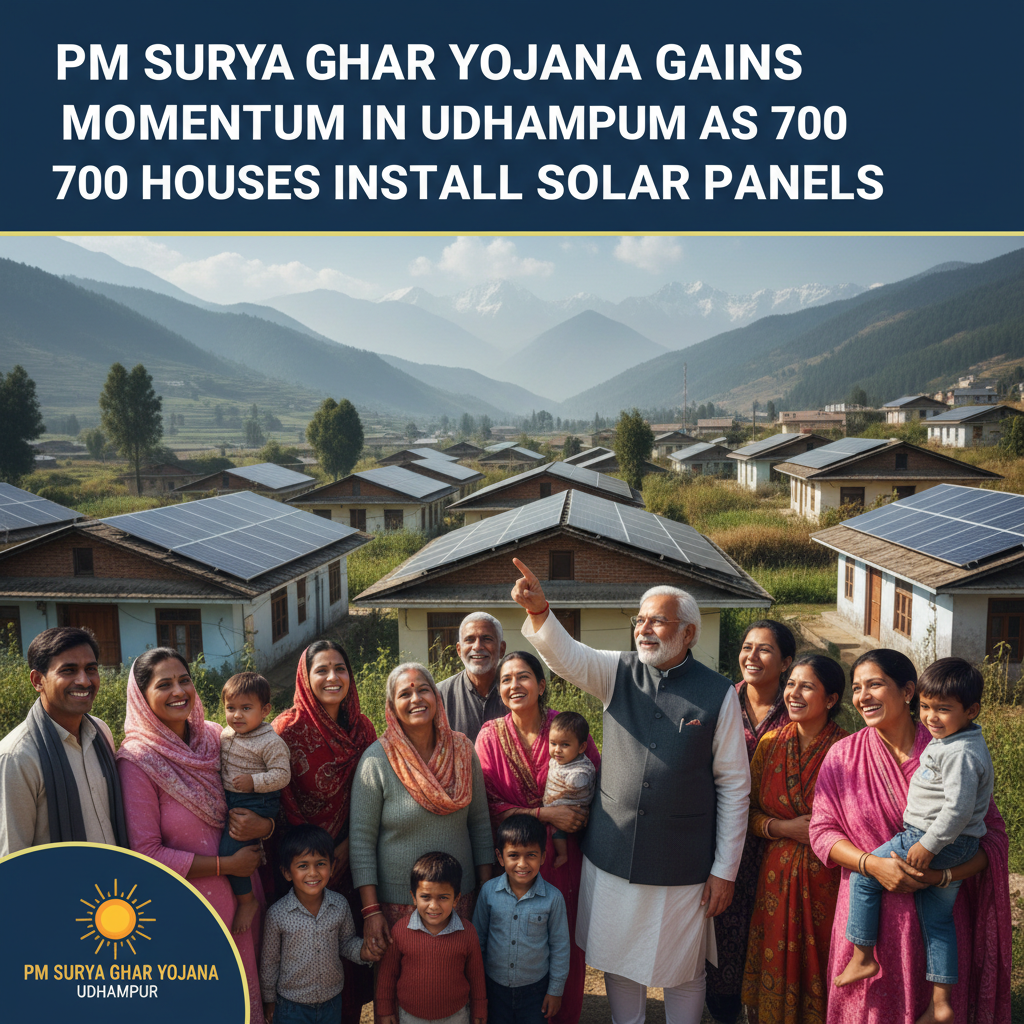
The PM Surya Ghar Yojana has emerged as a flagship initiative of the Government of India, spearheaded by the Ministry of New and Renewable Energy (MNRE), to accelerate rooftop solar adoption across households. Launched in 2023, the scheme envisages providing a subsidy of up to 40 percent of the total project cost, complemented by state‑level incentives for high‑performance installations. In the Udhampur district of Jammu and Kashmir, the programme has already recorded remarkable traction, with around 700 families completing solar panel installations within the first few months of rollout. This early success is being hailed as a replicable model for decentralised clean energy generation, showcasing how targeted financial support and robust awareness campaigns can drive rapid renewable energy uptake at the community level.
Key Features of the Scheme
The PM Surya Ghar Yojana incorporates several user‑friendly design elements aimed at simplifying the adoption journey for citizens. Beneficiaries enjoy a streamlined application process, reduced documentation hurdles, and direct linkage with state renewable energy agencies for swift clearance. Moreover, the scheme offers expert technical support, ensuring that each household receives a solar system optimally sized to match its consumption pattern. The subsidy ceiling of INR 45,000 per household, as highlighted by official MNRE data, dramatically lowers the upfront capital barrier, making solar power financially viable for a broader demographic.
- Subsidy up to forty percent of the project cost
- Simplified online application portal
- Expedited clearance from state renewable energy agencies
- Technical advisory services for system design
Implementation in Udhampur: 700 Households Go Solar
In Udhampur, the coordinated efforts of the Jammu and Kashmir Renewable Energy Development Agency (JKREDA) and local banking partners have turned the PM Surya Ghar Yojana into a tangible reality for 700 resident families. Each installation, averaging 5 kilowatts, collectively contributes over 3.5 megawatts of clean electricity, translating into average bill savings of INR 3,200 per month for adopters. The project’s environmental footprint is equally compelling: the generated solar power is projected to offset approximately 8,500 metric tons of carbon dioxide annually, aligning with the Union Territory’s climate‑action targets. 
Beyond environmental gains, the initiative is stimulating local employment. Every installation creates temporary jobs for civil works, electrical wiring, and commissioning, providing a modest but meaningful boost to the regional economy. Community outreach programmes, conducted in partnership with NGOs, have educated residents about long‑term savings and the procedural steps for availing subsidies, further fuelling adoption enthusiasm.
- Aggregate installed capacity: 3.5 MW
- Average monthly electricity bill reduction: INR 3,200
- Annual CO₂ offset: ~8,500 metric tons
- Temporary jobs generated: ~140 per 100 installations
Eligibility, Subsidy and Application Process
Eligibility for the PM Surya Ghar Yojana is deliberately inclusive yet specific to ensure sustainable impact. Homeowners must possess a pucca (permanent) house, a roof area of at least ten square metres, and an existing electricity connection. Women beneficiaries receive special emphasis, reflecting the scheme’s alignment with gender‑inclusive development goals. The application workflow begins with submitting essential documents — recent electricity bills, property ownership proof, and Aadhaar details — through the dedicated MNRE portal. Upon verification, the subsidy is credited directly to the applicant’s account, after which the remaining balance can be financed via low‑interest loans offered by partner banks, enabling repayment over five years.
Applicants benefit from a transparent, real‑time dashboard that tracks generation, consumption, and subsidy disbursement, fostering trust and accountability. The portal also hosts a repository of technical guidelines and links to partner resources, ensuring that beneficiaries can navigate the process with confidence.
- Minimum roof area: 10 m²
- House must be pucca and have electricity connection
- Women owners receive priority
- Subsidy credited post‑verification, reducing upfront cost
- Financed options via partner banks with 5‑year repayment
Economic and Social Impact on Residents
The PM Surya Ghar Yojana is delivering multifaceted benefits to Udhampur’s households. Financially, families report an average annual saving of INR 38,400 on electricity bills, freeing up household income for education, health, and skill development. Socially, reduced reliance on erratic grid power enhances energy security, especially during peak demand periods. The scheme also empowers women by decreasing household expenditure, enabling greater investment in their children’s future.
According to surveys conducted by JKREDA, more than 85 percent of adopters express high satisfaction with the programme, citing both cost reductions and improved power reliability. The green certificate mechanism further augments economic appeal, allowing households to sell excess generation to the grid at a preferential tariff, thereby creating a modest revenue stream.
- Average annual savings per household: INR 38,400
- Improved energy reliability reported by 78 % of beneficiaries
- Women empowerment: increased disposable income for health & education
- Revenue from surplus export via green certificates
Challenges and Government Response
Despite its early successes, the PM Surya Ghar Yojana faces several implementation hurdles, including the need for continued capacity building among local installers, stringent quality assurance, and grid integration of surplus generation. To address these, the MNRE has announced a series of intensive training workshops in Udhampur, focusing on best practices for system design, maintenance, and safety compliance. Additionally, a robust five‑year warranty framework mandates periodic performance reporting, which is reviewed by the state renewable energy cell to ensure long‑term system health.
Real‑time performance monitoring dashboards are now publicly accessible, providing transparency and fostering community trust. The government also plans to integrate smart metering solutions, enabling precise tracking of generation and consumption patterns, which will be crucial for future scaling.
- Training workshops for 200 local technicians scheduled for Q4 2025
- Five‑year warranty on all installed components
- Performance dashboards accessible to public
- Smart meter integration roadmap underway
Future Outlook and National Targets
Looking ahead, the PM Surya Ghar Yojana aims to double the number of participating households in Jammu and Kashmir by the end of the financial year, a target driven by the overwhelming positive response in Udhampur. Nationally, the scheme is positioned to play a pivotal role in achieving India’s ambitious goal of installing one million rooftop solar systems by 2027, a milestone that would significantly bolster the country’s renewable energy capacity.
Policy analysts underscore that sustained success hinges on transparent fund disbursement, robust monitoring mechanisms, and integration with complementary programmes such as the PM KUSUM scheme for agricultural solar pumps. Moreover, upcoming initiatives like the National Hydrogen Mission present opportunities for hybrid models combining solar generation with green hydrogen production, paving the way for decentralized, resilient energy ecosystems.
Stakeholders anticipate that, with continued political will and community engagement, the PM Surya Ghar Yojana will become a cornerstone of India’s clean energy transition, delivering economic, environmental, and social dividends across urban and rural landscapes alike.
- National target: 1 million rooftop systems by 2027
- Expansion plan: double Udhampur participation by FY 2025‑26
- Synergy with PM KUSUM and National Hydrogen Mission
- Smart metering and green certificates to enhance economic incentives
Stay updated with the latest Yojana schemes and government initiatives for better awareness and eligibility. For personalized guidance on accessing these benefits, reach out to us.