



Key Features of the Allocation
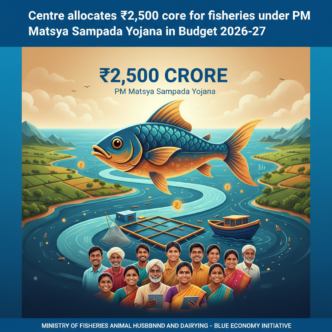
The Union Budget 2026‑27 has earmarked ₹2,500 crore for the fisheries sector under the PM Matsya Sampada Yojana. This allocation represents a 35 % increase over the previous year’s outlay and is positioned as the cornerstone of the government’s blue‑economy agenda. The funds will be disbursed in three tranches: the first tranche will finance the creation of modern aquaculture parks, the second will support hatchery expansion and seed‑stock production, while the third will be dedicated to research, monitoring and capacity‑building initiatives. Officials have said the money will be released through a competitive grant‑based mechanism that requires state governments and eligible NGOs to submit detailed project proposals.
- The financing is split between central and state components, with a 60:40 sharing ratio for most states.
- Special earmarks have been made for coastal states such as Kerala, Tamil Nadu, Gujarat and West Bengal, where marine aquaculture holds the highest growth potential.
- A dedicated digital platform will track fund utilisation in real time, enhancing transparency and reducing delays.
Impact on Farmers
Small and marginal fish farmers across the country stand to gain the most from this injection of capital. Under the PM Matsya Sampada Yojana, beneficiaries can apply for subsidised credit at interest rates as low as 4 % and access a suite of technology‑transfer programmes that introduce biofloc systems, recirculating aquaculture systems (RAS) and climate‑resilient breeding stocks. The scheme also launches a “Fish Farmer Insurance Scheme” that provides cover against crop loss caused by extreme weather events, disease outbreaks or price volatility in domestic and export markets. Moreover, a network of extension officers will be deployed to each district to guide applicants through the application process, help them secure land‑use permissions and connect them with certified feed suppliers.
- Eligibility is limited to families owning less than 2 hectares of cultivated water surface or holding a valid fisherman’s licence.
- Applicants must be registered with the Fisheries Department of their respective state and possess a bank account linked to an Aadhaar number.
- Women‑headed households receive an additional 10 % uplift in grant amounts to encourage gender‑inclusive participation.
Funding Mechanism and Eligibility Criteria
The ₹2,500‑crore outlay is financed through the Consolidated Fund of India and is allocated as follows: ₹1,200 crore for infrastructure development, ₹800 crore for research and development, ₹300 crore for market‑linkage creation, and ₹200 crore for insurance and risk‑mitigation. The Ministry of Fisheries, Animal Husbandry and Dairying will act as the nodal agency, while the National Fisheries Board will coordinate with state fisheries departments to disburse the grants. Eligibility is determined on the basis of a “Fisheries Production Index” that measures historical output, pond area, and socio‑economic vulnerability. States with a higher index receive a larger share of the central pool, ensuring that regions with existing aquaculture activity can scale up faster. 
Applicants can access detailed eligibility charts and application forms on the official portal of the Ministry of Fisheries (fisheries.gov.in), which also hosts a help‑desk and video tutorials to guide first‑time users.
Expert Opinions and Industry Outlook
Industry analysts describe the budgetary commitment as a “turning point” for India’s fisheries sector, which currently contributes only 1.5 % to the nation’s gross agricultural output but holds a potential of over 10 % if fully harnessed. Dr. Anita Deshmukh, a marine economist at the Indian Institute of Technology (IIT) Chennai, remarks that the scheme could “reduce import dependence on shrimp and tilapia by up to 30 % within the next five years, thereby strengthening export competitiveness and foreign‑exchange earnings.” Former Finance Ministry Secretary R. S. Verma adds that the financial stimulus aligns with the broader “Blue Economy” roadmap, which aims to generate 15 million jobs and add $150 billion to GDP by 2030.
Recent trade data shows that India’s fish exports rose by 12 % year‑on‑year in FY 2025‑26, driven largely by demand for marine shrimp and marine finfish. The new funding is expected to accelerate this trend by modernising production methods and certifying farms under international sustainability standards such as the Aquaculture Stewardship Council (ASC).
Implementation Framework and Monitoring
Roll‑out of the PM Matsya Sampada Yojana will be coordinated through a three‑tier structure: the Ministry of Fisheries provides overall policy direction; the National Fisheries Board oversees grant allocation and technical support; and state fisheries departments supervise on‑ground execution. A digital dashboard, accessible at dashboard.fisheries.gov.in, will display real‑time data on fund utilisation, project milestones and key performance indicators (KPIs) such as hatchery capacity added, number of farmers trained and volume of certified sustainable produce. Independent auditors appointed by the Comptroller and Auditor General (CAG) will conduct quarterly reviews to ensure adherence to financial and environmental safeguards.
Capacity‑building programmes will be delivered through partnerships with leading research institutions, including the Central Marine Fisheries Research Institute (CMFRI) and the National Fisheries Research and Development Institute (NFRDI). These collaborations will facilitate technology demonstrations, training of master trainers and the creation of a national repository of best‑practice case studies.
Environmental Safeguards and Sustainable Practices
Environmentalists have welcomed the emphasis on sustainable aquaculture but caution that scale‑up must be accompanied by robust regulatory frameworks to prevent ecological degradation. The scheme mandates that all new projects undergo an environmental impact assessment (EIA) and adopt water‑recycling technologies where feasible. The Ministry has also introduced a “Green Aquaculture Certification” that will be awarded to farms meeting stringent criteria on feed composition, effluent treatment and biodiversity protection.
To mitigate the risk of invasive species and disease transmission, the programme includes a national biosecurity protocol that requires routine surveillance and mandatory reporting of outbreaks. In addition, the budgetary allocation earmarks funds for mangrove restoration projects, recognizing the role of coastal ecosystems in supporting wild fish stocks and providing natural buffers against climate shocks.
Challenges and Mitigation Strategies
Despite its ambitious scope, the implementation of PM Matsya Sampada Yojana faces several hurdles. First, many rural districts lack the institutional capacity to prepare high‑quality project proposals, leading to delays in fund disbursement. To address this, the Ministry plans to deploy a cadre of “Project Facilitation Officers” who will assist local stakeholders in drafting business plans and navigating bureaucratic requirements.
Second, the success of the scheme hinges on market development. Without reliable buyers, increased production could result in price collapse. Therefore, the budget includes a dedicated “Fish Market Modernisation Fund” that will finance the construction of regulated wholesale markets, cold‑chain logistics hubs and e‑procurement platforms linking farmers directly to exporters and retail chains.
Finally, financing gaps may emerge if state‑level matching contributions are not forthcoming. The Centre has introduced a contingency pool that can be tapped by states demonstrating a minimum 30 % increase in aquaculture output over the previous fiscal year, thereby incentivising proactive participation.
Broader Context Within India’s Blue Economy Agenda
The allocation under PM Matsya Sampada Yojana is part of a larger policy push to realise India’s “Blue Economy” vision, which seeks to harness oceanic resources for economic growth while preserving marine ecosystems. This vision is also reflected in the National Blue Economy Action Plan 2024‑2030, which prioritises sustainable fisheries, offshore wind energy, marine biotechnology and coastal tourism. By directing significant fiscal resources toward inland and coastal aquaculture, the government aims to diversify rural livelihoods, reduce migration pressures, and enhance food‑security resilience.
International collaborations are also being pursued. Recent agreements with the United Nations Food and Agriculture Organization (FAO) and the World Bank will facilitate knowledge exchange, access to climate‑smart technologies, and low‑interest financing for green aquaculture projects. These partnerships are expected to accelerate the adoption of best practices and help India achieve its target of doubling fish production from the current 13 million metric tonnes to 26 million metric tonnes by 2030.
Conclusion
The latest budgetary commitment to PM Matsya Sampada Yojana underscores the government’s focus on blue‑economy initiatives. By investing in fisheries, the Centre hopes to create jobs, enhance rural incomes and ensure food security through a robust fish supply chain.
Stay updated with the latest Yojana schemes and government initiatives for better awareness and eligibility. For personalized guidance on accessing these benefits, reach out to us.