


Overview of the Budget
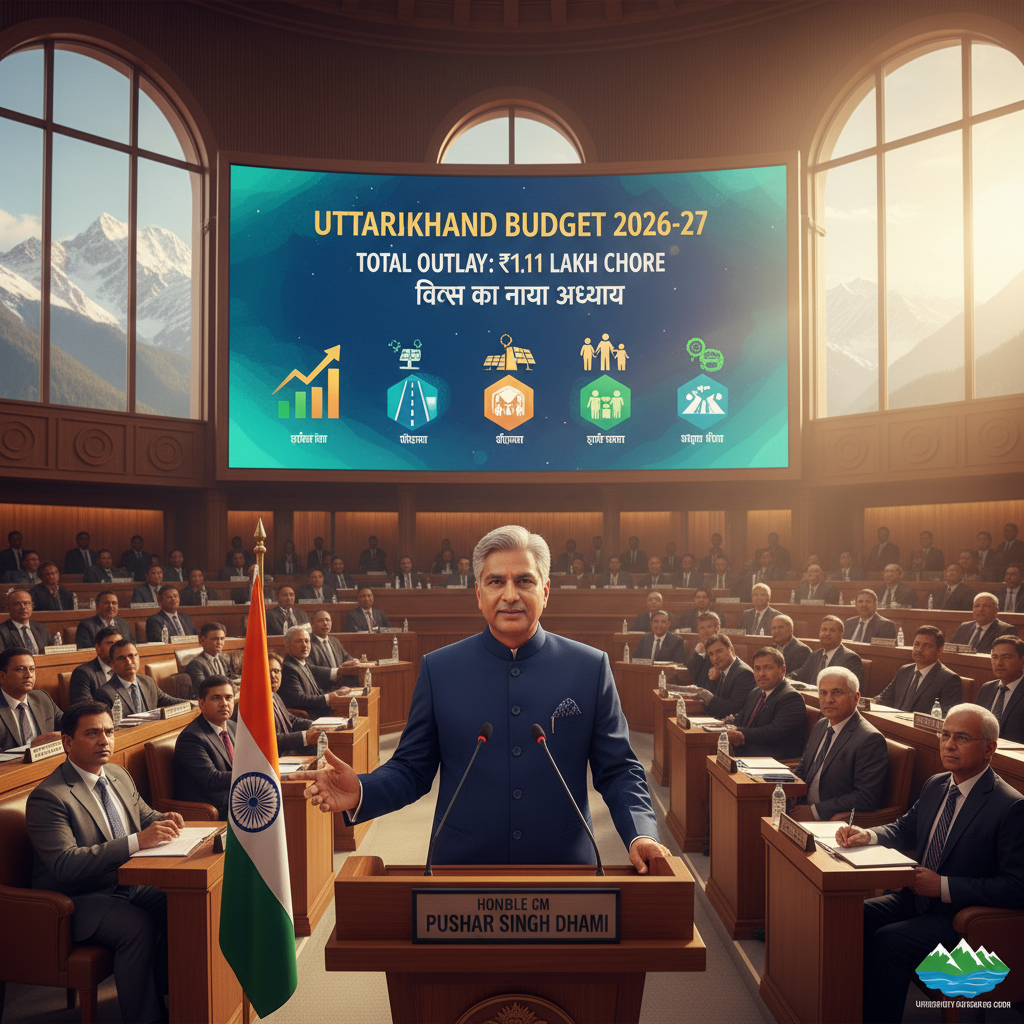
The chief minister of Uttarakhand, Pushkar Singh Dhami, presented the Uttarakhand State Budget 2026 on 5 February 2026, unveiling a total outlay of Rs 1.11 lakh crore for the fiscal year 2026‑27. This marks a substantial rise from the previous year’s allocation and signals the government’s intent to accelerate development across the hill state. The budget was tabled in the state assembly amid a crowd of elected representatives, industry leaders and civil‑society groups, who listened closely to the chief minister’s emphasis on balanced growth that bridges urban hubs and remote villages.
According to the finance department’s projection, revenue receipts are expected to climb by around 9 percent year‑on‑year, driven by an upswing in state GST collections and new non‑tax avenues. The fiscal deficit has been pegged at 3.2 percent of Gross State Domestic Product (GSDP), staying within the reform framework suggested by the Finance Commission and reinforcing a disciplined fiscal stance.
The presentation highlighted several cross‑cutting themes: bolstering infrastructure, expanding welfare programmes, and encouraging digital transformation. By tapping a diversified revenue base, the government aims to fund ambitious projects while maintaining macro‑economic stability, a balance that policymakers say will be critical for sustaining growth in the coming years. 
For a deeper dive into the state’s fiscal management, refer to the Uttarakhand Wikipedia page and the official Finance Ministry of India releases.
Fiscal Priorities and Allocation
The Uttarakhand State Budget 2026 places a pronounced emphasis on three core fiscal priorities: infrastructure development, energy security, and digital transformation. Capital expenditure has been raised to Rs 45,000 crore, a 15 percent increase over the prior fiscal year, earmarking funds for highways, urban housing, and renewable‑energy projects.
Key allocations include:
- Road connectivity: Rs 12,000 crore for widening the Delhi‑Haridwar highway and constructing 1,200 km of new rural roads.
- Renewable energy: Rs 8,500 crore for a 500 MW solar park and incentives for wind farms.
- Digital infrastructure: Rs 4,200 crore to expand the state‑wide broadband network and upgrade e‑governance portals.
- Disaster resilience: A dedicated corpus of Rs 5,000 crore for climate‑adaptation and disaster‑management initiatives.
On the revenue side, the budget estimates GST collections of approximately Rs 30,000 crore, reflecting a broader tax base. Non‑tax revenues such as mineral royalties and tourism fees are projected to contribute an additional Rs 12,000 crore, underscoring the government’s strategy to reduce reliance on a single source of income.
Key Infrastructure Projects
Infrastructure continues to dominate the budget’s implementation agenda, with several high‑visibility projects slated for commencement in the next twelve months. The chief minister announced the following milestones:
- Delhi‑Haridwar Highway Widening: Completion of four lanes to cut travel time between the national capital and the pilgrimage gateway by up to 30 percent.
- Rural Road Expansion: Construction of 1,200 km of all‑weather roads connecting remote villages, expected to create 150,000 temporary jobs.
- Industrial Corridors: Development of three new corridors—Kashipur‑Rudrapur, Pantnagar‑Bhimtal, and Chamoli‑Gopeshwar—aimed at attracting private investment worth over Rs 10,000 crore.
- Solar Power Park: A 500 MW solar park in the Chamoli district, projected to generate 2,500 GWh annually and reduce the state’s carbon emissions by an estimated 1.2 million tonnes.
- Heritage Tourism Circuit: Rs 2,000 crore allocated for upgrading hotels, transport links, and heritage sites across Rishikesh, Mussoorie, and Dehradun, set to boost tourist arrivals by 12 percent.
These initiatives collectively aim to generate over 250,000 employment opportunities during the construction phase, while also positioning Uttarakhand as a hub for clean‑energy investments.
For more on Uttarakhand’s energy strategy, see the Renewable Energy in India Wikipedia entry and the state’s official energy department.
Welfare Schemes and Social Sectors
In line with its commitment to inclusive growth, the Uttarakhand State Budget 2026 allocates a significant portion of resources to welfare programmes targeting women, children, farmers, and marginalized communities.
Farmers: Rs 12,000 crore is earmarked for the continuation and expansion of the ‘Kisan Sathi’ scheme, which provides direct cash transfers to small and marginal farmers. Eligibility criteria include land holdings of up to 2 hectares and a maximum family income of Rs 1.5 lakh per annum.
Women and Girls: Under the ‘Beti Bachao, Beti Padhao’ initiative, Rs 1,500 crore will fund scholarships, skill‑development workshops, and entrepreneurship incubators for girl students across the state.
Health: The health budget rises to Rs 8,000 crore, focusing on strengthening primary health centres, expanding the Ayushman Bharat Scheme to cover an additional 1.5 million beneficiaries, and launching tele‑medicine hubs in remote hilly regions.
Education: Rs 10,000 crore is earmarked for upgrading school infrastructure, installing smart classrooms, and enhancing vocational training institutes. The allocation also includes a scholarship fund of Rs 500 crore for STEM programmes in government schools.
These welfare measures are designed to improve human development indices, reduce poverty gaps, and create a skilled workforce ready to support the state’s burgeoning industrial and tourism sectors.
Impact on Citizens and Economy
The ripple effects of the Uttarakhand State Budget 2026 are anticipated to be profound. Improved road connectivity is projected to cut average travel time in remote districts by up to 30 percent, facilitating better access to markets, healthcare, and education. Enhanced energy generation from solar and hydro projects is expected to lower electricity tariffs for households and industries, boosting competitiveness and encouraging foreign direct investment in manufacturing.
From a macro‑economic perspective, economists forecast that the budget’s growth‑oriented spending could lift Uttarakhand’s Gross State Domestic Product growth rate to 7.5 percent in FY 2027, outpacing the national average. The emphasis on renewable energy and digital infrastructure is also likely to spawn a new wave of green‑tech startups, creating thousands of high‑skill jobs.
Social impact assessments suggest that the expanded health and education budgets will improve key development indicators such as infant mortality rate and literacy, especially in the state’s under‑served rural blocks. Moreover, the tourism‑focused heritage circuit is expected to increase visitor spending by an estimated Rs 4,200 crore annually, providing a vital boost to local economies.
Expert Reactions and Future Outlook
Industry analysts have praised the budget’s balanced approach, noting the prudent fiscal stance coupled with aggressive capital spending. Dr. R. Singh, senior economist at the National Institute of Financial Studies, remarked that “the fiscal deficit target of 3.2 % of GSDP demonstrates a measured confidence in revenue projections while allowing room for essential investments.”
However, some critics caution that the revenue assumptions may be optimistic given global economic headwinds and fluctuations in GST collections. Opposition leaders have called for greater transparency in the allocation of funds for flagship projects, urging the government to publish detailed implementation timelines and performance metrics.
The chief minister, in his concluding remarks, assured that a mid‑year review will be conducted to assess progress and recalibrate priorities if necessary. He emphasized that the budget is a “transformative step” aimed at positioning Uttarakhand as a model for sustainable development in the Himalayas.
Looking ahead, the administration plans to launch a series of public‑private partnership (PPP) initiatives in renewable energy, smart‑city projects, and digital service delivery. These measures are designed to attract private capital, accelerate innovation, and ensure that the benefits of growth are widely shared across the state’s diverse communities.
Stay updated with the latest Yojana schemes and government initiatives for better awareness and eligibility. For personalized guidance on accessing these benefits, reach out to us.