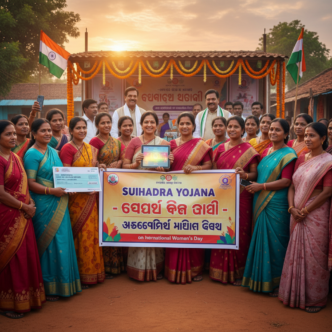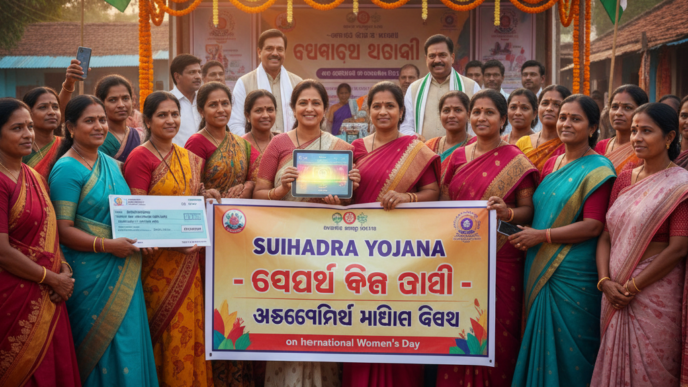





In a landmark move that underscores the Odisha government’s focus on gender‑sensitive fiscal policy, the state is set to disburse Rs 5,000 crore under the Subhadra Yojana tomorrow, directly crediting over 1.02 crore women who meet the eligibility criteria. The cash transfer, announced in the 2024‑25 budget, marks the first phase of a broader initiative aimed at boosting household purchasing power, narrowing the gender wage gap, and accelerating financial inclusion across both rural and urban locales. Officials indicated that the amount will be transferred in a single tranche to bank accounts linked to the beneficiaries’ Aadhaar‑verified accounts, leveraging the state’s existing Direct Benefit Transfer (DBT) infrastructure. The rollout coincides with a national conversation on cash‑based welfare schemes, and the government of Odisha has partnered with the National Payment Corporation to ensure real‑time monitoring. While the exact per‑beneficiary quantum will vary based on local socio‑economic parameters, early estimates suggest an average annual assistance of Rs 5,000 per household, a figure that could significantly augment everyday expenses for millions of families.
Scheme Overview
The Subhadra Yojana is structured as a direct cash transfer that bypasses intermediaries and lands straight into the bank accounts of eligible female heads of household. By capitalising on the state’s extensive network of bank branches and the Aadhaar‑linked citizen database, the programme guarantees that each beneficiary receives a pre‑determined credit, typically Rs 5,000 per annum, though modest variations may exist across districts. The funding originates from the state’s consolidated fund, with the finance department earmarking a dedicated Rs 5,000 crore allocation that will be released in a single, transparent tranche. This approach not only reduces the risk of leakage but also fosters a culture of formal banking among women who have traditionally operated in the informal cash economy. Moreover, the scheme is integrated with other welfare pillars such as the Pradhan Mantri Kisan Samman Nidhi for agricultural households, creating synergies that amplify overall developmental impact. The rollout is expected to generate a ripple effect across local markets, as increased disposable income stimulates demand for goods ranging from food supplies to household appliances, thereby supporting small and medium‑scale enterprises.
To safeguard the integrity of the disbursement, the government has deployed a suite of technological safeguards, including machine‑learning anomaly detection that flags duplicate Aadhaar links or irregular transaction patterns. Real‑time dashboards hosted on the Odisha e‑Governance portal will display metrics such as the number of successful credits, pending payments, and regional coverage, allowing supervisors to intervene promptly. Additionally, a dedicated grievance redressal portal will enable beneficiaries to report delays or discrepancies, with a guaranteed response window of 48 hours. These measures collectively aim to create a transparent, accountable, and citizen‑centric implementation framework that can be replicated in other states pursuing similar cash‑transfer models. 
Target Beneficiaries and Eligibility Criteria
Subhadra Yojana targets approximately 1.02 crore women across Odisha, cutting across diverse socio‑economic groups. Eligibility is primarily extended to women who serve as the primary head of their household and belong to one of the following categories: (i) Scheduled Caste (SC) or Scheduled Tribe (ST) members; (ii) marginal farmers cultivating less than two hectares of land; (iii) members of Self‑Help Groups (SHGs) who possess a Below Poverty Line (BPL) certificate; and (iv) widows, single mothers, or women with disabilities who meet the income thresholds set by the Rural Development Department. In addition, the scheme grants priority status to women who are the sole earners in their families, ensuring that the most vulnerable receive timely assistance. Applicants must furnish a suite of documents, including a valid Aadhaar card, proof of residence, land‑holding records, and a self‑declaration form confirming eligibility. These documents are cross‑verified against the state’s integrated citizen database, which aggregates data from the National Population Register (NPR), the Public Distribution System (PDS), and the Land Records Information System (LRIS). This multi‑source verification mechanism is designed to minimise false claims and ensure that only genuine beneficiaries receive the transfer.
The selection methodology also incorporates a tiered priority system. For instance, widows and women with disabilities receive a higher weighting in the verification algorithm, reflecting the government’s commitment to inclusive welfare. Moreover, the scheme explicitly excludes women who are already covered under other state‑run cash‑transfer programmes, thereby avoiding duplication and ensuring optimal utilisation of the allocated Rs 5,000 crore. By stratifying beneficiaries based on socio‑economic vulnerabilities, the programme aims to achieve a targeted impact that directly addresses gender‑based economic disparities.
Objectives, Impact and Economic Outlook
Subhadra Yojana pursues three interlocking objectives: first, to augment the purchasing power of women, enabling them to meet daily household expenses and invest in income‑generating activities; second, to promote financial inclusion by encouraging beneficiaries to open and maintain bank accounts, thereby integrating them into the formal financial ecosystem; and third, to stimulate localized economic activity through the infusion of cash that circulates within communities. Preliminary economic simulations indicate that the injection of Rs 5,000 crore could boost the state’s Gross State Domestic Product (GSDP) by an estimated 0.2 percent within the first fiscal year, primarily through heightened consumer spending on essential goods and services. Beyond macro‑economic gains, the scheme is expected to foster socio‑empowerment, as increased financial autonomy often translates into greater decision‑making authority within households, improved health outcomes, and enhanced educational aspirations for children.
From a gender‑equity perspective, the initiative aligns with national policy frameworks that seek to close the gender wage gap and promote women’s participation in the labour force. By providing a stable cash inflow, the scheme enables women to undertake small‑scale entrepreneurship, purchase agricultural inputs, or fund skill‑development programmes without the constraints of traditional credit markets. Moreover, the direct‑benefit approach is recognised globally as an efficient poverty‑alleviation tool, as evidenced by studies from the World Bank and the International Monetary Fund, which highlight the rapid impact of cash transfers on household welfare. As such, Subhadra Yojana is positioned not only as a fiscal stimulus but also as a catalyst for broader social transformation.
Implementation, Monitoring and Political Context
The rollout schedule has been meticulously phased to ensure operational smoothness. The inaugural wave, slated to commence tomorrow, will credit approximately 25 lakh beneficiaries across priority districts, with subsequent phases expanding coverage to the remaining 77 lakh women in a staggered manner. A joint task force comprising officials from the Finance Department, the Department of Women and Child Development, and senior representatives from major banks will supervise the disbursement process on a real‑time basis. The task force will utilise an interactive dashboard that updates hourly with key performance indicators, such as the number of transactions completed, pending payments, and regional coverage percentages. This transparency framework is complemented by an SMS‑based notification system that informs each beneficiary once funds are credited to their account, thereby reducing uncertainty and enhancing trust.
Political reactions to the scheme have been mixed. While the ruling coalition has hailed Subhadra Yojana as a visionary step toward a cash‑less, inclusive economy, opposition parties have raised concerns about its fiscal sustainability, urging the government to safeguard capital expenditures and ensure that the programme does not become a long‑term burden on state finances. Economists, however, have generally praised the direct‑benefit transfer model for its efficiency and targeted impact. Dr. Aparna Singh, a senior fellow at the Centre for Development Studies, remarked that “Subhadra Yojana could serve as a benchmark for other states aiming to combine fiscal prudence with social equity.” The scheme’s ultimate success will depend on its ability to deliver timely payments, maintain robust monitoring, and adapt to feedback from beneficiaries and stakeholders.
Stay updated with the latest Yojana schemes and government initiatives for better awareness and eligibility. For personalized guidance on accessing these benefits, reach out to us.