


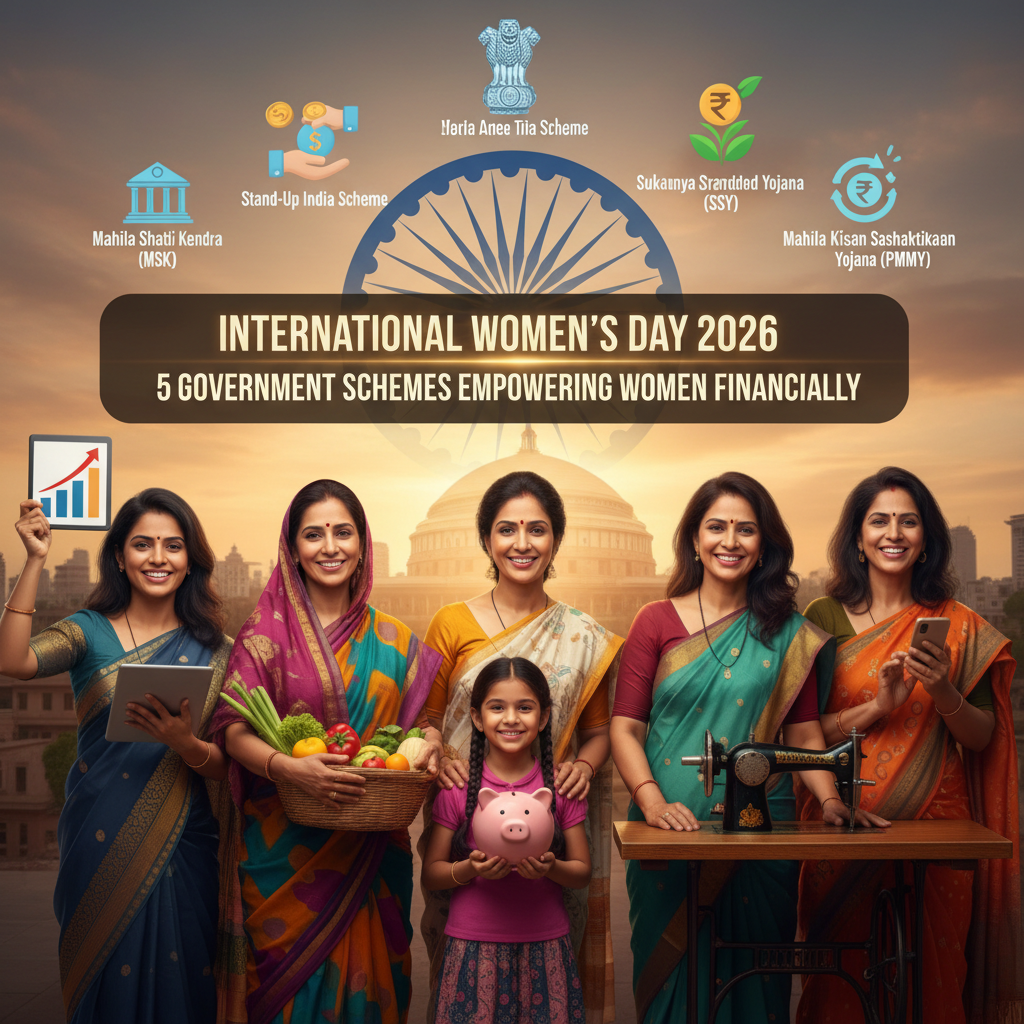
International Women’s Day 2026: 5 Government Schemes Empowering Women Financially
International Women’s Day, observed each year on March 8, serves as a pivotal moment to assess progress toward gender parity and to spotlight the remaining gaps. The 2026 global theme, “Finance for Women: Empowering Economic Independence,” underscores the critical role of policy interventions in narrowing the economic gender gap. In India, where women’s labour force participation hovers around 23 % (World Bank, 2024), the government has intensified its focus on financial inclusion through a suite of targeted schemes. These programmes aim to deliver not only capital but also skill development, mentorship, and market linkage, enabling women to expand micro‑enterprises, secure agricultural incomes, and build long‑term financial resilience. Consequently, they contribute directly to household incomes, improve community well‑being, and foster a more inclusive national economy.
1. Mahila Shakti Kendra (MSK)
Launched by the Ministry of Women and Child Development, Mahila Shakti Kendra (MSK) establishes multipurpose centres in densely populated and underserved blocks across the country. Each centre functions as a one‑stop hub for women entrepreneurs, offering intensive entrepreneurship development programmes, legal counselling on business registration and labour rights, and facilitation of micro‑credit through partnered banks and micro‑finance institutions. Beneficiaries receive mentorship from industry experts, access to market intelligence, and networking opportunities with peer groups to foster collaborative ventures. According to official reports from the Ministry, over 5,200 MSK centres have been operationalised since the scheme’s inception in 2022, directly reaching more than 1.2 million women. The initiative prioritises low‑cost, scalable interventions that aim to increase the proportion of women‑owned micro‑enterprises, thereby generating employment and elevating community‑level incomes.
- Entrepreneurial training workshops
- Legal aid services
- Concessional micro‑credit through partner banks
Learn more about women empowerment initiatives 
2. Stand‑Up India Scheme
The Stand‑Up India scheme, administered by the Ministry of Finance, mandates scheduled commercial banks to provide term loans ranging from ten lakh rupees to one crore rupees to at least one woman‑owned venture and one scheduled caste or scheduled tribe venture per branch. The loan facility covers a broad spectrum of activities, including manufacturing, services, agri‑enterprise, and trading. Beyond financing, beneficiaries receive structured mentorship that pairs them with seasoned entrepreneurs, as well as connections to digital marketplaces that accelerate sales and brand visibility. The scheme also features a streamlined online application process, a dedicated grievance redressal cell, and a monitoring dashboard that tracks loan disbursement and business performance, ensuring transparency and accountability. As of the fiscal year 2025‑26, more than 78,000 loan applications have been sanctioned under the scheme, with a cumulative disbursement exceeding ₹ 12,500 crore.
- Loans from ₹10 lakh to ₹1 crore
- Mentorship and market linkage
- Focus sectors: agriculture, services, manufacturing
Press Information Bureau – Stand‑Up India
3. Sukanya Samriddhi Yojana (SSY)
Though technically a savings scheme rather than a direct enterprise‑support programme, the Sukanya Samriddhi Yojana (SSY) plays an instrumental role in building the financial foundation for girl children, who will become the next generation of entrepreneurs. The scheme offers an attractive, government‑guaranteed interest rate that is periodically revised and compounds annually, with the added benefit of complete tax exemption on both deposits and accrued interest. Parents can deposit up to ₹1.5 lakh per annum into an SSY account, and the accumulated corpus can be withdrawn after the girl turns 18 for purposes such as higher education, marriage, or seed capital for a micro‑business. By incentivising the education and financial planning of girls, SSY indirectly creates a pipeline of financially literate women who are better positioned to launch and sustain enterprises.
- High interest compounding (currently 7.6 % per annum)
- Tax‑free maturity benefits
- Funds can finance education or business ventures
Wikipedia – Sukanya Samriddhi Yojana
4. Mahila Kisan Sashaktikaran Yojana (MKS)
Implemented by the Ministry of Agriculture and Farmers’ Welfare, the Mahila Kisan Sashaktikaran Yojana (MKS) targets women engaged in agriculture by providing skill enhancement programmes, access to certified seeds and inputs, and micro‑insurance coverage. The scheme also facilitates collective marketing through farmer producer organisations, allowing women farmers to achieve better price realization for their produce. By integrating financial literacy modules, MKS empowers female agrarians to manage farm‑level finances, negotiate credit terms, and plan for post‑harvest investments, thereby increasing household cash flow and reducing vulnerability to market fluctuations. In the 2024‑25 fiscal year, over 1.8 million women farmers were enrolled in MKS, with an average income uplift of 12 % reported across participating states.
- Skill training for agri‑entrepreneurs
- Access to certified inputs and micro‑insurance
- Collective marketing support through producer organisations
5. Pradhan Mantri Mudra Yojana (PMMY) – Women Segment
While the Pradhan Mantri Mudra Yojana (PMMY) is a universal micro‑finance scheme, its women‑specific component dedicates a portion of the loan portfolio exclusively to female applicants. The loan category, known as “Shishu,” targets new‑age entrepreneurs and offers funding up to ₹10 lakh without collateral, aiming at start‑ups in services, retail, and home‑based businesses. Interest rates are competitive, and repayment tenures are flexible, lowering the barrier to entry for women who traditionally lack collateral. The scheme’s extensive reach, backed by a network of over 5,000 financial institutions, ensures that even women in remote areas can access capital to launch or expand small ventures. According to the Ministry of Finance’s 2025 report, women accounted for 38 % of total Mudra loan disbursements, amounting to ₹ 3.2 lakh crore in the previous fiscal year.
- Collateral‑free loans up to ₹10 lakh
- Targeted at service and retail start‑ups
- Flexible repayment options
Pradhan Mantri Mudra Yojana official site
Collectively, these five initiatives illustrate the Indian government’s commitment to financial empowerment for women, aligning with the International Women’s Day 2026 focus on economic independence. By blending credit access, skill development, and forward‑looking savings instruments, the programmes create multiple entry points for women to participate in the formal economy. Policymakers continue to refine these schemes based on feedback from beneficiaries, with plans to expand digital platforms and enhance monitoring mechanisms. As the nation celebrates the achievements of women across sectors, the synergy between policy intent and on‑ground impact promises a future where financial independence is not merely an aspiration but a tangible reality for every Indian woman.
Stay updated with the latest Yojana schemes and government initiatives for better awareness and eligibility. For personalized guidance on accessing these benefits, reach out to us.