



Vikash Manthan 1.0: Record‑breaking Investment and 7.9 % Growth
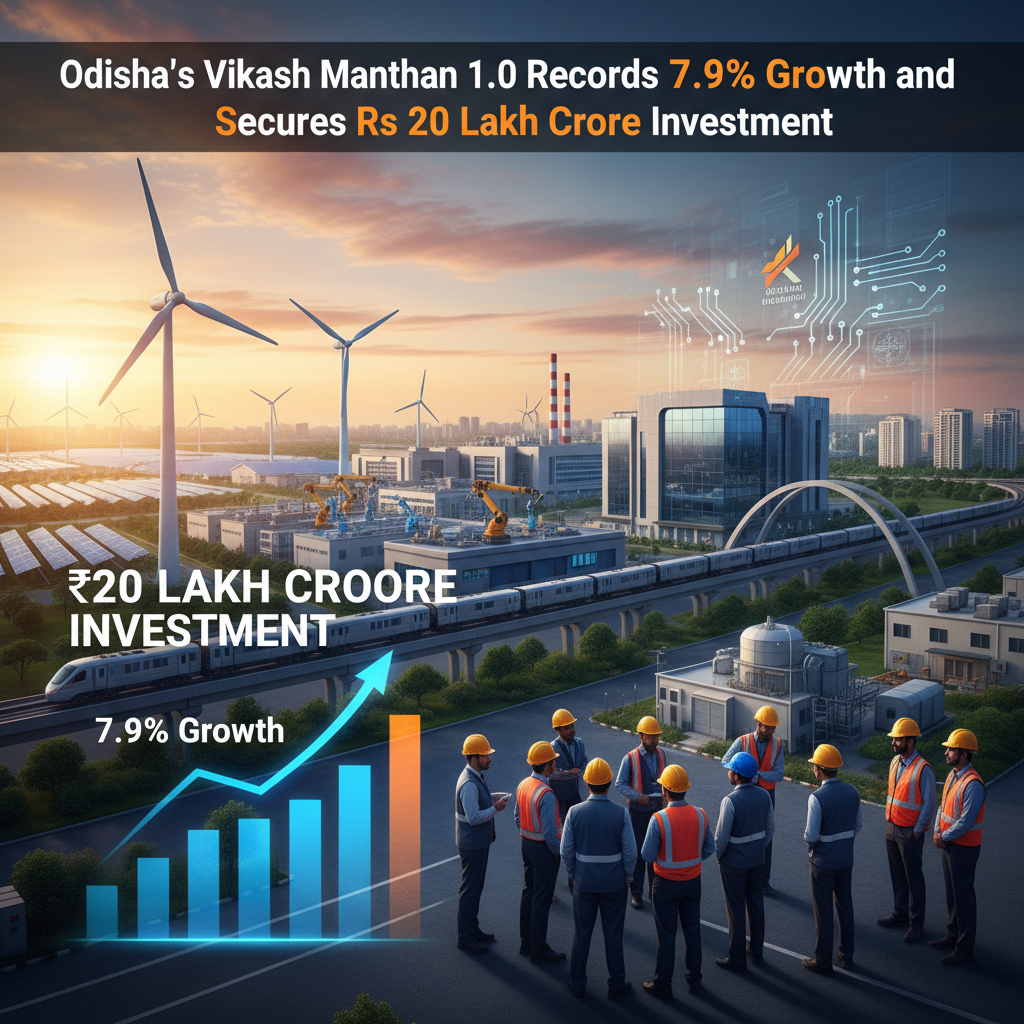
Odisha’s Vikash Manthan 1.0 initiative, launched in early 2024, has delivered a 7.9 percent expansion in the state’s industrial output and secured Rs 20 lakh crore of investment within a 20‑month window that ended in February 2026. The figure, disclosed by the Department of Industry and Enterprises, reflects a confluence of manufacturing upgrades, ancillary service expansion, and a ripple effect across logistics, housing and education sectors. Analysts attribute the growth to a coordinated policy suite, aggressive investor outreach and a streamlined clearance process that cut average approval times from 180 days to under 45 days. The achievement places Odisha among a handful of Indian states that have crossed the 7 percent growth threshold in a single fiscal year, underscoring the scheme’s potency as a catalyst for economic acceleration.
Policy Toolkit Fuelling Investor Confidence
The momentum behind Vikash Manthan 1.0 can be traced to a calibrated set of interventions that lower risk and compress project timelines. A single‑window clearance system now consolidates land acquisition, environmental approvals and statutory clearances into one administrative node, slashing the typical clearance cycle to less than 45 days for priority projects. Financial incentives include up to 15 percent capital subsidies and interest‑rate concessions of up to 2 percent on loans for land purchase and equipment procurement. The state has also rolled out a suite of infrastructure facilities: pre‑developed industrial parks with uninterrupted power, high‑speed broadband and ready‑to‑use utilities, coupled with land allotment at concessional rates. Moreover, regulatory flexibility permits conditional environmental clearances provided robust mitigation plans are submitted, and a fast‑track licensing pathway accelerates clearances for critical infrastructure components. These measures have collectively reduced the total cost of capital for investors by an estimated 3‑4 percent, making Odisha a competitively priced destination compared with neighbouring states.
Sectoral Breakdown and Economic Ripple Effects
The investment pipeline under Vikash Manthan 1.0 is marked by its heterogeneity, encompassing more than 190 projects that span five core sectors. The following outlines the key areas: 
- Metal & Mining – expansion of steel plants, aluminium smelting units and mineral processing facilities.
- Automotive & Auto Components – establishment of component manufacturing hubs targeting export markets.
- Renewable Energy – solar and wind farm developments, including large‑scale storage solutions.
- Electronics & Semiconductors – pilot fabs and assembly lines aimed at reducing import dependence.
- Textiles & Apparel – modernisation of garment factories with an emphasis on technical textiles.
These projects are projected to contribute an estimated Rs 12 lakh crore to the state’s Gross State Domestic Product (GSDP) over the next five years, reinforcing the scheme’s macro‑economic significance. Beyond capital inflow, the scheme has generated tangible socio‑economic benefits for local communities. In districts such as Sundargarh and Keonjhar, construction activity has spurred a 28 percent rise in revenue for logistics firms, while ancillary manufacturers report order growth of 22‑35 percent. This demand surge has translated into higher working capital, expanded staffing and a corresponding uplift in per‑capita income. Housing developers have responded with new residential projects for migrant workers, and educational institutions have introduced short‑term skill modules aligned with factory requirements, thereby improving employability. The ripple effect extends to health and education outcomes: districts hosting major projects have recorded a 1.2 percent improvement in the Human Development Index (HDI) over the same period, a testament to the scheme’s inclusive growth agenda.
Human Capital, Skill Development and Sustainability Measures
Recognising that a skilled workforce is essential for sustaining high‑value manufacturing, Vikash Manthan 1.0 incorporates a dedicated skill‑development component. The government has funded twelve state‑of‑the‑art training centres focusing on robotics, advanced welding, renewable energy systems and Industry 4.0 technologies. Partnerships with premier institutes such as the Indian Institute of Technology Bhubaneswar, the National Institute of Technology Rourkela and leading private training providers ensure curriculum relevance and industry alignment. As of the latest enrollment figures, more than 52,000 candidates have signed up for upskilling courses, with placement rates exceeding 78 percent in participating enterprises. These programmes are designed to be eligible for stipend support under the Odisha Skill Development Mission, making them financially accessible to youth from economically disadvantaged backgrounds.
Environmental stewardship is woven into the scheme’s fabric through a comprehensive sustainability framework. Projects exceeding a predefined investment threshold must undergo a rigorous Environmental Impact Assessment (EIA) and commit to mitigation measures that align with international standards. The state offers additional tax rebates for initiatives that source at least 30 percent of their power from renewable sources, adopt waste‑to‑energy technologies, or achieve ISO 14001 certification. Preliminary audits indicate that roughly 34 percent of approved projects have integrated renewable energy components, collectively projected to curb annual carbon emissions by over 1.4 million tonnes. Water‑recycling systems, green belt creation around industrial clusters and strict effluent‑treatment norms further underscore the commitment to sustainable development. These measures not only safeguard local ecosystems but also enhance the competitiveness of Odisha’s industrial portfolio in global markets that increasingly favour low‑carbon footprints.
Monitoring, Evaluation and Governance Framework
Transparency and accountability are enforced through a publicly accessible performance dashboard that tracks a suite of key performance indicators (KPIs), including investment inflow, project execution milestones, employment generation, land utilisation and sustainability scores. The dashboard, hosted on the official Vikash Manthan portal, updates in real time and is complemented by quarterly reviews conducted by an independent advisory council comprising academia, industry representatives and civil‑society actors. These reviews generate publicly released findings, enabling stakeholders to monitor progress and propose course corrections where necessary. The governance model also incorporates a grievance redressal mechanism that allows project proponents and local communities to flag implementation challenges, ensuring that policy adjustments are data‑driven and responsive. This rigorous oversight has been instrumental in maintaining investor confidence and reinforcing the scheme’s credibility on the global stage.
Looking Ahead: From Manthan 1.0 to Manthan 2.0
Building on the lessons distilled from the inaugural phase, the Odisha government is preparing to launch Vikash Manthan 2.0 in the fiscal year 2027. The next iteration will broaden the sectoral focus to include emerging domains such as semiconductor fabrication, artificial intelligence research incubators, advanced materials and biotechnology. Anticipated investment targets are set at Rs 25 lakh crore, with an emphasis on technology transfer, export‑oriented production and deep‑tech entrepreneurship. Strategic collaborations with central government schemes, notably the Production‑Linked Incentive (PLI) programme, are being woven into the fabric of Manthan 2.0 to amplify synergies and attract global partners. The upcoming phase also aims to deepen the sustainability agenda by targeting carbon‑neutral operations for at least 50 percent of approved projects by 2030. By leveraging the solid foundation laid in Manthan 1.0, Odisha aspires to cement its position as a premier industrial hub in eastern India and a model for state‑led economic transformation.
Stay updated with the latest Yojana schemes and government initiatives for better awareness and eligibility. For personalized guidance on accessing these benefits, reach out to us.