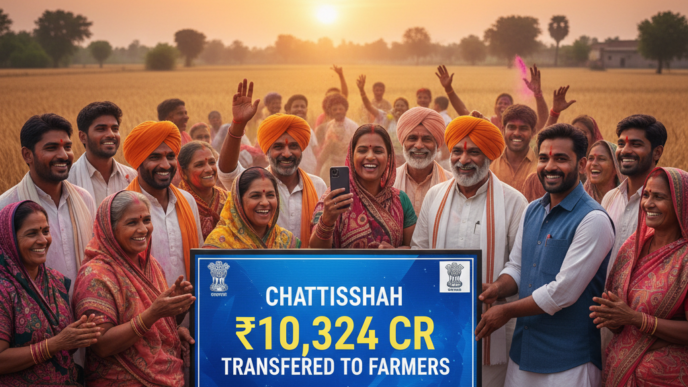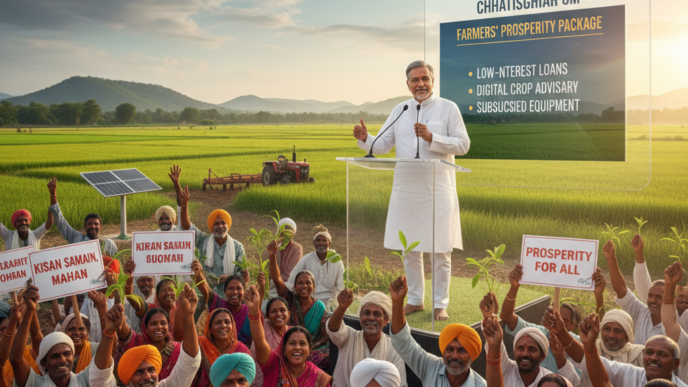





Chhattisgarh Announces ₹10,000 Crore Paddy Price Differential Payout for 25 Lakh Farmers Ahead of Holi
In a landmark move that could reshape agrarian economics in central India, the Chhattisgarh government unveiled a ₹10,000 crore scheme to bridge the gap between market prices of paddy and the Minimum Support Price (MSP). The payout, announced just days before the festive onset of Holi, targets over 25 lakh small and marginal cultivators across the state’s rice‑belt districts. By guaranteeing a differential payment when market rates dip below the MSP, the initiative seeks to safeguard farmer incomes, curb distress migration, and reinforce rural purchasing power ahead of the upcoming planting season.
Overview of the Paddy Price Differential Payout Scheme
The scheme functions as a targeted price support mechanism, wherein the state will compensate farmers for the shortfall between the prevailing market price and the officially declared MSP for paddy. According to the Department of Agriculture, the differential will be calculated on a per‑acre basis and transferred directly into the beneficiaries’ bank accounts through the state’s digital payment platform. This approach aims to eliminate intermediaries and ensure that the assistance reaches the intended recipients without leakage.
Chief Minister Bhupesh Baghel emphasized that the policy aligns with the broader vision of making Chhattisgarh a “model state for agricultural prosperity.” He noted that the initiative builds on previous welfare measures such as the Pradhan Mantri Kisan Samman Nidhi, crop insurance, and irrigation expansion projects. 
Eligibility and Geographic Scope
To qualify for the differential payout, a farmer must meet several criteria:
- Target group: Small and marginal paddy growers cultivating the crop during the last kharif season.
- Geographic coverage: The benefit will be rolled out across 12 high‑production districts, including Raipur, Bilaspur, Surguja, and Dhamtari.
- Documentation: Applicants must possess a valid land‑holding certificate and be registered on the state’s farmer portal.
- Bank linkage: The payout will be transferred to an Aadhaar‑verified bank account linked to the farmer’s registration.
Official estimates from the Finance Department suggest that more than 25 lakh cultivators meet these conditions. The government has opened a dedicated help‑desk on the portal to assist applicants with documentation and verification, aiming to streamline the process and reduce grievances.
Financial Impact and Expected Benefits
While the exact payout amount will vary depending on market fluctuations, preliminary calculations indicate an average assistance of ₹4,000 per acre. For a typical smallholder cultivating 1–2 acres, this translates into an additional annual income of ₹12,000–₹18,000.
From a macro‑economic perspective, the aggregate outflow of ₹10,000 crore is projected to raise the average earnings of eligible farmers by up to 15 percent. Finance Minister O.P. Chaudhary highlighted that this influx of cash is expected to stimulate ancillary sectors such as agro‑processing, cold storage, and transportation, thereby generating multiplier effects in rural economies.
Experts note that the scheme could also serve as a buffer against volatile global commodity prices. A recent report by the Business Standard underscores that price differentials have widened in recent years due to export demand shifts, making such targeted support increasingly relevant for farmer stability.
Implementation and Disbursement Timeline
The rollout is slated to commence in the first week of March, marking the beginning of the post‑kharif harvest period. The Finance Department will issue a detailed disbursement schedule during the upcoming budget session, outlining tranche-wise payments tied to harvest cycles.
Farmers are urged to ensure that their bank details, including IFSC codes and Aadhaar linkage, are up‑to‑date on the official portal. Failure to update this information could result in delayed or blocked transfers. The government has integrated the disbursement system with the Employees’ Provident Fund Interface for real‑time tracking, allowing cultivators to monitor the status of their applications and receive notifications upon credit.
Additionally, a public awareness campaign will be conducted through local radio, WhatsApp groups, and village-level kiosks to educate farmers about the application process, required documents, and grievance redressal mechanisms.
Broad Implications and How to Avail the Benefit
Beyond immediate financial relief, the differential payout is anticipated to foster broader rural development. Increased disposable income in farming households is likely to boost demand for locally produced goods, encouraging entrepreneurship in sectors such as organic inputs, handicrafts, and agri‑tourism. Moreover, the scheme may set a precedent for other states grappling with similar agrarian distress, potentially influencing national policy discussions on price support mechanisms.
For farmers eager to claim the benefit, the process is straightforward:
- Log in to the Chhattisgarh Farmer Registration Portal (https://agr.cgstate.gov.in).
- Upload a scanned copy of the land‑holding certificate and verify Aadhaar‑linked bank details.
- Submit the application; the system will generate a unique reference number for tracking.
- Monitor the status through the portal’s dashboard; any discrepancies can be addressed via the 24/7 help‑desk.
In case of grievances or delays, beneficiaries can approach the district agriculture office or file a complaint through the portal’s grievance redressal module, ensuring transparency and accountability.
Stay updated with the latest Yojana schemes and government initiatives for better awareness and eligibility. For personalized guidance on accessing these benefits, reach out to us.