


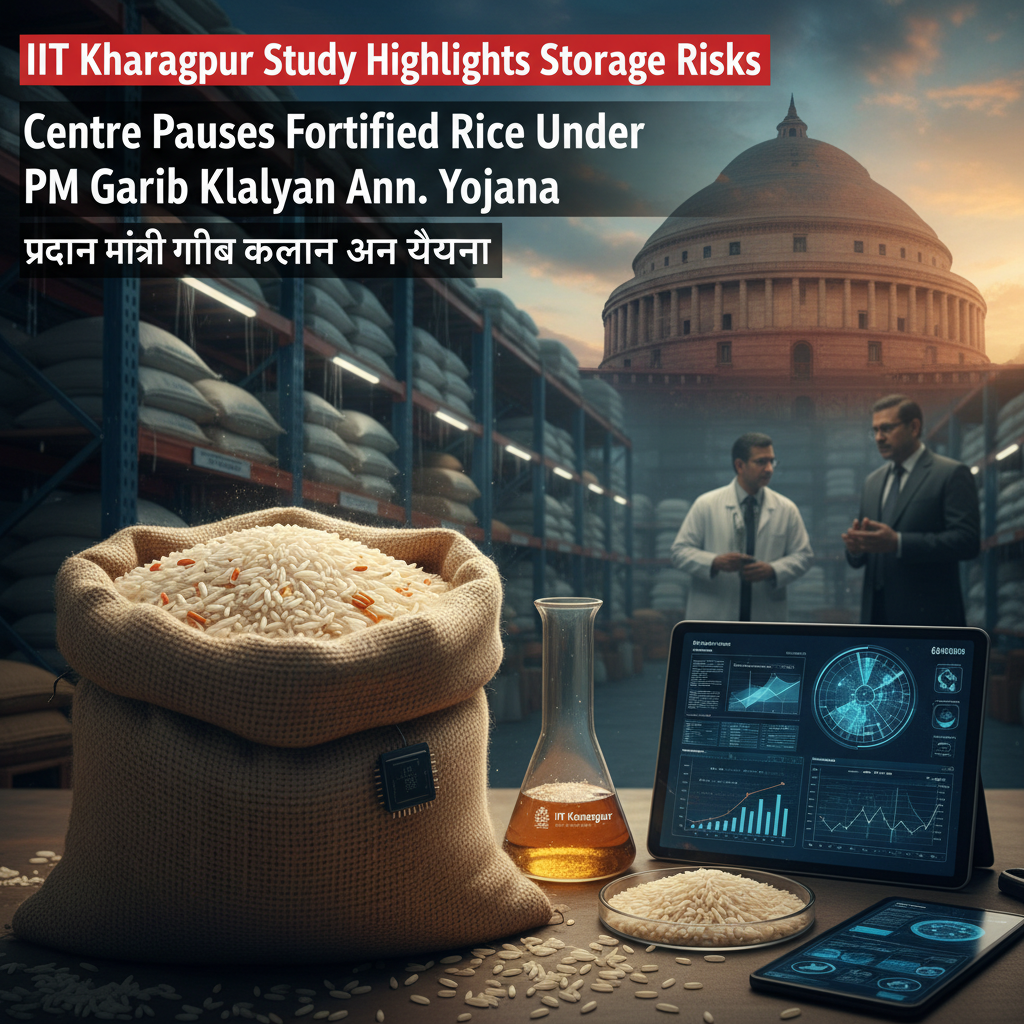
Research conducted by the Indian Institute of Technology Kharagpur has uncovered critical storage vulnerabilities in fortified rice distributed through the Pradhan Mantri Garib Kalyan Anna Yojana, prompting the Ministry of Consumer Affairs to pause its distribution until a robust monitoring system is established. The study, released on 28 February 2026, examined how high humidity and temperatures up to 35 °C degrade essential micronutrients such as iron, zinc and vitamin A. Laboratory tests on samples from Delhi, Hyderabad and Bengaluru warehouses revealed a 12‑15 percent loss of vitamin A activity and a measurable reduction in iron bioavailability after just 90 days under sub‑optimal conditions. While the fortified grain is a cornerstone of the scheme aimed at tackling anemia and hidden‑hunger among the nation’s poorest households, the findings raise concerns about the reliability of current storage infrastructure across key procurement hubs.
Background of the Study
The investigation employed a mixed‑methods approach, combining quantitative stability testing with qualitative interviews of warehouse managers. Researchers simulated real‑world storage environments by exposing fortified rice batches to temperatures ranging from 25 °C to 35 °C and relative humidity levels between 60 % and 85 %, reflecting the climatic diversity of India’s major grain‑handling states. High‑performance liquid chromatography (HPLC) quantified vitamin A retention, while inductively coupled plasma mass spectrometry (ICP‑MS) measured iron concentrations. Packaging material was also evaluated; multi‑layered polyethylene bags showed slower nutrient loss compared with traditional jute sacks, underscoring the role of packaging in preservation. The study’s findings were published in the peer‑reviewed journal Food Chemistry, highlighting that without climate‑controlled storage, fortified rice may lose up to 15 % of its intended nutritional benefit before reaching consumers.
Government Response
In direct reaction to the report, the Ministry of Consumer Affairs announced an immediate halt to the distribution of fortified rice under the Pradhan Mantri Garib Kalyan Anna Yojana. A high‑level meeting involving the Food Safety and Standards Authority of India (FSSAI), the National Health Mission and senior logistics officials resulted in a directive for all state‑run procurement agencies to conduct a rapid audit of existing stock. The ministry also ordered the formation of a task force — comprising FSSAI officers, IIT experts and private logistics partners — to draft revised storage guidelines within two weeks. Until those protocols are verified, the scheme will continue to dispense plain, unfortified rice, a pause that has sparked debate in the Lok Sabha, where opposition parties called for parliamentary scrutiny and transparency regarding the audit’s scope and timeline. 
Implications for Beneficiaries
Over 100 million households rely on the fortified rice component of the Pradhan Mantri Garib Kalyan Anna Yojana for daily nutrition, particularly vulnerable groups such as children under five, pregnant and lactating women, and the elderly. Nutritionists warn that a sudden shift to unfortified grains could exacerbate micronutrient deficiencies, undermining decades of public health gains. The temporary withdrawal may increase rates of anemia among women and impair cognitive development in children, especially in high‑risk districts where alternative fortified products are scarce. To mitigate the nutritional gap, the government plans to scale up fortification of wheat flour and blended cooking oil, while a pilot supplementation programme distributing micronutrient powders will be rolled out in identified “high‑risk” blocks, aiming to preserve essential vitamin and mineral intake during the transition.
Expert Opinions
Public health specialist Dr. Anjali Mehta from the Indian Institute of Public Health stressed that fortification’s efficacy hinges on nutrient stability throughout the supply chain. “If vitamins degrade before consumption, the entire public‑health investment collapses,” she noted, urging immediate investment in temperature‑controlled warehouses and real‑time nutrient monitoring. Economist Dr. Ramesh Singh of the National Institute of Agricultural Economics cautioned that prolonged delays could erode public trust in flagship welfare programmes, advocating for a balanced approach that accelerates infrastructure upgrades without compromising outreach. Internationally, the World Food Programme’s “quality‑by‑design” framework — adopted successfully in Brazil and Kenya — offers a model for integrating robust supply‑chain management with routine nutrient testing, a strategy Indian policymakers are now exploring for adaptation.
Way Forward
Stakeholders have outlined a multi‑phase roadmap to resume fortified rice distribution with enhanced safeguards: implementation of temperature‑controlled warehouses at all major distribution hubs; adoption of RFID‑based batch tracking to monitor storage conditions in real time; regular third‑party audits by accredited laboratories; and capacity‑building programmes for supply‑chain managers on best practices for handling fortified commodities. The Ministry of Consumer Affairs has pledged additional budgetary allocations — estimated at ₹2,500 crore over the next three years — to fund these upgrades, leveraging existing logistics networks such as those under the Pradhan Mantri Awas Yojana. A digital dashboard will provide live data on temperature, humidity and nutrient levels, enabling rapid corrective actions. Officials aim to reinstate fortified rice distribution before the close of the fiscal year, contingent on meeting stringent safety standards and completing the planned infrastructure upgrades.
Stay updated with the latest Yojana schemes and government initiatives for better awareness and eligibility. For personalized guidance on accessing these benefits, reach out to us.