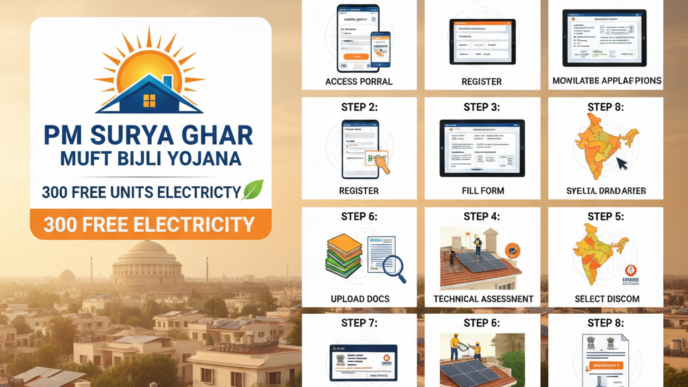





Introduction to PM Surya Ghar Yojana
India’s renewable energy ambition has taken a decisive turn with the launch of the PM Surya Ghar Yojana, a flagship programme announced by Prime Minister Narendra Modi in 2023. The scheme targets the installation of rooftop solar panels on one million households by 2025, turning every eligible home into a miniature power plant. By doing so, the government aims to cut electricity bills, reduce carbon emissions and accelerate the nation’s journey toward the 500 GW non‑fossil fuel capacity target set for 2030 (Learn more about India’s renewable goals). The initiative aligns with the broader Solar Energy mission and complements other programmes such as the PM‑KUSUM scheme, which promotes solar pump adoption in agriculture.
Under the Yojana, households can offset a significant portion of their grid electricity consumption, leading to immediate financial relief and long‑term energy security. The programme also underscores the government’s commitment to decentralising power generation, which helps alleviate transmission losses and enhances grid resilience, especially during peak demand periods or grid outages.
Objectives and National Impact
The core objective of the PM Surya Ghar Yojana is to deploy rooftop solar systems on one million homes within the next two years, thereby adding approximately 5 GW of distributed solar capacity. This contribution is a critical component of India’s pledge to achieve net‑zero emissions by 2070 and supports the country’s broader climate commitments under the Paris Agreement. 
Beyond environmental benefits, the scheme is expected to generate skilled employment opportunities in the solar installation and maintenance sector. According to industry estimates, each megawatt of installed rooftop capacity can create up to 15 direct jobs, stimulating local economies and encouraging domestic manufacturing of photovoltaic modules.
Energy security is another major driver. By producing electricity close to the point of consumption, the scheme reduces reliance on centralized power plants and the associated transmission infrastructure, leading to lower system losses and more stable supply for consumers.
Financial Incentives and Subsidy Details
Eligible households can receive a subsidy covering up to 20 % of the total installed capacity cost, subject to a ceiling that varies by state and system size. For systems up to 3 kW, the maximum subsidy typically does not exceed INR 50,000 per kilowatt, translating to a potential saving of several lakhs of rupees on a full installation.
In addition to the central subsidy, many state governments offer supplementary rebates, low‑interest loans, and accelerated depreciation benefits, further easing the upfront financial burden. The scheme also provides net‑metering facilities, allowing consumers to export surplus generation to the grid and receive credit at the prevailing retail tariff, thereby improving the overall economics of solar adoption.
Financial assistance is transferred directly to the applicant’s bank account via Direct Benefit Transfer (DBT) after successful installation verification, ensuring transparency and reducing bureaucratic delays. Applicants can track the status of their subsidy claim through the official portal (Surya Ghar Portal).
Eligibility Criteria and Application Process
To qualify for the PM Surya Ghar Yojana, a household must own the residential property, possess a valid electricity connection, and have a roof that receives a minimum of five hours of direct sunlight daily. The roof must also be structurally suitable to support the weight of solar panels and mounting hardware.
Applicants are required to submit a set of documents through the online portal, including a government‑issued identity proof, address proof, a recent electricity bill, and clear photographs of the roof. These documents enable the verification team to assess eligibility and plan the installation design.
The application workflow proceeds as follows: after uploading the required files, the system generates a unique application ID. A certified solar installer then conducts a site survey, prepares a detailed proposal, and secures necessary permits from the local electricity distribution company. Once the applicant approves the design, a formal agreement is signed, and the installation can commence.
Installation Steps, Monitoring and Real‑World Success Stories
The installation journey begins with a comprehensive site assessment, during which technicians evaluate roof angle, shading, load‑bearing capacity, and orientation to determine the optimal system size. Following the assessment, a detailed proposal outlining the number of panels, expected energy yield, and cost estimate is prepared and presented to the applicant.
After client approval, the installer obtains the required permits and proceeds with mounting the structural supports. Photovoltaic modules are then securely attached to the mounts, and the wiring connects the panels to an inverter that converts direct current (DC) to alternating current (AC) suitable for household appliances. A final inspection by the electricity board ensures compliance, after which the system is commissioned and linked to the net‑metering arrangement.
Once operational, performance can be monitored in real time via a mobile application provided by the installer or the utility company. The app displays key metrics such as daily generation, household consumption, and exported units, enabling owners to optimise usage patterns.
Maintenance is straightforward: routine cleaning to remove dust and periodic inspection of connections ensure sustained efficiency. Most reputable installers offer annual maintenance contracts that cover inverter checks, performance verification, and warranty servicing, helping extend the system’s typical 25‑year lifespan.
Case Studies
- A family in Delhi reduced their monthly electricity bill by 60 % after installing a 6 kW system under the scheme, saving over INR 1.2 million annually.
- A rural household in Rajasthan achieved complete energy independence, powering lighting, fans and a mobile charging station solely through a 3 kW rooftop array.
- Cooperative societies in Gujarat have collectively installed solar arrays on community halls, cutting shared electricity costs by 45 % and reinvesting savings into local development projects.
Looking ahead, the government plans to expand the programme to include commercial establishments and housing societies, while policy discussions are underway to increase subsidy percentages for low‑income families and streamline approval procedures. Integration with smart‑grid technologies is also being explored to optimise energy distribution and enable advanced demand‑response capabilities.
Environmental Impact
Every megawatt‑hour (MWh) of solar electricity generated under the Yojana displaces approximately 0.5 tonnes of carbon dioxide that would otherwise be emitted by coal‑fired power plants. A typical 5 kW residential system can offset 20–25 tonnes of CO₂ over its 25‑year operational life, contributing significantly to cleaner air and climate mitigation.
Comparison with Conventional Sources
Unlike fossil‑fuel‑based generation, which subjects consumers to volatile fuel prices and high operational costs, solar installations offer a fixed cost structure after the initial investment. The levelised cost of electricity (LCOE) from rooftop solar in high‑irradiance regions has fallen below that of grid power, making it an increasingly attractive option for cost‑conscious households.
Energy Resilience
When paired with battery storage, rooftop solar can provide backup power during grid outages, enhancing energy security for critical loads such as medical equipment and communication devices.
Skill Development
The Ministry of New and Renewable Energy (MNRE) has launched training initiatives to upskill young engineers and technicians in solar installation, commissioning, and maintenance. These programmes, delivered in partnership with technical institutes and private training centres, award certifications that improve employability and support the growth of a skilled workforce capable of meeting the rising demand for solar projects nationwide.
Addressing Common Misconceptions
- Solar panels require constant bright sunlight – they continue to generate electricity on cloudy days, though at reduced output.
- Installation is complex and expensive – modern turnkey solutions simplify the process, and bulk procurement drives down costs.
- Solar panels damage roof structures – properly engineered mounting systems distribute loads safely and preserve roof integrity.
Stay updated with the latest Yojana schemes and government initiatives for better awareness and eligibility. For personalized guidance on accessing these benefits, reach out to us.