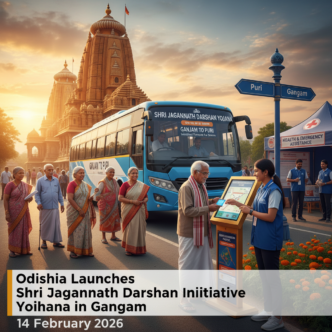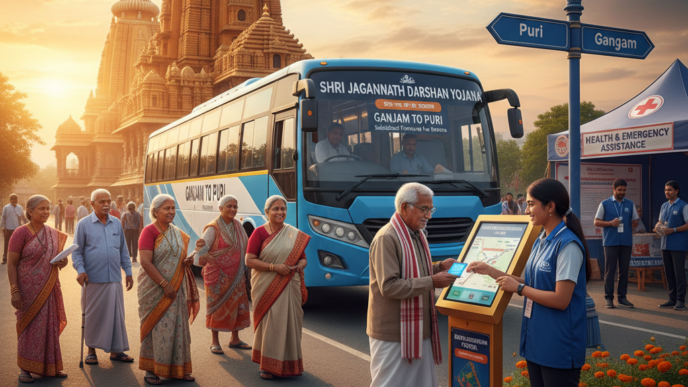





Shri Jagannath Darshan Yojana Launched in Ganjam: A Transformative Pilgrimage Initiative
On 14 February 2026, the Government of Odisha formally inaugurated the Shri Jagannath Darshan Yojana at Chatrapur, marking a watershed moment for millions of devotees across Ganjam district. The scheme is designed to make the sacred journey to the revered Jagannath Temple in Puri not only spiritually fulfilling but also financially feasible, safe and accessible for senior citizens, persons with disabilities and low‑income families. By blending fiscal subsidies, logistical support and infrastructural upgrades, the initiative aims to convert what was once a distant aspiration into a concrete reality for a vast cross‑section of society. Within weeks of the launch, registration portals opened, officials began community outreach, and the first phases of infrastructure modernization were set in motion, underscoring the state’s commitment to inclusive pilgrimage services.
Core Objectives and Eligibility Criteria
The Shri Jagannath Darshan Yojana rests on four strategic pillars: reducing travel costs, guaranteeing priority darshan access, enhancing safety through improved transport and health services, and fostering participation of marginalized communities. Eligibility is strictly defined to ensure that the most vulnerable groups reap the benefits. Applicants must be permanent residents of Ganjam, provide proof of age (for senior citizens) or a certified disability certificate, and submit an income declaration that falls below the state‑defined poverty line. Additional documentation includes a recent passport‑size photograph, a functional mobile number and a domicile certificate. Once eligibility is verified, beneficiaries receive a unique application ID and a provisional voucher redeemable for travel tickets, accommodation and health‑camp passes.
- Senior citizens (aged 60 years and above) receive a 50 % discount on intra‑state railway fares and a fixed stipend for lodging.
- Persons with certified disabilities are entitled to complimentary wheelchair‑compatible shuttle services between designated pick‑up points and the temple complex.
- Low‑income households can apply for a travel grant covering up to three pilgrimage trips per year.
- All eligible applicants gain access to health camps staffed by qualified medical personnel stationed at key transit hubs.
Implementation Phases and Infrastructure Upgrades
The rollout of the Shri Jagannath Darshan Yojana is meticulously phased to achieve measurable outcomes within a short horizon. Phase I (March‑May 2026) focuses on upgrading Chatrapur railway station, adding a dedicated waiting lounge, multilingual signage and solar‑powered lighting to boost night‑time safety. Phase II (June‑August 2026) sees the deployment of a fleet of 25 specially equipped buses featuring ramps, audible stop announcements and ergonomic seating for mobility‑impaired pilgrims, with schedules synchronized with Indian Railways to guarantee punctual arrivals at the temple gate. Phase III (starting September 2026) launches a user‑friendly digital enrollment portal that allows applicants to upload documents, track application status and receive electronic vouchers, thereby streamlining the entire beneficiary journey. 
Funding for the programme is sourced from the Odisha State Budget’s Social Welfare Segment, supplemented by a modest grant from the Ministry of Tourism. A cross‑departmental steering committee—comprising representatives from Transport, Health, Social Security and Rural Development—oversees financial disbursement, monitors progress and ensures transparent reporting. Early estimates suggest that the infrastructure upgrades will cut average travel time from Ganjam to Puri by roughly 20 minutes, a critical improvement for senior citizens who may have limited stamina.
Economic and Social Impact Assessment
The anticipated socio‑economic dividends of the Shri Jagannath Darshan Yojana are already materialising. Early impact assessments project a 25 % surge in pilgrim footfall during the first year, translating into an additional INR 150 crore in local commerce around the temple precinct. Small‑scale vendors—tea stalls, souvenir shops and homestay operators—expect a 20 % increase in sales, creating ancillary employment opportunities for youth and women in the region. Moreover, road improvement projects linking remote Ganjam villages to the main pilgrimage corridor are expected to boost accessibility to essential services such as schools and health centres, thereby reinforcing broader rural development goals.
From a public‑health perspective, the placement of mobile health camps at key transit points addresses emergency medical needs of elderly travellers and provides preventive check‑ups for a population that traditionally faces limited healthcare access. These initiatives are projected to reduce pilgrimage‑related medical emergencies by an estimated 15 % within the first six months, underscoring the scheme’s holistic approach to welfare.
Community Engagement and Stakeholder Collaboration
Stakeholder participation remains a cornerstone of the Shri Jagannath Darshan Yojana. Religious bodies, including the Shri Jagannath Temple Management Committee, have pledged volunteer manpower for crowd management, spiritual counseling and guided tours, thereby enhancing the pilgrim experience. Local non‑governmental organisations have launched extensive outreach campaigns, educating potential beneficiaries about registration procedures, travel tips and health precautions. Public consultation meetings held in March 2026 across Ganjam’s blocks recorded an overwhelmingly positive response, with over 78 % of participants indicating a willingness to apply for the scheme.
Feedback from these forums has directly informed refinements to the voucher allocation algorithm, ensuring a fair distribution that prioritises the most vulnerable groups. Moreover, partnerships with private transport operators and hospitality providers have been formalised through memoranda of understanding, guaranteeing a reliable pool of shuttle services, accommodation and catering that can scale in response to demand.
Monitoring, Evaluation and Future Expansion Plans
A robust monitoring framework has been instituted to evaluate the Shri Jagannath Darshan Yojana on a quarterly basis. Key performance indicators include the number of beneficiaries enrolled, average travel cost reduction, satisfaction scores derived from post‑pilgrimage surveys and the operational efficiency of transport assets. Independent audit agencies conduct periodic financial reviews to safeguard against misallocation of funds, while data analytics inform continuous improvement cycles. Lessons learned during the pilot phase are being integrated into refinements of the digital platform, expansion of beneficiary categories and the introduction of supplementary support mechanisms such as pilgrimage insurance.
Looking ahead, the Odisha government envisions scaling the Shri Jagannath Darshan Yojana to other culturally significant districts, notably Puri and Koraput, where similar pilgrimage demand exists. Integration with the broader “Heritage Tourism Initiative” is also being explored, aiming to create a cohesive network of state‑wide pilgrimage support services that can be marketed domestically and internationally. For citizens eager to stay informed about similar schemes and eligibility criteria, resources are available at the official Odisha government portal (Odisha Gov) and on detailed Wikipedia entries such as the Jagannath Temple.
Stay updated with the latest Yojana schemes and government initiatives for better awareness and eligibility. For personalized guidance on accessing these benefits, reach out to us.