


Assam Secures 100 Electric Buses Under Central Scheme
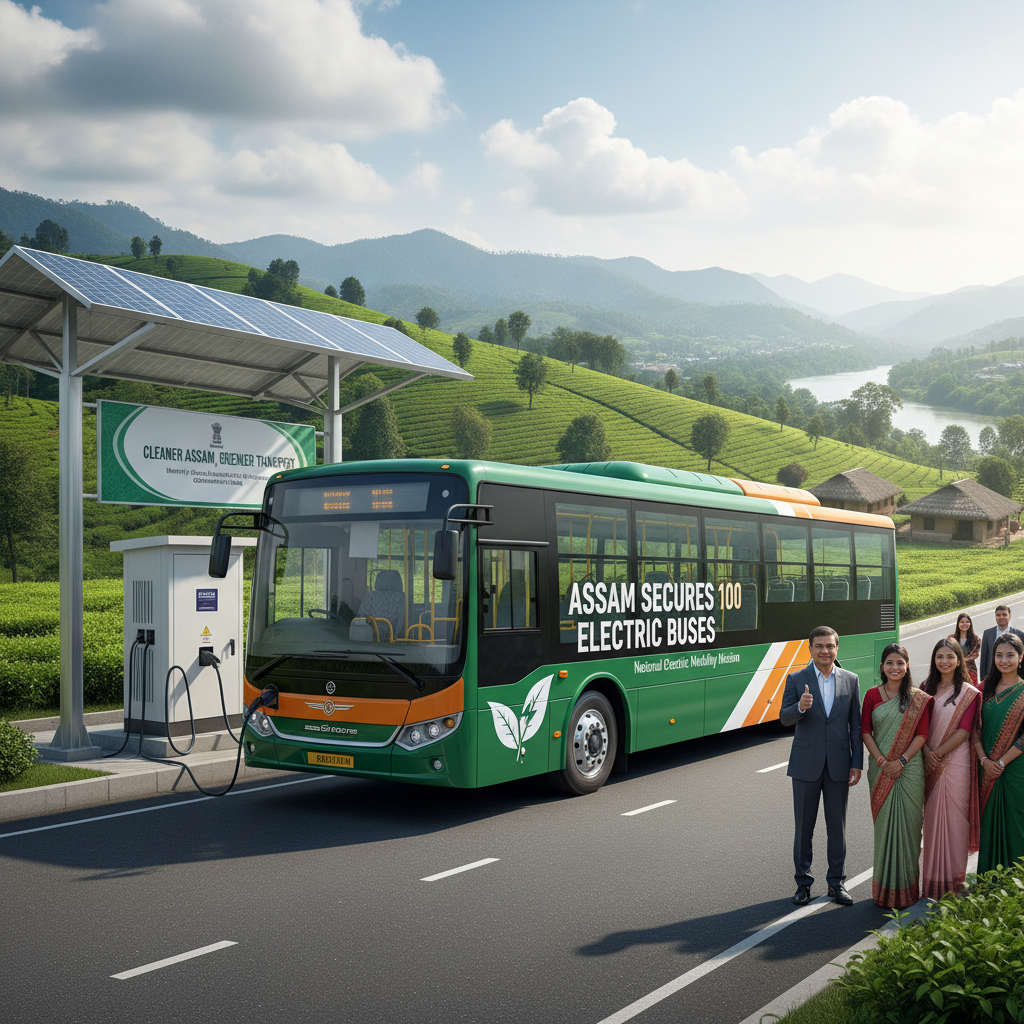
Assam has officially taken delivery of 100 electric buses (e‑buses) as part of the central government’s ambitious public‑transport modernization program, marking a decisive step toward zero‑emission mobility in the Northeast. The rollout, announced earlier this year by the Ministry of Heavy Industries and Public Enterprises, targets the replacement of diesel‑powered fleet units across major urban centers in the state. Chief Minister Himanta Biswa Sarma highlighted that the initiative aligns with national climate goals and seeks to alleviate chronic congestion in Guwahati, Silchar, and Dibrugarh. The buses, supplied by leading Indian manufacturers, are expected to commence service on high‑frequency routes before the end of the current fiscal year, delivering cleaner air and quieter streets to millions of commuters.
For readers seeking deeper insight, the official announcement can be reviewed on the Ministry’s press portal Ministry of Heavy Industries and detailed coverage is available on Wikipedia.
National Electric Mobility Mission and Policy Framework
The acquisition forms a core component of the National Electric Mobility Mission, a policy thrust launched in 2022 to accelerate the adoption of electric vehicles (EVs) in public transport across Indian states. The mission provides financial incentives covering up to 70 % of procurement costs, mandates technology transfer, and supports the development of charging infrastructure. Assam’s inclusion reflects its strategic position as a gateway to the Northeast and its growing urban congestion challenges, which have prompted the state transport department to seek sustainable alternatives to diesel buses. The policy also encourages state governments to integrate electric fleets with renewable energy sources, thereby reducing dependence on fossil‑fuel‑based electricity. 
Additional context on the mission’s objectives is documented on the Indian government’s policy site India Current Affairs and illustrated on the Wikipedia page for electric vehicle policy.
Implementation Timeline and Deployment Strategy
According to the Assam Transport Department, the first batch of 100 e‑buses will be deployed on high‑frequency routes in Guwahati, Silchar, and Dibrugarh by the close of the fiscal year. The rollout follows a phased approach: an initial pilot phase will monitor key performance indicators such as battery life, passenger load factor, and maintenance costs; subsequent phases will scale up to full operational deployment by March 2027, contingent on the successful installation of charging stations at depot sites. The department has identified three primary corridors for the pilot — Guwahati’s Bus Rapid Transit (BRT) corridor, Silchar’s inter‑city link, and Dibrugarh’s airport‑city route — to ensure maximum utilization and passenger uptake.
The timeline also includes a comprehensive training program for drivers and maintenance staff, scheduled to commence in July 2025, ensuring safe and efficient operation of the new fleet. The phased deployment strategy is designed to allow data‑driven adjustments, optimizing route planning and charging schedules based on real‑world usage patterns.
Financial Details and Technical Specifications
The central scheme offers a subsidy of up to 70 % of the total procurement cost, with the remaining liability falling on the state government. For Assam, the estimated outlay stands at INR 1,200 crore, encompassing bus purchase, charging infrastructure, and driver training programs. Each bus is equipped with a 300 kWh lithium‑ion battery pack, delivering an operational range of approximately 250 km on a single charge. The vehicles feature regenerative braking, climate‑controlled interiors, and real‑time passenger information displays that broadcast arrival times, route details, and safety alerts.
Environmental benefits are projected to be substantial: switching from diesel to electric propulsion is expected to cut carbon dioxide emissions by an estimated 120,000 tonnes annually across the participating routes. This reduction supports India’s commitment under the Paris Agreement and advances the state’s target of a 30 % reduction in vehicular pollution by 2030. Moreover, the quieter operation of e‑buses improves urban acoustic environments, contributing to better quality of life for residents.
For technical specifications, refer to the detailed technical datasheet released by the Ministry of Heavy Industries Technical Specifications.
Economic, Employment, and Stakeholder Impact
The deployment phase has already generated approximately 1,200 direct jobs in manufacturing, installation, and depot management. Indirect employment opportunities are expected to rise in sectors such as renewable energy supply, battery recycling, and ancillary maintenance services. The state government estimates a multiplier effect of three times on local businesses, including charging station operators, food vendors near depots, and software providers for fleet management. These economic spillovers are projected to stimulate growth in peripheral industries and foster skill development among youth.
Stakeholder reactions have been largely positive. Transport unions have welcomed the initiative, emphasizing health benefits from reduced exhaust emissions and improved working conditions for drivers. Environmental NGOs have lauded the move as a “significant stride toward sustainable urban mobility,” while opposition parties have raised concerns about fiscal prudence, urging transparent accounting of subsidies and performance outcomes. A dedicated task force has been formed to streamline permitting processes and expedite land allocation for depot sites, addressing some of the logistical hurdles highlighted by critics.
Looking ahead, the successful integration of these 100 e‑buses sets a precedent for scaling up the electric fleet to 500 units by 2030, contingent on funding availability and technology upgrades. Policy analysts suggest that Assam’s model could be replicated in other states with similar geographic and demographic profiles, potentially catalyzing a nationwide transition toward greener public transport. Continuous monitoring of performance metrics will inform future procurement decisions and help refine subsidy mechanisms to ensure cost‑effectiveness.
Stay updated with the latest Yojana schemes and government initiatives for better awareness and eligibility. For personalized guidance on accessing these benefits, reach out to us.