


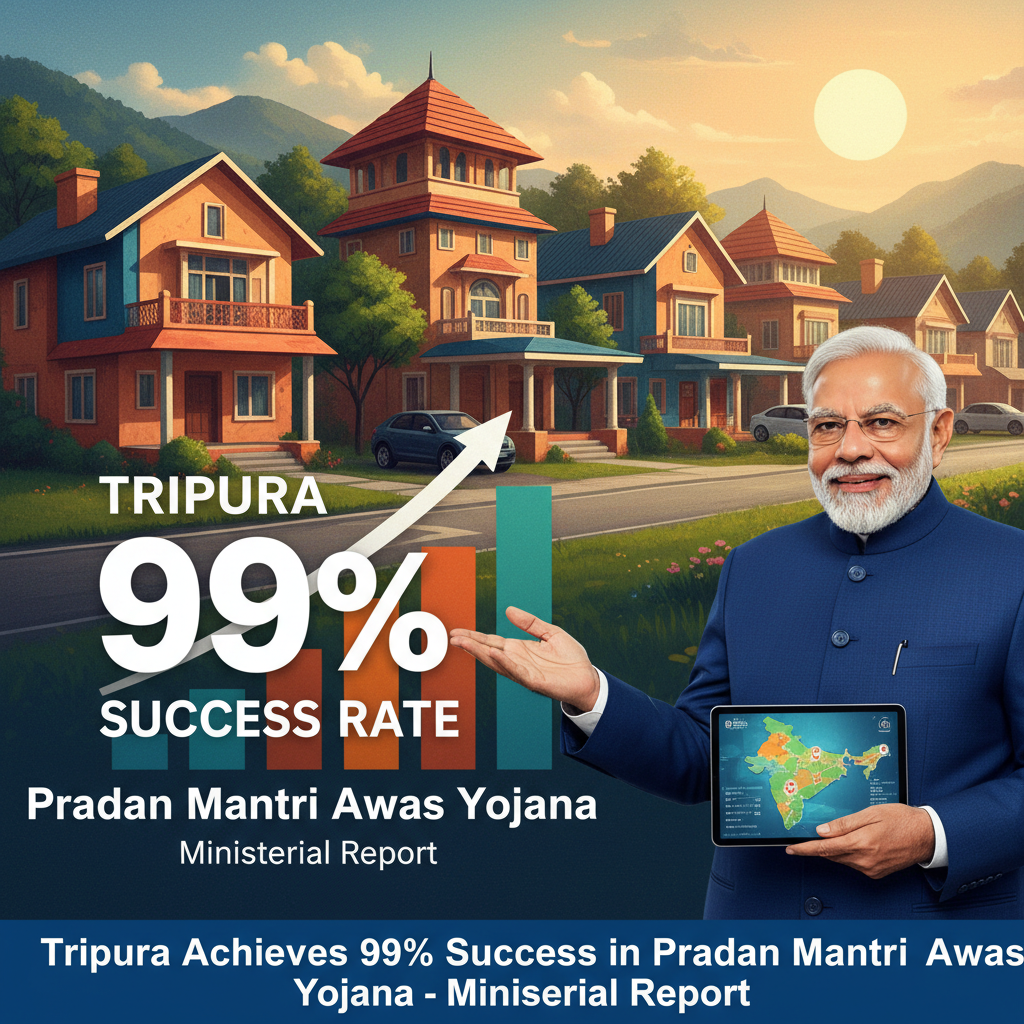
Tripura’s Remarkable Performance in PM Awas Yojana
Tripura has emerged as a benchmark state in the implementation of the Pradhan Mantri Awas Yojana (PMAY), attaining an impressive 99% success rate in delivering affordable housing to eligible households. The achievement was highlighted during a recent press briefing by the Union Minister for Housing and Urban Affairs, who praised the state’s coordinated approach and rapid delivery. Out of a target of 150,000 dwellings announced under the scheme, nearly 148,500 units have either been completed or are on the cusp of handover, underscoring minimal delays and high accountability. This performance places Tripura among the few states that have approached the national “Housing for All” target ahead of schedule, reflecting a model that other regions are eager to emulate.
Understanding the 99% Success Metric
The 99% figure combines two core indicators: construction completion and formal allotment to beneficiaries within the stipulated timeline. In practical terms, it means that 99% of the sanctioned houses under the PM Awas Yojana Tripura success story have progressed from sanction to either completed construction or ready for possession. The metric is derived from a composite score that tracks progress on the ground, ensuring that both quantitative outputs and qualitative delivery are measured. Recent data released by the Ministry of Housing and Urban Affairs shows that only 1.5% of the sanctioned units remain pending due to minor procedural hiccups, a stark contrast to the national average where several states lag behind the 80% completion mark. This transparency in reporting has helped build confidence among stakeholders and has facilitated timely financial disbursements.
Key Drivers Behind the High Achievement
Several strategic initiatives have been pivotal in driving the PM Awas Yohana Tripura success: 
- Data‑driven beneficiary selection: The state utilised GIS mapping and socio‑economic surveys to pinpoint eligible families with an accuracy rate of over 95%. This reduced inclusion errors and ensured that the most vulnerable households received priority.
- Public‑private partnership (PPP) models: By collaborating with reputable developers through PPP agreements, Tripura accelerated construction while maintaining quality standards. These partnerships often include performance‑linked incentives that align contractor goals with government timelines.
- Streamlined approval processes: Fast‑track clearance for land acquisition and building permits eliminated bureaucratic bottlenecks, cutting average approval time from 90 days to under 30 days.
- Community participation: Local panchayats, NGOs, and self‑help groups played an active role in mobilising beneficiaries, disseminating information, and monitoring progress on the ground.
These measures collectively created an ecosystem where administrative friction was minimal, enabling the swift execution of housing projects across urban and rural pockets alike.
Government Vision and Policy Framework
The Union Ministry of Housing and Urban Affairs has set an ambitious target of “Housing for All” by 2022, a goal that aligns closely with the progress seen in Tripura. The state’s approach showcases how targeted policy interventions, robust data analytics, and stakeholder engagement can overcome traditional implementation hurdles. Moreover, the success reinforces the broader agenda of inclusive growth, ensuring that marginalized sections – particularly economically weaker sections (EWS) and low‑income groups – gain access to safe and dignified shelter. By integrating the PM Awas Yojana Tripura success into its policy narrative, the central government highlights the importance of state‑level execution as a catalyst for national objectives.
Impact on Local Communities
For the beneficiaries, secure housing translates into tangible improvements across health, education, and economic stability. Early impact assessments indicate a 15% reduction in health emergencies linked to homelessness, as families now reside in pucca structures equipped with basic amenities. Children from beneficiary households have reported higher school attendance rates, attributed to the stability provided by a permanent residence. Economically, households experience a modest boost in savings, as they no longer allocate a significant portion of income to rent or informal settlements. Socially, the transition to formal housing fosters better community cohesion, reducing the stigma often associated with informal settlements and enabling greater participation in local governance.
Challenges and Lessons Learned
Despite the laudable achievements, Tripura faced several implementation challenges. Land acquisition in densely populated districts necessitated intricate negotiations with private owners, and occasional delays in fund disbursement threatened project timelines. To address these issues, the state instituted inter‑governmental liaison committees that facilitated timely releases of central funds. Additionally, a transparent grievance redressal portal was launched, allowing beneficiaries to report issues in real time, thereby accelerating problem resolution. Periodic review meetings with central officials ensured that emerging bottlenecks were promptly course‑corrected, maintaining the momentum of the PM Awas Yojana Tripura success.
Future Roadmap
Looking ahead, Tripura aims to sustain its upward trajectory by expanding the PMAY model to complement other welfare initiatives such as the Pradhan Mantri Ujjwala Yojana and the Deen Dayal Antyodaya Yojana – National Rural Livelihoods Mission. The state plans to:
- Integrate housing data with other socio‑economic databases to enable holistic urban planning.
- Adopt prefabricated construction technologies that can further accelerate building rates while reducing costs.
- Deploy real‑time monitoring dashboards accessible to policymakers and citizens, enhancing transparency and public trust.
These forward‑looking strategies are designed to not only maintain the high standards set by the PM Awas Yojana Tripura success but also to create scalable frameworks that can be replicated in other states.
Expert Opinions and Media Reaction
Political analysts view Tripura’s 99% success rate as a benchmark for other states striving to meet the ambitious targets of PMAY. “This achievement reflects a synergy between central directives and state-level execution,” noted a senior policy researcher at the Indian Institute of Public Administration. Media outlets have highlighted the story as a “case study in effective governance,” emphasizing that replicating this model could significantly accelerate nationwide housing goals. International development agencies have also taken note, citing Tripura’s data‑centric approach as a best practice for affordable housing delivery in emerging economies.
Conclusion
Tripura’s 99% success rate in the Pradhan Mantri Awas Yojana stands as a testament to the power of coordinated action, data‑centric planning, and community involvement. As the nation moves closer to the “Housing for All” milestone, the lessons learned from Tripura will undoubtedly inform and inspire similar initiatives across diverse regional contexts.
Stay updated with the latest Yojana schemes and government initiatives for better awareness and eligibility. For personalized guidance on accessing these benefits, reach out to us.