


Comprehensive Background of the Model Code of Conduct Allegation
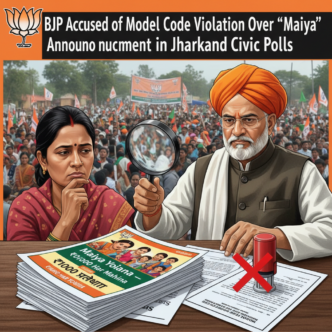
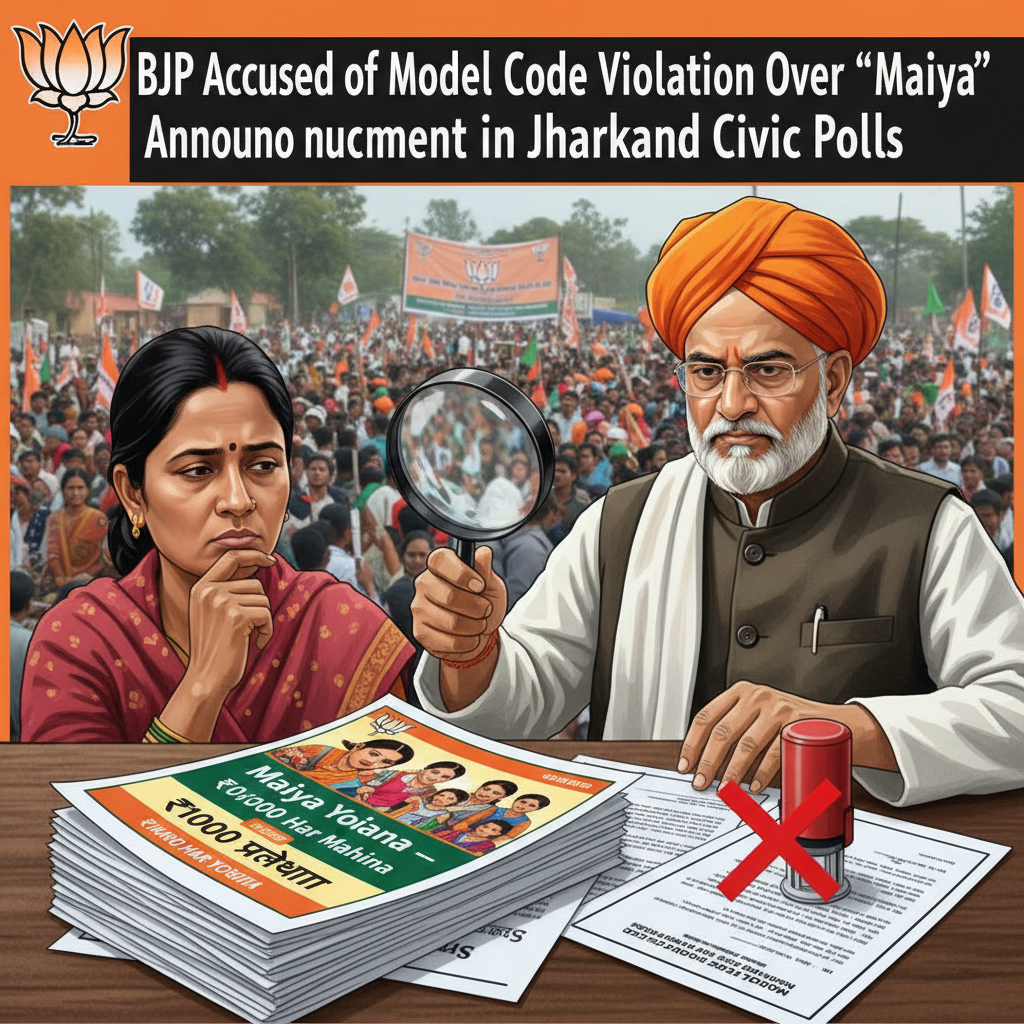
The Bharatiya Janata Party (BJP) unveiled a new welfare initiative called “Maiya Yojana” during the first phase of the Jharkhand civic polls, a move that immediately triggered scrutiny by the Election Commission of India (ECI). Under the Model Code of Conduct (MCC), which governs political parties and candidates from the announcement of elections until the voting day, any party that launches fresh schemes or promises benefits that could influence voters is required to seek explicit permission from the poll panel. Clause 1(4) of the MCC expressly forbids the introduction of new welfare programmes that are timed to sway electorate behaviour. Consequently, the sudden publicity of Maiya Yojana just days before the electorate were set to cast their votes led the ECI to issue a show‑cause notice, questioning whether the BJP had used state resources and administrative channels to promote a partisan welfare narrative in violation of this provision.
For context, the Model Code of Conduct is a comprehensive set of guidelines that parties and candidates must adhere to in order to ensure free and fair elections. Its jurisdiction covers everything from the language of political speeches to the deployment of government machinery for campaign purposes. While the MCC does not codify criminal penalties, it empowers the Election Commission to impose a range of sanctions, including fines, bans on advertisements, and restrictions on further scheme roll‑outs. The current controversy thus sits at the nexus of welfare politics and electoral ethics, prompting a broader debate among policymakers, civil‑society groups, and voters alike about the limits of partisan welfare announcements during election cycles.
Understanding ‘Maiya Yojana’: Objectives and Design
‘Maiya Yojana’ is a state‑level empowerment programme specifically aimed at women who serve as heads of households in selected districts of Jharkhand. The scheme promises a direct cash transfer of INR 1,000 per month to eligible beneficiaries, an amount chosen to offset some of the most pressing household expenses such as food, health care, and school fees. According to documents released by the Jharkhand Rural Development Department, the programme will be administered through the Direct Benefit Transfer (DBT) platform, ensuring that transfers are credited directly into beneficiaries’ bank accounts, thereby reducing leakages and enhancing transparency. Eligibility criteria include a household income ceiling, land‑ownership limits, and inclusion in existing welfare registries such as the Mahatma Gandhi National Rural Employment Guarantee Act (MGNREGA). By leveraging the DBT infrastructure already in place, the government aims to deliver assistance promptly while creating an auditable trail that can be inspected by independent watchdogs and opposition parties. 
The intended impact of the scheme is two‑fold. First, it seeks to improve nutrition outcomes for children by freeing up household resources; second, it aims to foster financial independence for women, thereby shifting decision‑making power within families towards them. Social analysts have noted that a modest cash infusion of INR 1,000 can, when consistently delivered, have a pronounced effect on poverty alleviation, especially in regions where women’s economic participation remains low. Moreover, the scheme is positioned as a response to growing demand for gender‑focused welfare measures in the state, aligning with national priorities that emphasise women’s empowerment through economic support.
Political Reactions and Opposition’s Accusations
The unveiling of Maiya Yojana has sparked a rapid and polarised political reaction across Jharkhand and at the national level. Opposition parties, most notably the Indian National Congress (INC) and the Jharkhand Mukti Morcha (JMM), have lodged formal complaints with the Election Commission, alleging that the BJP has weaponised state‑run welfare programmes for partisan gain. Their primary contention is that the scheme’s promotional material prominently features the lotus symbol alongside detailed scheme specifications, effectively branding the initiative as a BJP‑endorsed offering at a time when the MCC is in force. Critics also argue that the timing of the announcement—days before the civic poll—creates an uneven playing field, allowing the ruling party to leverage public resources to sway voter sentiment.
In contrast, several BJP supporters and state officials have defended the initiative as a welfare‑centric measure that is independent of electoral considerations. They contend that the scheme’s objectives—empowering women heads of households—precede any political calculus and should be evaluated on their developmental merits. Nevertheless, the opposition’s allegations have amplified public scrutiny and placed the scheme under a microscope that extends beyond its policy substance to questions of democratic fairness. This charged environment has compelled a range of stakeholders, including civil‑society organisations and media outlets, to demand greater transparency about how welfare programmes are conceived, funded, and communicated during election periods.
Election Commission’s Show‑Cause Notice and Enforcement Measures
In response to the mounting complaints, the Election Commission issued a formal show‑cause notice to the BJP’s Jharkhand state unit, demanding a detailed explanation of the circumstances surrounding the Maiya Yojana announcement. The notice specifically asks whether the programme was conceptualised and launched with the tacit approval of the state administration, and whether official communication channels were used to amplify its reach. The ECI has simultaneously mandated a temporary suspension of all promotional activities linked to the scheme until a thorough investigation can be completed. Legal scholars note that while the MCC does not impose criminal liability, non‑compliance can trigger administrative penalties ranging from monetary fines to bans on further scheme roll‑outs during the election period, and in extreme cases, disqualification of candidates who directly participated in the promotional campaign.
The procedural response underscores the Election Commission’s commitment to maintaining electoral integrity, even as political parties navigate the complex terrain of welfare‑driven campaigning. The investigation will examine evidence such as official press releases, distribution of pamphlets, and any utilisation of government officials or resources in the scheme’s promotion. Depending on the findings, the Commission may order remedial actions, including a directive for the BJP to refrain from further dissemination of Maiya Yojana details until after the election, or it may clear the party after determining that the scheme was purely welfare‑oriented and not politically motivated. Either outcome will set a significant precedent for future welfare announcements in the run‑up to elections across India.
Historical Precedents, Legal Implications and Future Outlook
The Maiya Yojana controversy is not an isolated incident; similar allegations have surfaced in previous electoral cycles. During the 2019 Lok Sabha elections, the BJP faced scrutiny for inaugurating infrastructure projects shortly before voting, an act the Election Commission deemed potentially influential on voter behaviour. In 2021, the ruling party in Maharashtra was cautioned for launching a cash‑transfer scheme aimed at farmers in the lead‑up to state polls. These precedents illustrate a recurring pattern wherein welfare announcements timed close to elections raise legitimate concerns about fairness and the undue use of state machinery.
Legally, the Model Code of Conduct provides the Election Commission with discretionary authority to interpret and enforce its provisions, but it lacks explicit statutory penalties. Consequently, each case is evaluated on its merits, focusing on intent, the scope of the scheme, and the channels used for promotion. Advocacy groups have called for legislative clarification that would introduce a “cool‑off” period during which no new welfare announcements can be made, thereby creating a level playing field for all parties. Additionally, there have been proposals for an independent oversight mechanism to certify that welfare schemes comply with the MCC before public launch, aiming to enhance transparency and public trust. As the investigation into Maiya Yojana unfolds, its outcome will likely influence future policy‑making and campaign strategies, shaping how welfare programmes are integrated into the electoral landscape of India.
- The ‘Maiya Yojana’ initiative aims to provide INR 1,000 monthly assistance to women heads of households in Jharkhand
- The Election Commission has issued a show‑cause notice, citing potential Model Code of Conduct violations
- Political parties across the spectrum are watching closely, as the outcome may reshape welfare‑related campaign tactics
Stay updated with the latest Yojana schemes and government initiatives for better awareness and eligibility. For personalized guidance on accessing these benefits, reach out to us.