


Introduction
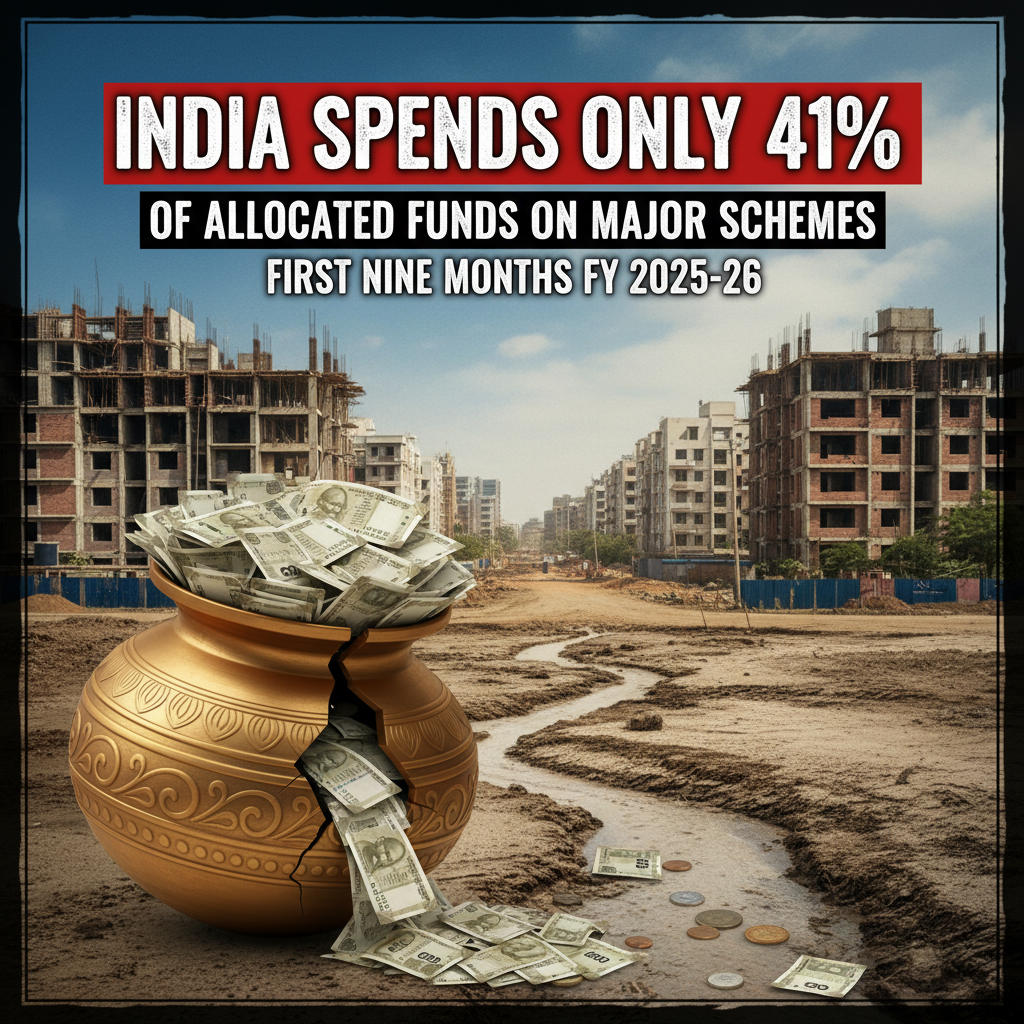
India’s central government implements a wide array of flagship programmes, commonly referred to as “Yojanas,” that aim to accelerate development across sectors such as housing, rural infrastructure, health, education, and employment generation. These schemes are funded through substantial budgetary allocations, reflecting the nation’s commitment to inclusive growth. However, recent audit reports and ministry releases reveal a striking pattern: in the first nine months of the current fiscal year, the utilisation of allocated funds for many of these high‑priority schemes has plateaued at just 41 percent of the total outlay. This under‑utilisation, widely discussed as India underspends schemes, raises critical questions about implementation efficiency, fiscal management, and the ultimate impact on citizens.
Understanding the 41% Utilisation Figure
The 41 percent figure comes from the Consolidated Fund Utilisation Report released by the Ministry of Finance in February 2026. The report aggregates data from 34 major centrally‑sponsored schemes spanning diverse sectors. While some programmes reported utilisation rates marginally above the average, several intersectoral initiatives fell well below, with the lowest performers registering figures in the low‑30 percent range. The report attributes the overall low utilisation to a combination of delayed fund disbursement, project‑level bottlenecks, and a shift toward performance‑linked financing that conditions tranche releases on measurable outcomes.
Key Schemes and Their Utilisation Statistics
Below is a snapshot of some of the high‑visibility schemes that have recorded utilisation far below the 41 percent benchmark. 
- Pradhan Mantri Awas Yojana (Urban & Rural): The housing mission, targeting “Housing for All” by 2022, allocated INR 1,20,000 crore for the fiscal year. As of the end of December 2025, only INR 45,600 crore had been spent, translating to a 38 percent utilisation rate.
- Pradhan Mantri Gram Sadak Yojana (PMGSY): With an allocation of INR 1,00,000 crore for road construction in rural areas, the scheme’s utilisation stood at 43 percent after the first three quarters, indicating a lag in road‑laying activities.
- Ayushman Bharat – Pradhan Mantri Jan Arogya Yojana (PMJAY): This health insurance scheme for the bottom 40 percent of the population received INR 6,400 crore in funding. Utilisation reached 45 percent, reflecting slower empanelment of hospitals and enrollment processes.
- Mahatma Gandhi National Rural Employment Guarantee Act (MGNREGA): The employment guarantee programme’s budget of INR 1,75,000 crore saw only 40 percent spent by the end of September 2025, a figure that policymakers link to seasonal labour migration and delayed wage disbursements.
- Deen Dayal Upadhyaya Grameen Kaushalya Yojana (DDU‑GKY): Skill development for rural youth saw a utilisation of 39 percent, primarily due to limited placement opportunities and training centre capacity constraints.
These statistics, while varying by sector, illustrate a systemic shortfall that undermines the intended impact of each mission. The housing mission, for example, is meant to deliver affordable homes to millions of urban and rural poor, yet the slow pace of construction keeps many families in informal settlements. Similarly, incomplete road networks under PMGSY hinder market access for agricultural produce, limiting income opportunities for rural households. The health insurance coverage under PMJAY remains out of reach for many vulnerable families when hospitals are not yet empaneled, and reduced MGNREGA spending translates into fewer wage‑employment days for seasonal migrants. Collectively, the data underscore how India underspends schemes that are central to the country’s development agenda.
Factors Driving Under‑Utilisation
1. Delayed Central‑State Fund Transfers: The Finance Ministry releases funds to states in tranches that are often tied to the submission of utilisation certificates. In many states, the process of compiling and verifying these certificates encounters bureaucratic delays, causing a lag between fund release and actual expenditure.
2. Project Clearance and Land Acquisition Hurdles: Infrastructural projects under PMGSY and housing under PMAY frequently require multiple clearances—environmental, forest, and land acquisition—before they can commence. The time‑intensive approval process compresses the window for spending, especially when fiscal year deadlines loom.
3. Performance‑Based Disbursement Norms: New fiscal guidelines encourage the release of funds only after meeting predefined output metrics (e.g., number of houses constructed, roads paved). While this incentivises outcome‑focused implementation, it also creates a short‑term cash‑flow crunch for implementing agencies that must front‑load expenditures to meet benchmarks.
4. Administrative Capacity Constraints: State and district‑level implementation bodies often lack the technical expertise or digital infrastructure to manage large‑scale fund flows, monitor expenditures, and produce timely reports. Capacity‑building initiatives are underway, but the gap remains significant.
Impact on Programme Objectives
Housing Security: Delayed construction under the Pradhan Mantri Awas Yojana postpones the delivery of affordable homes, pushing low‑income families into informal settlements and perpetuating housing insecurity. According to the Ministry of Housing and Urban Affairs, only 12 million of the targeted 20 million houses had been completed by the end of 2025, highlighting the gap between ambition and execution.
Rural Connectivity: Incomplete road networks hinder market access for agricultural produce, limiting income opportunities for rural households and slowing regional economic integration. The National Highways Authority of India estimates that every 1 percent increase in rural road coverage can boost agricultural incomes by up to 0.6 percent, underscoring the economic cost of stalled PMGSY projects.
Health Coverage Expansion: Slower empanelment of healthcare providers under Ayushman Bharat – PMJAY reduces the reach of health insurance to vulnerable populations, potentially increasing out‑of‑pocket health spending. As of September 2025, only 1,800 hospitals had been empaneled nationwide, leaving many districts without accredited facilities.
Employment Generation: Reduced spending on MGNREGA translates into fewer wage‑employment days, affecting livelihood security for seasonal migrants and marginal workers. The Ministry of Rural Development reported a shortfall of approximately 150 million person‑days of work compared to the previous fiscal year, a gap that directly impacts rural consumption patterns.
Strategic Responses from the Government
a. Digital Fund‑Tracking Dashboards: A real‑time monitoring platform is being piloted to provide transparent visibility into fund flows, utilisation status, and project progress. Early adopters in Maharashtra and Karnataka report a 12 percent reduction in approval delays, as officials can instantly flag bottlenecks and initiate corrective actions.
b. Streamlined Approval Pathways: Certain categories of projects now qualify for fast‑track clearance, cutting average sanction time from 90 days to under 45 days. The Ministry of Rural Development announced in July 2025 that road projects under PMGSY in high‑priority states would receive priority review, aiming to accelerate ground‑level work.
c. Capacity‑Building Modules: The National Institute of Public Finance and Policy (NIPFP) has launched a series of workshops for state finance officers focusing on utilisation reporting, performance measurement, and contract management. Over 300 officials have completed the training, which includes modules on using the new digital dashboards.
d. Outcome‑Based Contracts: Pilot projects in select states pair fund releases with measurable outcomes such as “number of households with completed toilets” or “kilometers of all‑weather road constructed.” By linking tranche disbursements to verified outputs, the government hopes to incentivise quicker project completion while maintaining accountability.
Looking Ahead: Paths to Improved Utilisation
To translate allocated budgets into tangible benefits for citizens, a multi‑pronged approach is essential:
1. Strengthening Inter‑Governmental Coordination: A joint central‑state task force could monitor utilisation on a monthly basis, identifying bottlenecks early and facilitating rapid remedial actions. Such a body would also serve as a platform for sharing best practices across states.
2. Enhancing Fiscal Flexibility: Introducing a modest carry‑forward provision would allow unspent funds from one fiscal year to be re‑absorbed without penalising the next year’s allocation, reducing pressure to rush incomplete projects at the fiscal year‑end.
3. Investing in Implementation Infrastructure: Expanding the digital toolkit for field officers—such as mobile‑based reporting, geo‑tagging of works, and satellite‑based monitoring—can improve data accuracy and accelerate reporting cycles. The Ministry of Electronics and Information Technology is planning a nationwide rollout of these tools by 2027.
4. Promoting Private‑Sector Participation: Leveraging public‑private partnerships for infrastructure and housing can inject additional capital and operational expertise, thereby accelerating project delivery. Recent pilots in Gujarat and Tamil Nadu have shown that private developers, when partnered with local bodies, can complete housing units up to 30 percent faster than traditional implementation routes.
Conclusion
India’s current fiscal picture reveals a paradox: ambitious, well‑intentioned programmes coexist with a stark shortfall in actual spending. While the 41 percent utilisation rate underscores challenges in execution, it also serves as a clarion call for reforms that bridge the gap between allocation and impact. By tightening governance, enhancing capacity, and fostering a results‑oriented culture, the government can ensure that the promise of each Yojana translates into lived improvements for millions across the nation. Addressing the root causes of under‑spending—through better fund flow management, faster clearances, and robust monitoring—will be pivotal in turning fiscal commitments into concrete development outcomes, thereby strengthening the social contract between the state and its citizens.
Stay updated with the latest Yojana schemes and government initiatives for better awareness and eligibility. For personalized guidance on accessing these benefits, reach out to us.