


Introduction
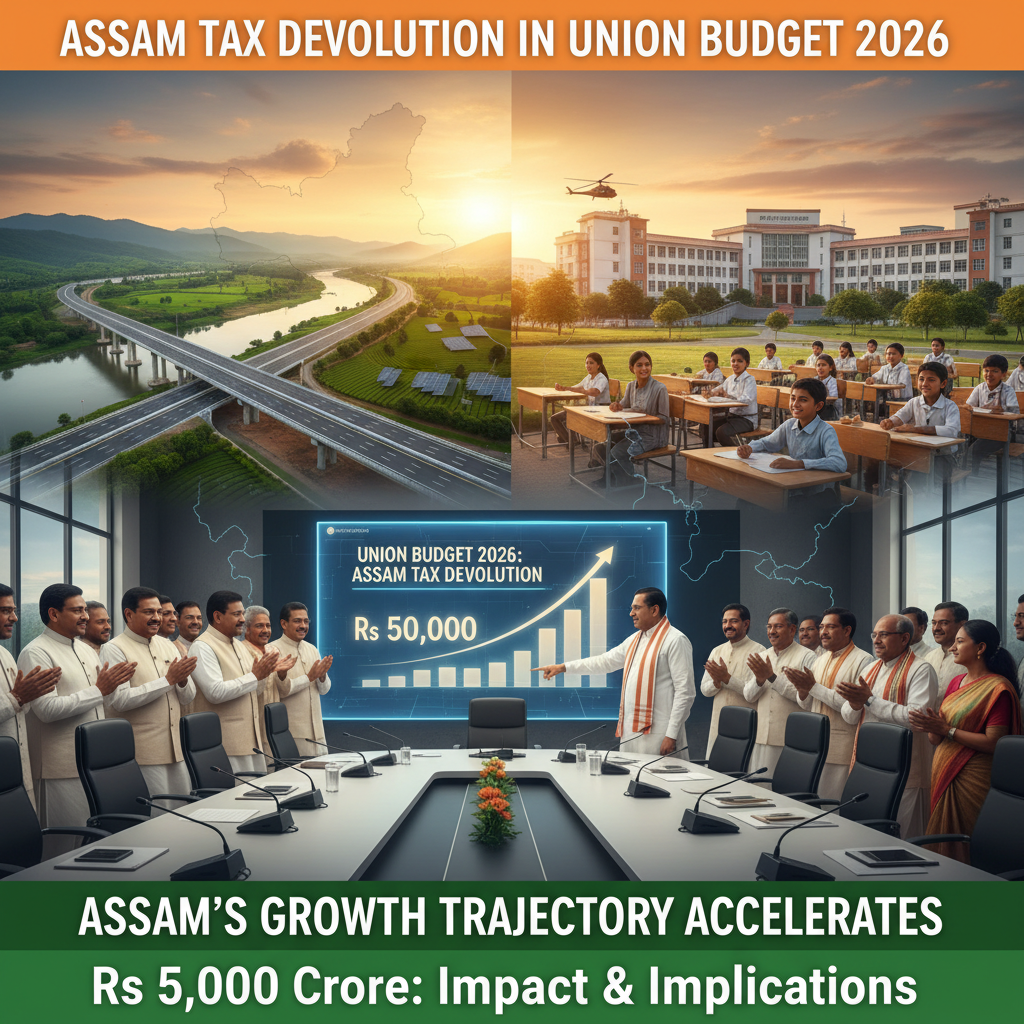
The Union Budget 2026 has earmarked Rs 50,000 crore for Assam tax devolution, a historic fiscal infusion that underscores the central government’s push for inclusive growth in the Northeast. This allocation marks a record‑high share for the state and is positioned as a catalyst for accelerating infrastructure, education, health, and environmental projects across Assam’s diverse regions. Stakeholders across political, economic, and civil society spectra view the move as a decisive step toward narrowing developmental gaps and unlocking the state’s vast potential in tourism, agriculture, and renewable energy. For citizens, the enhanced resources translate into tangible improvements in public services, job creation, and better standards of living, making the Assam tax devolution a focal point of national attention.
Budget Allocation Overview
Within the broader fiscal architecture, the tax devolution component distributes a share of central taxes to states based on criteria set by the Finance Commission and the priorities articulated in the Union Budget. The Rs 50,000 crore figure represents a 12 % increase over the previous fiscal year’s allocation, reflecting a strategic emphasis on high‑growth states like Assam. This sum forms part of a comprehensive Rs 2.5 lakh crore devolution package announced for the fiscal year, which collectively aims to fortify state‑level finances nationwide. The Finance Commission’s latest recommendations underpin the distribution formula, which weighs revenue generation capacity, per‑capita income, and developmental indicators.
For Assam, the 2026 allocation blends regular devolution with targeted conditional grants. In addition to the baseline share, the state will receive a special Rs 5,000 crore grant dedicated to water‑resource management, addressing long‑standing flood and irrigation challenges. Such targeted assistance is designed to rectify regional imbalances and ensure that the benefits of fiscal expansion reach underserved districts, particularly those in the Barak Valley and the Himalayan foothills. 
Key sectors slated for investment include:
- Infrastructure Investment: Rs 15,000 crore earmarked for highway upgrades, bridge construction, and urban transit systems, bolstering connectivity between major towns and rural hinterlands.
- Health & Education: Rs 8,000 crore allocated for the expansion and modernization of medical colleges, primary schools, and vocational training institutes, aiming to improve human capital metrics.
- Environmental Initiatives: Rs 2,500 crore earmarked for afforestation drives, river basin conservation, and clean‑energy projects, aligning with national climate commitments.
These allocations reflect a holistic approach that integrates economic, social, and ecological objectives, positioning Assam to achieve sustainable development milestones over the next decade.
Impact on Assam’s Development
The influx of funds through the Assam tax devolution is projected to accelerate several flagship projects that have long been constrained by fiscal limitations. Chief Minister Himanta Biswa Sarma has emphasized that the additional resources will be pivotal in achieving the state’s ambition of becoming one of the top‑10 economies in India within five years. By channeling capital toward high‑impact sectors, the budget seeks to stimulate private investment, create employment, and raise per‑capita incomes.
Road connectivity upgrades, for instance, are expected to reduce travel time between Guwahati and the eastern districts by up to 30 %, facilitating smoother movement of goods and services. Improved highways also stand to boost tourism in the Brahmaputra valley, attracting both domestic and international visitors. Renewable energy parks slated for development in the Dibrugarh and Tinsukia districts will harness the state’s abundant solar and hydro resources, contributing to India’s clean‑energy targets while generating ancillary job opportunities.
In the social sector, the Rs 8,000 crore earmarked for health and education will facilitate the construction of new medical colleges in Silchar and Tezpur, expanding access to advanced healthcare for millions. Upgrading primary schools and introducing digital classrooms in remote areas aims to close the education gap, especially for girls and marginalized communities. Skill‑development programs, funded through a portion of the devolution, will focus on emerging sectors such as agro‑processing, handicrafts, and IT services, equipping youth with market‑relevant competencies.
Environmental projects, supported by the Rs 2,500 crore allocation, will prioritize afforestation of degraded lands and the restoration of the Brahmaputra’s tributaries. These initiatives are designed to mitigate flood risks, protect biodiversity, and promote eco‑tourism, thereby enhancing the quality of life for residents in flood‑prone districts.
Details of Tax Devolution
Tax devolution in India operates on the principle of sharing central taxes with states, a mechanism institutionalized by the Finance Commission’s periodic recommendations. For Assam, the 2026 fiscal year’s devolution comprises both unconditional gross devolution and conditional grants that tie funding to specific developmental outcomes. The regular devolution share is calculated based on the state’s fiscal capacity, revenue effort, and per‑capita income, ensuring a fair distribution relative to other states.
Beyond the baseline allocation, the Union Budget has introduced a suite of targeted grants that address sector‑specific challenges. Notably, a dedicated Rs 5,000 crore grant for water‑resource management is intended to strengthen flood‑control infrastructure, upgrade irrigation networks, and promote watershed development. This grant underscores the central government’s recognition of Assam’s unique geographical vulnerabilities and the need for sustained investment in resilient water systems.
Eligibility criteria for these grants are defined by the Ministry of Finance in consultation with state planning authorities. Typically, states must submit detailed project proposals, demonstrate fiscal prudence, and commit to transparent monitoring mechanisms. The acceptance of these proposals triggers the release of funds in tranches, allowing for phased implementation and mid‑term reviews.
The overall devolution framework also includes a performance‑linked component, where additional incentives are provided to states that meet predefined targets in areas such as health outcomes, education enrollment, and infrastructure delivery. This incentivizes efficient utilization of resources and encourages states to adopt best practices in project execution.
Expert Opinions
Economic analysts and policy scholars have largely welcomed the Assam tax devolution as a timely intervention that can rejuvenate the state’s development trajectory. Dr. Ranjit Gupta, senior economist at the Indian Institute of Management Guwahati, remarked that “the infusion of central funds will expand fiscal space, enabling the state to undertake capital expenditures without jeopardizing fiscal discipline.” He highlighted that the allocation’s emphasis on infrastructure and human capital is likely to generate multiplier effects across the broader economy.
Civil society organizations have also voiced cautious optimism. The Assam Progressive Forum emphasized the importance of transparent governance, urging the state government to adopt robust audit mechanisms and public dashboards for real‑time tracking of fund utilization. Transparency, they argue, is essential to ensure that the resources translate into on‑ground improvements and are not plagued by leakages or corruption.
International development experts point to the potential for the devolution to accelerate progress on Sustainable Development Goals (SDGs). According to a recent report by the United Nations Development Programme (UNDP), targeted fiscal transfers, when coupled with capacity‑building initiatives, can significantly improve outcomes in poverty reduction, gender equality, and environmental sustainability in Indian states. The Assam tax devolution, they suggest, could serve as a model for other northeastern states seeking to harmonize growth with ecological stewardship.
Future Implications
Looking ahead, the effective deployment of the Rs 50,000 crore allocation will be a decisive factor in determining Assam’s socio‑economic development path. The state government has announced plans to launch a dedicated monitoring dashboard that will map fund disbursement, project milestones, and outcomes against predefined indicators. Such a system aims to enhance accountability, foster citizen participation, and enable data‑driven decision‑making.
If the funds are judiciously utilized, Assam could experience a transformational shift in its development metrics. Projections suggest that targeted investments could reduce poverty rates by up to 5 % within the next three years, while improving the Human Development Index (HDI) by 0.15 points. Enhanced infrastructure and education are expected to boost labor productivity, attracting private sector investments in sectors such as agro‑processing, tourism, and renewable energy.
Moreover, the fiscal boost may embolden the state to pursue ambitious policy reforms, such as expanding the Goods and Services Tax (GST) base, improving tax administration, and fostering public‑private partnerships (PPPs) for large‑scale projects. These reforms could further augment revenue Generation, reducing reliance on central transfers over the long term.
In the broader context, the Assam tax devolution exemplifies the central government’s strategy of empowering states with greater fiscal autonomy while ensuring alignment with national development priorities. By channeling resources toward high‑impact sectors, the budget seeks to create a virtuous cycle of growth, where improved public services stimulate economic activity, which in turn generates additional revenue for reinvestment.
Stay updated with the latest Yojana schemes and government initiatives for better awareness and eligibility. For personalized guidance on accessing these benefits, reach out to us.