


Key Details of the PMKVY‑Krishonnati Merger
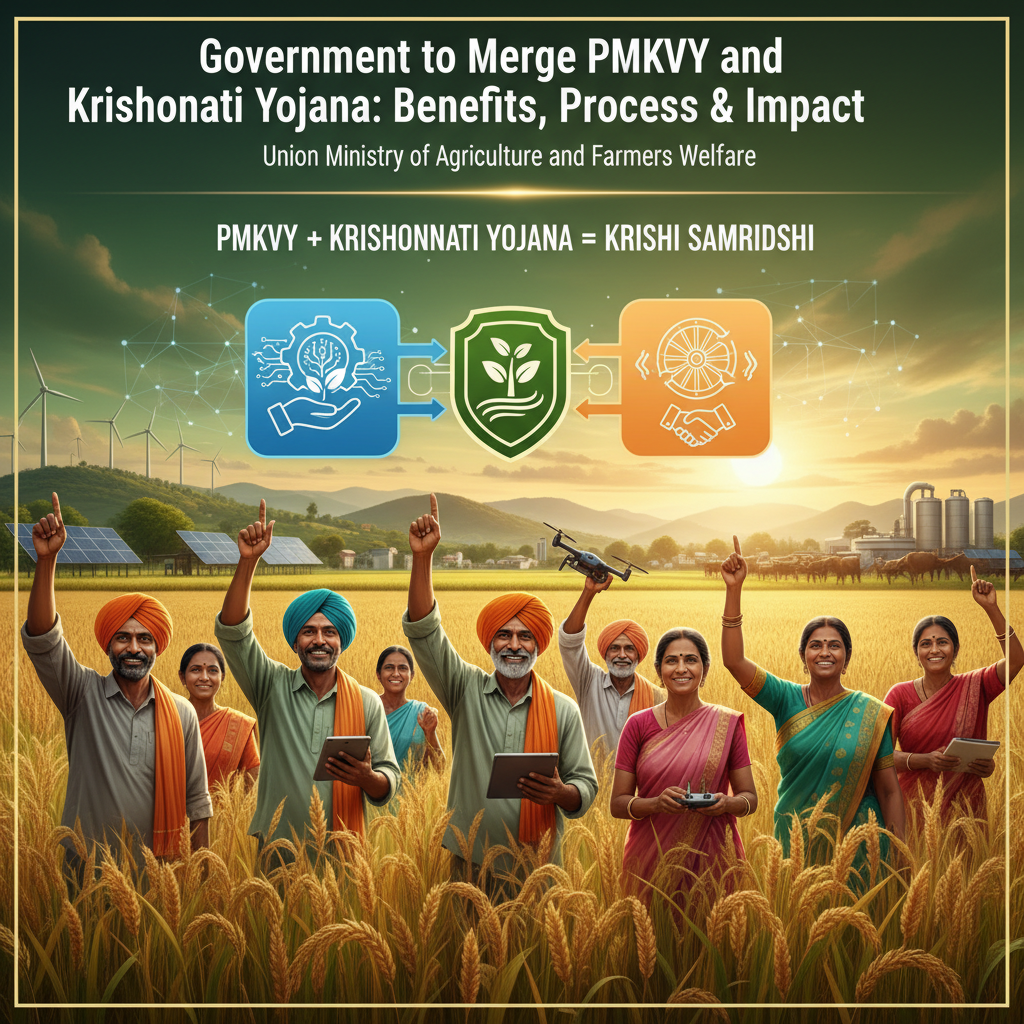
The Union Ministry of Agriculture and Farmers Welfare has formally announced the integration of the Pradhan Mantri Krishi Vikas Yojana (PMKVY) with the Krishonnati Yojana. The decision, communicated in a high‑level press briefing on 23 September 2025, aims to collapse duplicate administrative layers, pool fiscal resources, and deliver a seamless package of services to Indian farmers. A joint task force, comprising officials from the Ministry, state agricultural departments, and independent agrarian experts, will be constituted within the next two months to draft the operational blueprint. The integrated scheme will retain the nomenclature “PMKVY‑Krishonnati” for continuity while redefining its scope to include market‑linkage mechanisms, cold‑chain logistics, and agri‑entrepreneurship support under a single funding umbrella. Official estimates suggest a consolidated budget of ₹ 18,500 crore over the next five years, marking a 27 percent increase in outlay compared with the separate allocations of the two schemes.
Background of the Two Schemes
Launched in 2014, PMKVY was conceived as a comprehensive package to boost agricultural research, extension services, and infrastructure development. Its primary focus has been on seed production, micro‑irrigation, soil health cards, and farmer training programmes. Over the past decade, PMKVY has funded more than 3,200 state‑level projects, disbursed subsidy assistance to over 12 million farmers, and facilitated the adoption of precision‑farm technologies on 4.5 million hectares. In contrast, the Krishonnati Yojana, introduced in 2013, targets the entire agricultural value chain. Its pillars include farmer producer organisations (FPOs), contract‑ farming facilitation, cold‑chain establishment, and agri‑entrepreneur incubation. By 2024, Krishonnati had enabled 1,800 FPOs to access credit, built 275 cold‑storage facilities, and linked 3.2 million tonnes of produce to national and international markets.
Rationale Behind the Consolidation
Government officials cite three interlocking reasons for the merger. First, overlapping objectives—such as the promotion of irrigation and seed subsidies—have resulted in duplicated fund flows and fragmented implementation across ministries. Second, the current multi‑layered approval process has caused average project clearance times to exceed 14 months, delaying critical interventions for the agriculture sector. Third, a unified administrative architecture is expected to enhance transparency, streamline monitoring, and reduce bureaucratic friction, thereby improving the return on public investment. A recent audit by the Comptroller and Auditor General (CAG) highlighted that overlapping subsidies led to an estimated ₹ 1,200 crore of wastage annually, underscoring the urgency for consolidation. 
Expected Benefits for Farmers and the Agricultural Value Chain
The merger is projected to deliver tangible gains across the farming ecosystem. Simplified access to services is a headline benefit: beneficiaries will no longer need to submit separate applications for seed subsidies, micro‑irrigation components, or market‑linkage support, cutting paperwork by an estimated 40 percent. Larger, impact‑driven projects such as climate‑smart irrigation pilots and precision‑farm demonstration sites can now be financed from a consolidated pool, enabling scaling up from the current average project size of 150 hectares to over 500 hectares. Enhanced private‑sector participation is anticipated through clearer guidelines for contract‑ farming and agri‑tech incubators, potentially attracting $ 5 billion of investment by 2030. Moreover, a unified data platform will integrate soil‑health analytics, weather forecasts, and market price feeds, empowering farmers with real‑time decision‑making tools and reducing post‑harvest losses by up to 12 percent, according to early simulation models from the Indian Council of Agricultural Research (ICAR).
- Streamlined subsidy disbursement reduces processing time from 30 days to under 10 days.
- Consolidated funding enables larger‑scale pilots in precision agriculture and climate‑resilient crops.
- Facilitates stronger public‑private partnerships, drawing investment into agri‑tech and infrastructure.
- Improved data collection supports evidence‑based policy adjustments and performance tracking.
Implementation Roadmap and Timeline
The rollout will be executed in three distinct phases spanning 2025‑2028. Phase 1 (Q4 2025‑Q2 2026) involves the formation of the joint task force, mapping of existing PMKVY and Krishonnati projects, and the creation of a unified budgeting framework. The task force will also establish key performance indicators (KPIs) such as farmer income uplift, crop‑yield improvement, and reduction in input cost per hectare. Phase 2 (Q3 2026‑Q4 2027) will launch pilot integrations in selected districts of Punjab, Madhya Pradesh, and Telangana, where the combined scheme will test end‑to‑end service delivery—from seed subsidy to market linkage—under a single digital portal. Success metrics will include a minimum 8 percent increase in net farm income and a 15 percent reduction in post‑harvest loss within the pilot zones. Phase 3 (2028 onward) envisions nationwide expansion, supported by capacity‑building programs for state officials and a robust monitoring dashboard that will be publicly accessible to ensure accountability.
Stakeholder Reactions and Anticipated Challenges
Reactions to the merger have been mixed but largely constructive. The National Farmers’ Union welcomed the move, stating that “reducing the procedural burden will directly translate into quicker cash flows for small and marginal farmers.” Industry associations such as the Federation of Indian Chambers of Commerce & Industry (FICCI) have called for transparent criteria for private‑sector participation to avoid exclusionary practices. State governments have urged the Centre to provide adequate fiscal support and technical assistance, citing the need to adapt existing state‑level implementations to the new architecture. Nonetheless, challenges remain. Harmonising disparate data systems—particularly the PMKVY agritech database and Krishonnati’s market‑linkage portal—will require significant IT investment and standardisation of data formats. Ensuring continuity of benefits for current beneficiaries during the transition period is critical to prevent service gaps. Finally, sustaining political commitment and budgetary allocations over the five‑year horizon will be essential, especially as the integrated scheme scales to cover over 15 million farmers nationwide.
Conclusion
The proposed merger of PMKVY and Krishonnati Yojana represents a strategic pivot toward a more cohesive, efficient, and farmer‑centric agricultural policy framework. By consolidating funding, streamlining administrative processes, and integrating research, extension, and market‑linkage services, the integrated scheme holds the potential to boost productivity, enhance farmer incomes, and strengthen the resilience of India’s agricultural sector against climate and market shocks. Success will hinge on meticulous planning, robust stakeholder engagement, and the effective deployment of technology to monitor and evaluate outcomes. If executed with precision, the merger could set a new benchmark for integrated rural development programmes across the globe.
Stay updated with the latest Yojana schemes and government initiatives for better awareness and eligibility. For personalized guidance on accessing these benefits, reach out to us.