


Budget Allocation Highlights Renewable Energy Push
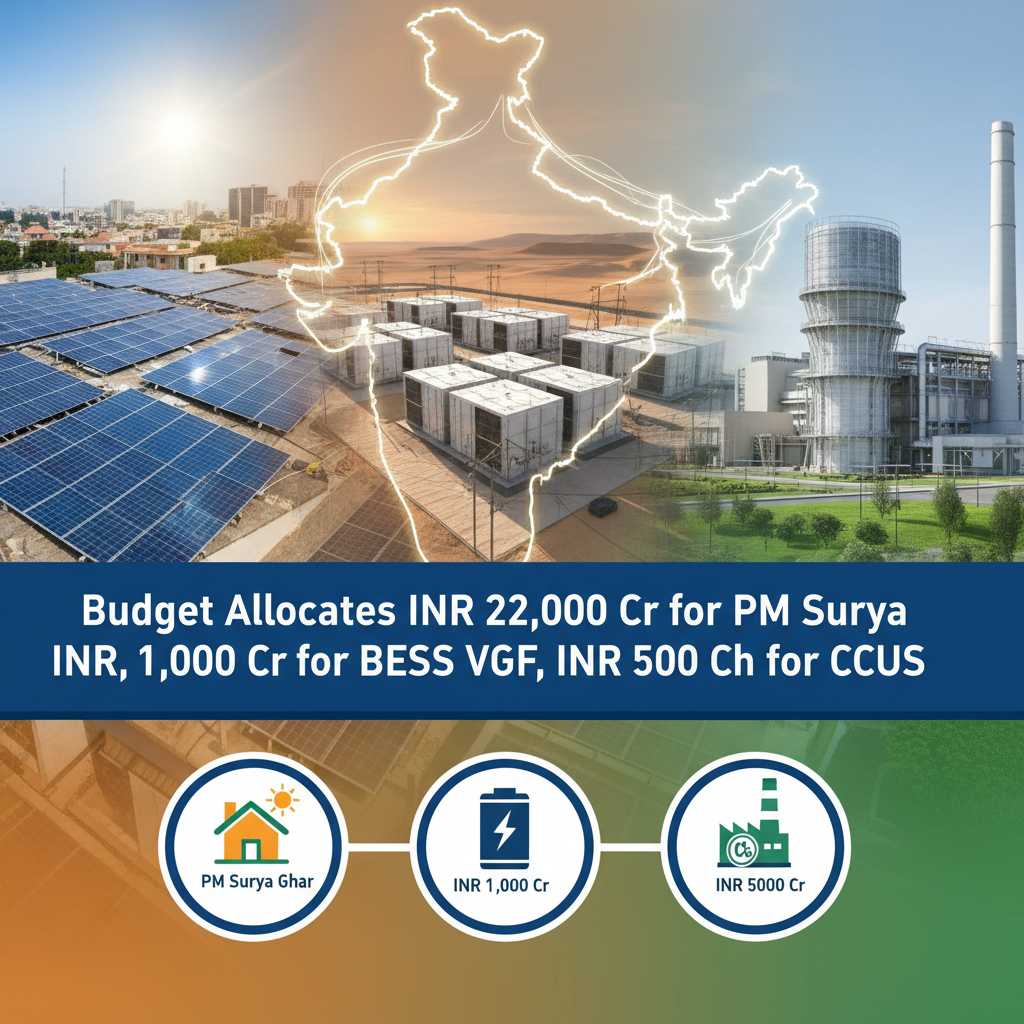
The 2026 Union Budget, presented by Finance Minister Nirmala Sitharaman, earmarked a historic INR 22,000 crore for the PM Surya Ghar budget, signalling an aggressive push toward solar rooftop adoption nationwide. Alongside this, the government allocated INR 1,000 crore for the Battery Energy Storage System (BESS) Virtual Grid Facility (VGF) and INR 500 crore for Carbon Capture, Utilisation and Storage (CCUS) projects. These figures represent a coordinated strategy to decarbonise the power sector, enhance grid resilience, and meet India’s climate commitments under the Paris Agreement. By concentrating resources on generation, storage, and emission mitigation, the budget aims to fast‑track the country’s renewable energy targets while delivering tangible benefits to citizens and industry alike.
PM Surya Ghar: Objectives and Implementation Details
Under the PM Surya Ghar initiative, the Ministry of New and Renewable Energy (MNRE) seeks to install solar panels on 10 million rooftops by 2030. The scheme offers a subsidy of up to 40 % of installation costs, preferential interest rates on loans, and a streamlined approval pathway that cuts bureaucratic lag by up to 30 %. Eligible beneficiaries include homeowners, housing societies, and institutional consumers across urban and rural areas. The program integrates a net‑metering facility, allowing participants to sell surplus solar generation to distribution utilities at a regulated tariff, thereby reducing electricity bills by an estimated 30‑40 % over the system’s lifetime. A dedicated digital portal provides end‑to‑end application tracking, performance monitoring, and post‑installation support, ensuring transparency and accountability. For more background, see the Solar rooftop Wikipedia page and the official MNRE website.
Detailed Benefits and Eligibility Criteria
The PM Surya Ghar budget supports a range of financial instruments: direct cash subsidies, low‑interest loans, and viability gap funding for small‑scale projects. Households can receive up to INR 2 lakh in subsidy for systems up to 3 kW, while larger installations (up to 10 kW) qualify for proportional assistance. Priority is given to low‑income families, gram panchayats, and educational institutions in high‑tariff zones. The scheme also mandates a minimum lifecycle performance guarantee of 25 years for installed modules, ensuring long‑term reliability. Additionally, the government has partnered with financial institutions to offer loan products with interest rates as low as 4.5 % per annum, and a grace period of up to 12 months before repayment begins. These measures are designed to lower the upfront barrier to entry and accelerate adoption across diverse socio‑economic groups. 
BESS VGF: Strengthening Grid Resilience and Storage Capacity
The allocated INR 1,000 crore for BESS VGF will be directed toward deploying large‑scale lithium‑ion and emerging solid‑state battery farms in renewable‑rich states such as Rajasthan, Gujarat, and Maharashtra. These storage hubs are expected to provide up to 5 GW of firm capacity by 2030, enabling peak‑shaving, frequency regulation, and firming of intermittent solar output. The funding also earmarks resources for research and development of next‑generation storage technologies, aiming to reduce reliance on imported battery components and foster domestic innovation. Pilot projects in collaboration with the Indian Institute of Technology (IIT) system will test hybrid storage configurations that combine battery assets with pumped hydro and compressed air solutions. This integrated approach is projected to enhance grid stability, lower curtailment rates, and support the seamless integration of additional renewable capacity into the national grid.
Carbon Capture, Utilisation and Storage (CCUS) Initiative
With a dedicated INR 500 crore for CCUS, the budget marks a decisive shift toward industrial decarbonisation. The funds will finance pilot projects in carbon‑intensive regions — including Jharkhand, Chhattisgarh, and Madhya Pradesh — targeting the capture of up to 10 million tonnes of CO₂ annually by 2030. Captured carbon will be converted into value‑added products such as synthetic fuels, methanol, and building materials, creating new revenue streams for participating industries. Partnerships with private sector leaders like Tata Chemicals and research institutions such as the Indian Institute of Science (IISc) will accelerate technology maturation and scale‑up. A robust regulatory framework is being drafted to oversee site selection, monitoring, verification, and long‑term storage integrity, aligning with International Energy Agency (IEA) best practices. This initiative not only helps India meet its NDC targets but also opens pathways for carbon credit generation and export of low‑carbon products.
Impact on Citizens, Industry, and Economic Growth
The tri‑fold allocation is expected to generate a cascade of positive outcomes: household electricity bills could decline by 30‑40 % within five years, while small and medium enterprises (SMEs) gain reliable, low‑cost backup power through the BESS VGF, reducing production downtime. Heavy‑industry players can leverage CCUS incentives to comply with stricter emission norms without prohibitive capital expenditures, fostering competitiveness in global markets. The combined effect is projected to create over 1.5 million jobs in solar installation, battery manufacturing, and carbon‑capture sectors by 2035. Moreover, the increased renewable penetration — targeted at 55 % of the electricity mix by 2030 — will enhance energy security, reduce import dependency on fossil fuels, and contribute to a projected 25 % rise in renewable energy generation capacity over the next decade. These synergies position India as a emerging leader in green technology and sustainable economic development.
Expert Opinions and Market Reactions
Industry leaders have praised the budget as a “transformative catalyst” for the clean energy ecosystem. Dr. Anila Shah, Director of Renewable Energy at MNRE, stated that the PM Surya Ghar budget reflects a “balanced strategy that addresses generation, storage, and decarbonisation in an integrated manner.” Analysts at BloombergNEF noted that while the figures are modest compared with global benchmarks, they represent a significant step forward for a country navigating fiscal constraints. The Confederation of Indian Industry (CII) highlighted the importance of private‑sector participation, urging the government to facilitate greater foreign direct investment (FDI) in battery and CCUS technologies. However, experts caution that successful implementation hinges on efficient on‑ground execution, robust monitoring mechanisms, and the ability to attract supplemental private capital. The coming months will be critical in translating these allocations into concrete projects and measurable emission reductions.
Conclusion: A Roadmap for Sustainable Energy Future
In summary, the 2026 Union Budget’s targeted allocations for the PM Surya Ghar scheme, BESS VGF, and CCUS delineate a comprehensive roadmap toward a low‑carbon, resilient energy landscape. By intertwining financial incentives, technological advancement, and regulatory reforms, the government aims to accelerate renewable adoption, enhance grid stability, and curb industrial emissions. While challenges remain in scaling implementation and mobilising private investment, the strategic funding lays a solid foundation for India’s ambitious climate targets. Stakeholders ranging from individual consumers to multinational corporations are poised to benefit from a more sustainable, energy‑secure nation, ushering in a new era of green growth and innovation.
Stay updated with the latest Yojana schemes and government initiatives for better awareness and eligibility. For personalized guidance on accessing these benefits, reach out to us.