


Union Budget 2026 Highlights Clean Energy Investments
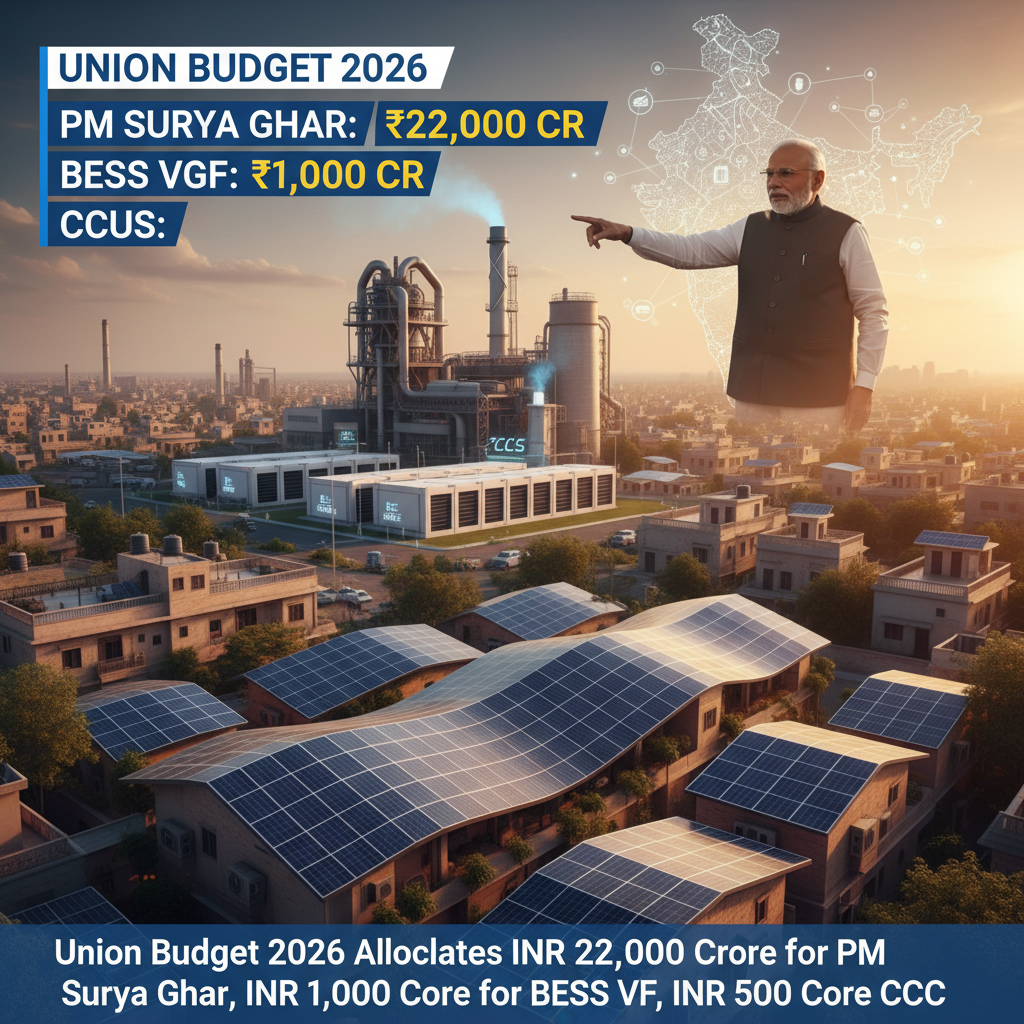
The Union Budget 2026 has earmarked INR 22,000 crore for the PM Surya Ghar scheme, INR 1,000 crore for Battery Energy Storage System (BESS) Viability Gap Funding (VGF), and INR 500 crore for Carbon Capture, Utilisation, and Storage (CCUS) projects. These allocations signal a decisive shift toward a low‑carbon electricity system, aiming to increase renewable capacity, improve grid stability, and curb industrial emissions. The move dovetails with India’s commitment to achieve 450 GW of renewable energy by 2030 and fulfil its Paris Agreement targets. By concentrating funds on rooftop solar, grid‑scale storage, and CCS technologies, the government seeks to reduce reliance on imported fossil fuels, lower electricity tariffs for consumers, and create a new pipeline of green jobs.
PM Surya Ghar budget allocation: Empowering Rooftop Solar Across India
The PM Surya Ghar initiative is set to install rooftop solar panels on one million households by 2027, translating into an estimated 15 GW of distributed solar capacity. A capital subsidy of up to 40 % and low‑interest loans will be available to eligible residential consumers, housing societies, and cooperative societies that meet the scheme’s criteria. Beneficiaries can apply through state Discoms or accredited private installers, with the application process streamlined by a dedicated online portal that integrates satellite verification and smart‑meter data for real‑time performance monitoring. The scheme also proposes a performance‑based incentive for Discoms, encouraging them to accelerate installations and reduce permitting delays. According to the Ministry of New and Renewable Energy, the program could cut average household electricity bills by 30‑40 % and defer the need for new utility‑scale power plants, thereby enhancing energy security. Stakeholders can find detailed guidelines on the official PM Surya Ghar website (https://mnre.gov.in/solar-rooftop) and a Wikipedia overview (https://en.wikipedia.org/wiki/Rooftop_solar).
Eligibility extends to all residential consumers with a roof area of at least 10 m², a valid electricity connection, and a willingness to commit to a minimum 25‑year power purchase agreement. The scheme prioritises households in rural and semi‑urban areas, aiming to bridge the urban‑rural energy divide. In addition, the government has announced a special incentive for women‑led households, offering an extra 5 % subsidy to promote gender‑inclusive clean energy adoption. By democratizing solar generation, PM Surya Ghar is expected to catalyse a shift from centralized coal‑fired generation to a more resilient, decentralized grid architecture. 
Battery Energy Storage System VGF: Strengthening Grid Flexibility
To mitigate the intermittency of renewable sources, the Budget reserves INR 1,000 crore for BESS Viability Gap Funding. The VGF is designed to close the cost gap between conventional generation and advanced storage solutions, making projects financially attractive for developers. This allocation is projected to unlock up to 5 GW of storage capacity, encompassing utility‑scale battery farms, hybrid solar‑plus‑storage installations, and community‑level units for rural electrification. The funding will also finance research into next‑generation chemistries such as solid‑state and sodium‑ion batteries, aiming to extend cycle life and improve safety. Experts anticipate that enhanced storage will reduce renewable curtailment rates from the current 7 % to below 2 % within five years, delivering smoother power supply during peak demand periods.
Implementation will be overseen by the Ministry of Power in collaboration with the Solar Energy Corporation of India (SECI) and state utilities. Developers can apply for VGF assistance through a competitive bidding process, with projects judged on technical feasibility, cost‑effectiveness, and local employment generation. Successful projects will receive up‑front capital support covering up to 30 % of eligible expenditures, payable upon commissioning. In addition, the scheme includes a performance‑linked subsidy that rewards higher round‑trip efficiency and longer discharge durations. By bolstering grid flexibility, the BESS VGF is expected to accelerate the integration of variable renewables, lower reliance on fossil‑fuel peaker plants, and provide ancillary services such as frequency regulation and voltage support.
Carbon Capture, Utilisation, and Storage Funding: Advancing Industrial Decarbonisation
The allocation of INR 500 crore for CCUS underscores the government’s strategy to tackle emissions from heavy‑industry clusters in Gujarat, Maharashtra, and Tamil Nadu. CCUS technologies capture carbon dioxide at the source, transport it via dedicated pipelines, and either store it in deep geological formations or repurpose it for producing synthetic fuels, chemicals, and building materials. The funding will be directed toward pilot projects at six high‑emission facilities, the development of a national CO₂ transport network spanning 1,200 km, and incentives for industrial adoption of capture technologies. A dedicated CCUS task force, comprising representatives from the Ministry of Environment, Forest and Climate Change, the Ministry of Heavy Industries, and international partners, will oversee project selection and monitor compliance with emission reduction targets.
Stakeholders can expect a suite of support mechanisms, including accelerated depreciation benefits, concessional financing, and a carbon credit eligibility framework that aligns with the Indian Carbon Market. The scheme also earmarks resources for technology transfer agreements with global research consortia, facilitating the localisation of advanced capture equipment and reducing import dependency. By integrating CCUS into the national energy mix, India aims to achieve a 30 % reduction in industrial emissions by 2035 while preserving competitiveness in sectors critical to economic growth. Further details on CCUS initiatives are available on the Ministry of Environment website (https://moefcc.gov.in/ccus) and a Wikipedia entry (https://en.wikipedia.org/wiki/Carbon_capture_and_storage).
Challenges, Opportunities and Policy Integration
While the budgetary commitments are ambitious, translating them into on‑ground impact will require coordinated action across several fronts. First, financing efficiency must be improved to ensure that funds are disbursed promptly to approved projects, avoiding the delays that historically plagued earlier renewable schemes. Second, advancing emerging technologies such as solid‑state batteries and next‑generation CCUS will demand sustained R&D investment and public‑private partnerships. Third, policy coherence between central schemes and state‑level incentives is essential; streamlined land acquisition processes and uniform permitting norms can accelerate project timelines.
Public participation remains a cornerstone of successful implementation. Engaging local communities, especially in tribal and remote regions, will foster acceptance and ensure equitable benefit distribution. Transparent monitoring mechanisms, leveraging satellite imagery, smart meters, and third‑party audits, will build trust and enable real‑time performance tracking. Analysts also highlight the socioeconomic upside: the clean energy push is projected to create up to 3 million new jobs by 2030, spanning installation, operations, research, and manufacturing, thereby supporting inclusive growth and rural development.
Looking ahead, the integration of PM Surya Ghar, BESS VGF, and CCUS into broader policy frameworks such as the National Electricity Policy, the India Renewable Energy Mission, and the Climate Change Action Plan will provide a cohesive roadmap for India’s decarbonisation journey. Continued stakeholder collaboration, adaptive financing models, and robust capacity‑building programmes will be pivotal in turning these budgetary pledges into tangible, sustainable outcomes for the nation.
Stay updated with the latest Yojana schemes and government initiatives for better awareness and eligibility. For personalized guidance on accessing these benefits, reach out to us.