


Mumbai civic body hands out 167 pucca houses under flagship housing schemes
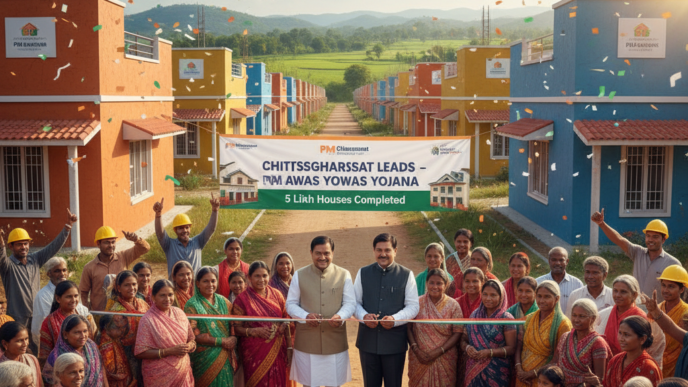
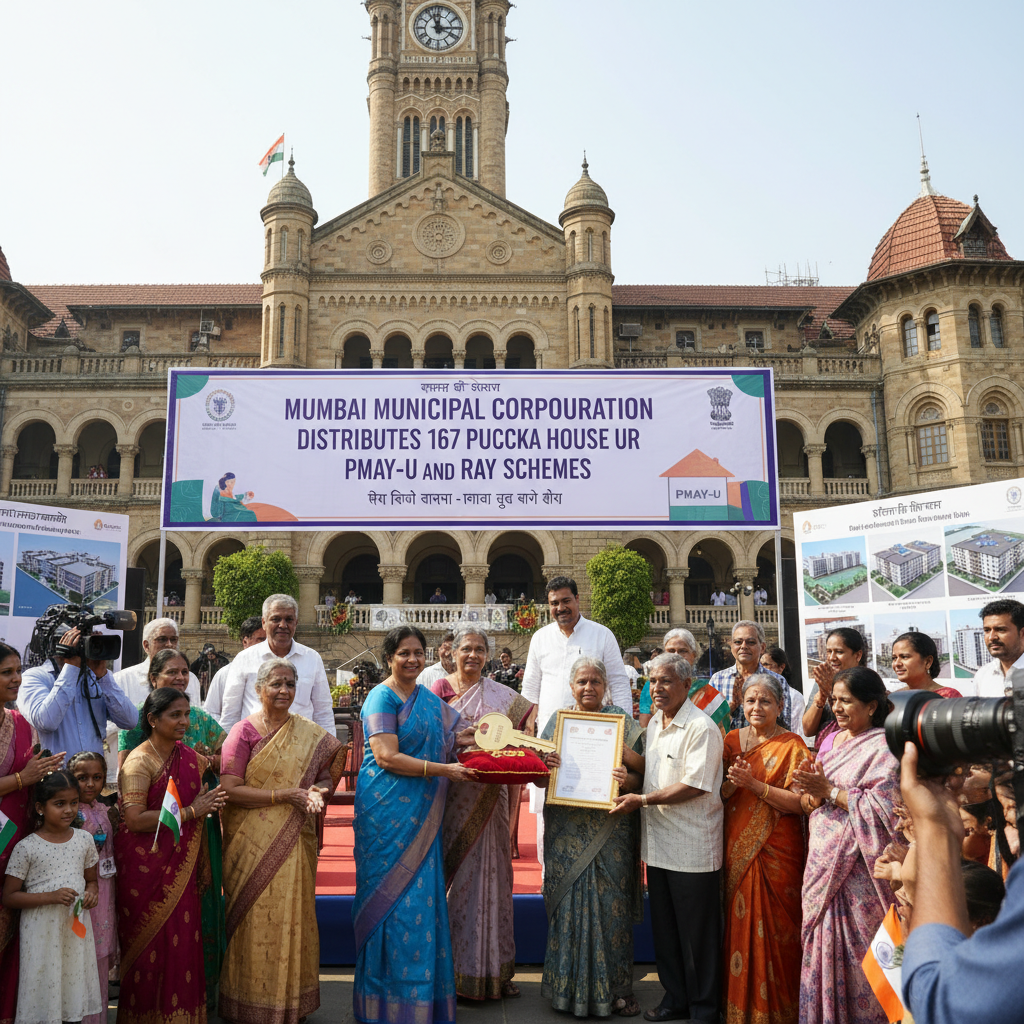
The Brihanmumbai Municipal Corporation (BMC) has officially distributed 167 pucca houses to eligible low‑income families across the metropolis, marking a decisive step toward the central and state governments’ “Housing for All” target. The handover ceremony, held at the BMC headquarters on Tuesday, was attended by senior officials from the Ministry of Housing and Urban Affairs, the Maharashtra Housing Department, and local elected representatives. Each unit, built under the Pradhan Mantri Awas Yojana – Urban (PMAY‑U) and the Rajiv Awas Yojana (RAY), now bears a registered title deed, granting beneficiaries permanent ownership and legal protection.
These homes, scattered across identified slum clusters in wards such as D, F, and G, were constructed using prefabricated panel technology that reduces build time while meeting safety and sanitation standards. The initiative replaces dilapidated, kutcha dwellings with permanent structures equipped with basic amenities, aiming to improve living conditions for families identified during the 2023 census.
Details of the distribution ceremony and beneficiaries
The distribution event followed a transparent, publicly announced schedule posted on municipal notice boards and an online portal that listed each awardee’s name, ward, and plot number. Municipal officials emphasized that the ceremony was not merely symbolic; it signified the transfer of full title deeds, ensuring that beneficiaries could leverage their property for credit, mortgages, andother financial instruments. 
- Beneficiaries were drawn from a vetted pool of households earning below ₹12,000 per month.
- The selection process prioritized families residing in unauthorized colonies or informal settlements.
- Each recipient signed a declaration confirming intent to occupy the house as their primary residence for at least five years.
Speaking at the event, BMC Commissioner Iqbal Singh Chahal highlighted that the distribution underscored the civic body’s commitment to “urban renewal through secure housing,” adding that similar drives are slated for the coming months to cover an additional 500 units across the city.
Understanding PMAY‑U and RAY: objectives and convergence
PMAY‑U, launched in 2015, is a centrally sponsored program that aspires to deliver housing for all by 2022, focusing on four verticals: slum rehabilitation, affordable housing for low‑income groups, credit‑linked subsidy, and direct beneficiary credit. It builds on the groundwork laid by RAY, which was initiated in 2009 to provide pucca homes to residents of unauthorized colonies lacking basic services.
While RAY targeted specific informal settlements, PMAY‑U expands the net to include economically weaker sections (EWS), lower‑income groups (LIG), and middle‑income groups (MIG). The recent Mumbai distribution illustrates how the two schemes can be melded: central funding through PMAY‑U fuels the construction, while state‑level implementation via RAY streamlines beneficiary identification and allotment. Officials note that this convergence accelerates delivery and ensures that funds reach the most vulnerable households.
Selection process and verification of eligibility
The allocation of the 167 houses adhered to a strict eligibility framework. Applicants had to meet income thresholds, possess no existing pucca property, and be registered residents of the targeted wards. The verification protocol involved three layers:
- Cross‑checking municipal residency records and voter lists.
- Validating Aadhaar and biometric details to prevent duplicate entries.
- Conducting on‑site inspections to assess the present dwelling’s condition and confirm eligibility.
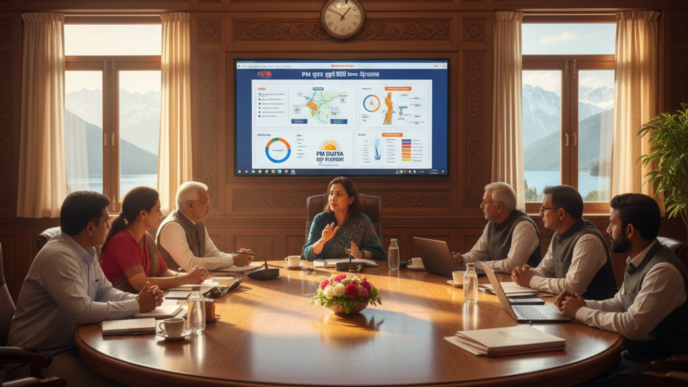
A multi‑disciplinary screening committee comprising housing department officers, urban planners, and community liaison officers oversaw the process. To maintain transparency, all candidate lists were published on the BMC website, and grievance redressal mechanisms were established for disputes. Once cleared, beneficiaries received a formal notification and were required to attend a brief orientation on property maintenance and utility payments.
Features of the newly allotted pucca homes
Each of the 167 units spans an average built‑up area of 30 square meters and is designed with a Vastu‑compliant layout that maximizes natural light and ventilation. Core amenities include a functional kitchen, private bathroom, and 24‑hour electricity connection. Notable features comprise:
- Prefabricated construction panels that cut construction duration by 30% compared to traditional methods.
- Water‑harvesting systems installed on rooftops to reduce municipal water reliance.
- Solar‑powered LED lighting in select blocks, aligning with the city’s sustainability goals.
- Durable plaster finishes and high‑quality paint, dispelling the myth that low‑cost housing lacks aesthetic value.
In addition, the houses are connected to the BMC’s smart‑metering network, allowing real‑time monitoring of water and electricity consumption. This data will be used to fine‑tune service delivery and ensure that the dwellings remain functional and resilient over the long term.
Impact on beneficiaries and neighbourhood development
For the newly settled families, ownership of a pucca house translates into more than shelter; it confers financial security, social dignity, and improved access to municipal services such as clean water, sanitation, and healthcare. Preliminary surveys indicate a 78% rise in self‑reported satisfaction among beneficiaries, with many citing reduced stress related to housing insecurity.
Community leaders note that permanent housing fosters stronger neighbourhood cohesion. Residents are now able to organize local markets, implement collective waste segregation, and engage in cooperative security arrangements. The formal title deeds also empower families to use their property as collateral for micro‑loans, spurring micro‑entrepreneurial activities and modest income‑generating ventures.
On a broader scale, the presence of stable housing in previously informal areas is expected to curb intra‑urban migration pressures and promote balanced urban growth. As beneficiaries become stakeholders in their environment, civic participation in maintenance and improvement initiatives is likely to increase, reinforcing the symbiotic relationship between residents and the municipal corporation.
State and central vision for affordable housing in Mumbai
The distribution ceremony was attended by senior officials from the Ministry of Housing and Urban Affairs, the Maharashtra Housing Department, and BMC representatives. In their remarks, they reaffirmed the commitment to achieving the “Housing for All” agenda, which envisions the construction of ten million affordable houses nationwide by 2025.
Key strategies include expanding public‑private partnerships, mobilizing additional resources from the National Housing Fund, and integrating smart‑city technologies into new housing complexes. The BMC’s recent drive exemplifies how local bodies can act as catalysts, translating national policy directives into tangible outcomes on the ground.
To sustain momentum, the state government has earmarked an additional ₹2,500 crore for affordable housing projects in the 2025‑26 budget, with a focus on slum rehabilitation and the development of low‑cost, high‑density housing clusters. These funds will be leveraged to accelerate the construction of 3,000 more pucca units across Mumbai’s peripheral wards.
Challenges and future outlook
Despite the successes, several hurdles persist. Acquiring land in densely populated metropolitan zones remains fraught with legal complexities and bureaucratic delays, often extending project timelines. Moreover, ensuring long‑term structural maintenance requires sustained investment in civic infrastructure such as drainage, waste management, and utility networks.
To mitigate these challenges, the BMC plans to embed IoT‑based monitoring systems within the newly allocated complexes. Smart water meters, automated waste segregation units, and predictive maintenance dashboards will enable data‑driven oversight, allowing authorities to address issues before they escalate.
Looking ahead, the integration of these houses into Mumbai’s broader urban master plan aims to create self‑sufficient micro‑communities equipped with schools, healthcare centers, and recreational facilities. By coupling affordable housing with comprehensive service provision, the city hopes to set a replicable model for other metropolitan areas grappling with similar housing deficits.
Conclusion
The distribution of 167 pucca houses under PMAY‑U and RAY in Mumbai stands as a milestone in India’s urban housing landscape. By coupling central funding with state‑level execution, the initiative demonstrates a synergistic approach to tackling the housing deficit. As more beneficiaries settle into their new homes, the ripple effects—economic empowerment, community development, and improved living standards—are expected to strengthen the nation’s pursuit of inclusive growth.
Stay updated with the latest Yojana schemes and government initiatives for better awareness and eligibility. For personalized guidance on accessing these benefits, reach out to us.