


Introduction
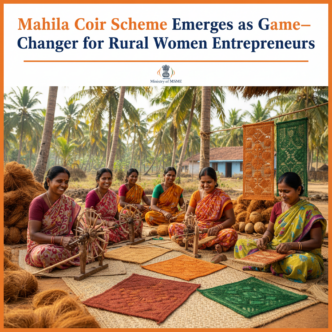
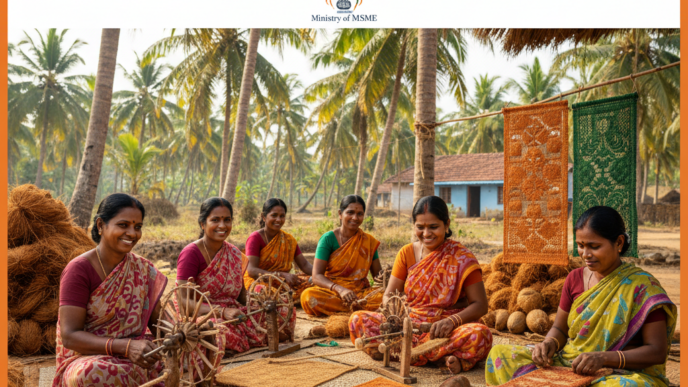
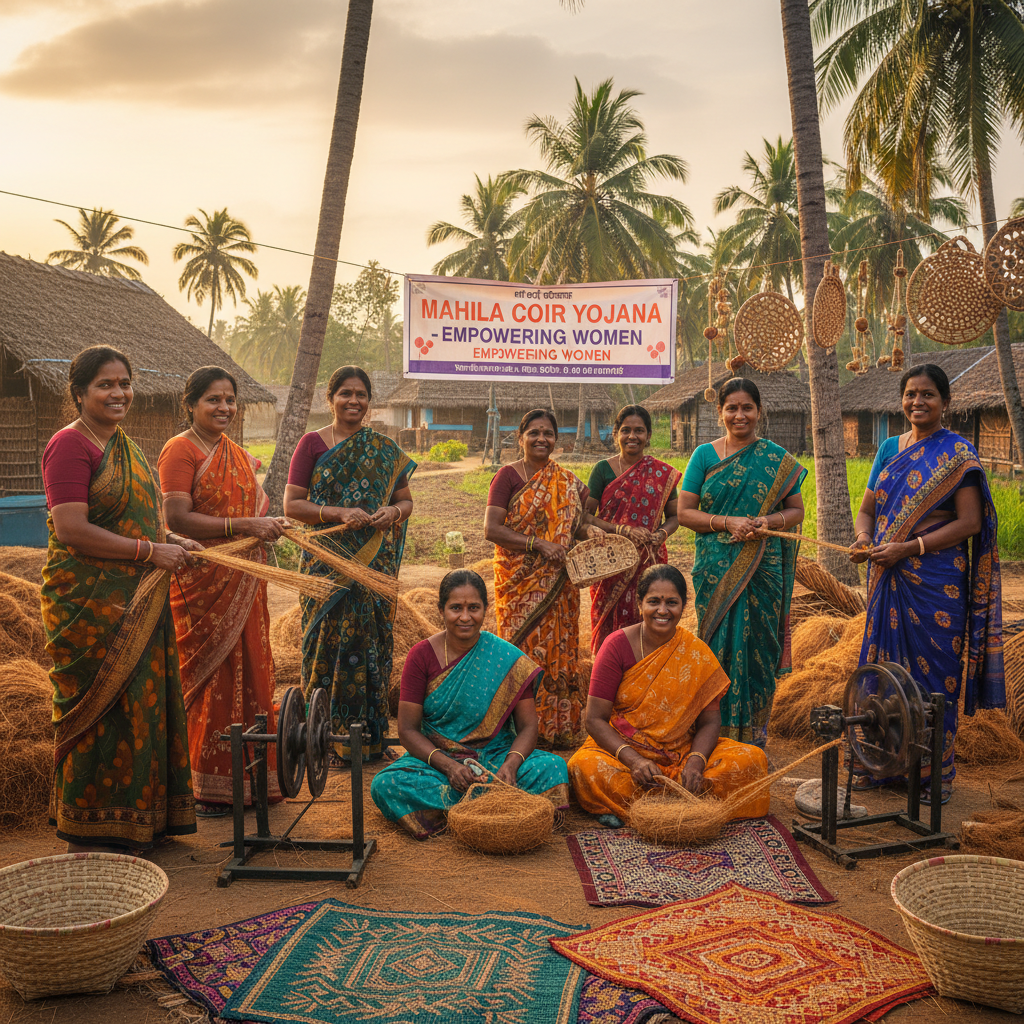
The Mahila Coir Scheme is a flagship programme of the Government of India aimed at empowering rural women through entrepreneurship in the coir sector. Launched under the Ministry of Rural Development, the scheme provides financial assistance, skill development, and market linkage to women engaged in or aspiring to enter coir production. By turning traditional coir work into a structured business opportunity, the initiative seeks to create sustainable livelihoods, reduce poverty, and promote gender equity in India’s rural economy.
Since its inception, the scheme has reached thousands of women across states such as Kerala, Tamil Nadu, Odisha, and the Northeast, where coir processing is a long‑standing livelihood source. According to official data released in 2023, over 12,000 women have benefited from seed capital and training, and nearly 3,500 new coir‑based enterprises have been registered under the programme.
Historical Background and Policy Vision
Introduced in the early 2000s, the Mahila Coir Scheme emerged from a recognition of the coir industry’s strategic importance in rural economies. Historically, women have been the primary processors of coconut husk into yarn, rope, and mats, yet they operated informally with limited access to capital or formal training. Policymakers identified this gap and envisioned a structured support system that would formalize women’s participation, enhance productivity, and integrate them into formal value chains. 
The vision of the scheme aligns with broader national goals such as the Sustainable Development Goals, particularly gender equality (Goal 5) and decent work (Goal 8). By institutionalizing assistance mechanisms, the government aims to transition women from subsistence‑level activities to organized, profit‑driven enterprises capable of scaling up and accessing wider markets.
Eligibility, Financial Assistance and Subsidy Structure
Eligibility is restricted to women who are residents of rural areas and are either directly involved in coir manufacturing or wish to establish a coir‑based venture. Priority is given to members of Self‑Help Groups (SHGs), tribal communities, and women belonging to economically weaker sections (EWS). Applicants must submit a valid identity proof, residence certificate, and a detailed business plan covering product lines, projected turnover, and market strategy.
Financial support is tiered based on the scale of operation:
- Seed capital for small‑scale units: Up to INR 10,000 for equipment procurement.
- Subsidies for medium‑scale units: Up to INR 50,000, released in three installments contingent on verified expenditure.
- Interest‑subsidized micro‑credit: Partnerships with scheduled banks provide loans at reduced interest rates, with the subsidy covering a portion of the interest burden.
The scheme also earmarks additional funds for working‑capital gaps, ensuring that beneficiaries can maintain cash flow during the early months of operation.
Training, Capacity Building and Product Diversification
A robust training framework underpins the scheme’s capacity‑building efforts. Curriculum modules cover modern coir extraction techniques, quality assurance, product diversification, and basic entrepreneurship. Training is delivered through a network of government‑run institutes, NGOs, and agricultural extension services across the country.
Hands‑on workshops, field visits to successful coir units, and mentorship from industry experts ensure that participants acquire both technical competence and managerial acumen. Recent pilots in Kerala’s Alappuzha district have introduced women to eco‑friendly coir composites used in furniture and interior décor, expanding product portfolios beyond traditional yarn and rope.
Value‑addition is a key focus. The government supports the development of items such as coir‑based furniture, decorative mats, biodegradable packaging, and technical textiles. To facilitate market linkage, beneficiaries are connected with state‑level exhibitions, national fairs, and e‑commerce platforms like Craftsvilla and Amazon India, granting exposure to domestic and international buyers.
Impact, Challenges and Future Roadmap
Impact assessments indicate that the Mahila Coir Scheme has generated significant socio‑economic benefits. In Kerala’s Alappuzha district, a women’s cooperative transformed a modest unit into an enterprise grossing over INR 2.5 million annually and creating employment for more than 50 family members. In Odisha’s Koraput region, tribal women formed a cooperative that now supplies eco‑friendly mats to retail chains across the state, contributing to rural income diversification.
Challenges remain, including seasonal availability of raw material, inadequate processing infrastructure, and market saturation in certain regions. To address these, the government has introduced seasonal procurement contracts, invested in portable processing units, and partnered with digital marketplaces to broaden market reach. Capacity‑building workshops on financial literacy and digital marketing equip women entrepreneurs with tools to navigate competitive landscapes.
Looking ahead, the scheme’s roadmap includes increasing subsidy ceilings, expanding its scope to emerging coir‑based technologies such as biocomposites, and fostering public‑private partnerships. Budget allocations for the upcoming fiscal year prioritize the development of dedicated coir clusters, enhanced research and development support, and the establishment of certification bodies to ensure product quality. Stakeholders anticipate that sustained policy focus will cement the Mahila Coir Scheme as a catalyst for rural entrepreneurship, sustainable development, and gender‑inclusive growth.
Stay updated with the latest Yojana schemes and government initiatives for better awareness and eligibility. For personalized guidance on accessing these benefits, reach out to us.